The short answer is that Suno is the best all-round AI music generator in 2026, Google Flow Music is the strongest alternative, and the choice that matters most has little to do with sound quality. It's what you're allowed to do with the track afterward. Free plans mostly give you a demo you can listen to. Paid plans give you files, and sometimes the right to sell them.
That question got harder this year. Major labels sued the biggest generators, then settled with some and kept suing others, and the settlements changed what a download is worth. Udio switched downloads off. Suno retired its older models and launched v6, built with label partners. This guide covers who owns the output, what each plan lets you do, how long tracks can run, and where vocals, stems and DAW handoff stand. The ranked picks are in the leaderboard below, and the judgment is in the sections after it.
A quick note on method: everything here comes from vendor pricing and help pages, press coverage and our own ranking data. We haven't run the tools ourselves, so there are no hands-on scores, only what the sources confirm.
The top 25 AI music generators right now
- # 1Top PickSunoAI AppSuno is an AI music generator that turns a text prompt or your own lyrics into complete, original songs with vocals, lyrics, and full production in under a minute, across every genre.79ToolRankStrong
- # 2Runner UpMiniMaxAI AppMiniMax is a leading AI technology company offering a range of AI-native products. It specializes in multimodal AI models for text, video, speech, music, and image generation, serving over 300 million users globally.75ToolRankStrong
- # 3Third PlaceGoogle Flow MusicAI AppGoogle Flow Music is a generative AI platform for creating, remixing and sharing studio-quality songs, built on Google's Lyria model. Users can direct music videos, vibe-code custom instruments and personalize their sound, working across Songs, Playlists, Spaces and Projects. It's the rebranded successor to ProducerAI.74ToolRankStrong



- 4Udio AI Music GeneratorAI AppUdio is an AI music generator that allows users to create any song imaginable using text prompts. It empowers creators, from professionals to amateurs, to express musical ideas and share their creations within a vibrant community. Discover and generate personalized soundtracks for any occasion.73ToolRankStrong
- 5Miaoxiang (Douyin Music Creation Lab)AI AppMiaoxiang, also known as Douyin Music Creation Lab, is a comprehensive AI music creation and distribution platform. It enables users to generate original music effortlessly, supporting AI songwriting, composition, and arrangement. The platform is designed for both beginners and professionals to create and distribute music seamlessly.60ToolRankStrong
- 6Eleven Music by ElevenLabsAI AppEleven Music by ElevenLabs is an AI music generator that allows users to create music, songs, rap beats, and melodies. It supports multilingual music generation and offers commercial use options, making it ideal for creators, developers, and enterprises.60ToolRankStrong
- 7LANDR Music ProductionAI AppLANDR offers AI-powered music mastering, global distribution to over 150 platforms, a vast library of royalty-free samples, and over 70 pro plugins. It also provides online music courses and collaboration tools, empowering musicians to create, master, and release their music professionally.59ToolRankSolid
- 8Magenta AI Music ProjectAI AppMagenta is a research project exploring the role of machine learning in creating art and music. It offers tools like Magenta Studio and DDSP-VST for musicians to integrate AI into their creative process.58ToolRankSolid
- 9Artlist StudioAI AppArtlist Studio is an AI-powered video production platform that offers creators full visual control over every stage of filmmaking. It integrates seamlessly with other Artlist tools, enabling high-end production with AI-generated video, image, music, and voice assets.58ToolRankSolid
- 10MurekaAI AppMureka is an AI music generator that creates unique and customizable songs, lyrics, and tracks for any project. Ideal for content creators, musicians, and filmmakers, it generates royalty-free music tailored to your needs using advanced technology.57ToolRankSolid
- 11Magenta Studio - Ableton PluginAI AppMagenta Studio is a collection of music plugins for Ableton Live, utilizing machine learning to enhance music creation. It offers tools like Continue, Generate, and Drumify to manipulate MIDI clips, providing creative possibilities for musicians.57ToolRankSolid
- 12Harmonai.orgAI AppHarmonai.org is a Stability AI Lab dedicated to releasing open-source generative audio tools. Their mission is to make music production more accessible and fun for everyone, empowering artists to express creativity without limitations and generate custom sound libraries.56ToolRankSolid
- 13Stable AudioAI AppStable Audio is a generative AI tool for creating original music and sound effects. It allows users to transform text prompts into high-quality audio up to six minutes long, suitable for commercial use. The platform also supports audio-to-audio generation for style transfers and variations, catering to both beginners and professionals.56ToolRankSolid
- 14Kits AIAI AppKits AI offers studio-quality AI music tools to streamline producer workflows. Create custom AI voices, sing in any style, play any instrument, and isolate vocals. All content is 100% royalty-free, empowering creators with new possibilities for creativity and revenue.56ToolRankSolid
- 15Brain.fmAI AppBrain.fm offers AI-generated functional music designed to enhance focus, relaxation, and sleep. Utilizing cutting-edge neuroscience, its personalized soundscapes aim to improve cognitive performance and promote specific mental states, helping users achieve deep work and better rest.55ToolRankSolid
- 16SOUNDRAW AI Music GeneratorAI AppSOUNDRAW is an AI music generator that creates royalty-free beats in seconds. Users can customize instruments, blend genres, and download stems. It offers a safe, copyright-free solution for creators and artists to monetize their music without legal concerns. Try it for free.55ToolRankSolid
- 17AIVAAI AppAIVA is your personal AI music generation assistant that allows users to create and download music tracks in various formats. It offers different tiers for usage, catering to both casual and professional music creators.54ToolRankSolid
- 18VocaloidAI AppVocaloid is a singing synthesizer software developed by Yamaha Corporation. It allows users to create music by inputting melodies and lyrics, which are then sung by virtual singers. The software offers various voice banks and editing tools for music production.53ToolRankSolid
- 19BoomyAI AppBoomy is an AI-powered platform that allows users to create original music effortlessly. It empowers individuals to unleash their creativity, share their songs, and monetize their work with full commercial rights, regardless of their prior music experience.53ToolRankSolid
- 20MubertAI AppAn AI music generator that creates unique, royalty-free tracks from text prompts or chosen styles in seconds, with commercial licensing for videos, apps, brands, and other content.53ToolRankSolid
- 21WAV AIAI AppWAV AI is a free AI music generator and suite of music tools that transforms text, lyrics, and images into original songs, beats, and tracks. It allows users to remix existing audio, extend short clips, split stems, and master audio, making it ideal for content creators, filmmakers, and brands looking for custom, copyright-safe music.51ToolRankSolid
- 22OpenMusic AIAI AppOpenMusic AI is an all-in-one AI music generator that creates full royalty-free songs and lyrics from text, plus tools for vocal removal, stem separation, mastering, and covers for creators and businesses.51ToolRankSolid
- 23Sponge Music (Haimian)AI AppA free AI music creation product from Douyin that generates original songs from a single sentence and can imitate popular tracks. It supports lyric writing, composition, and voice cloning.50ToolRankSolid
- 24Loudly AI Music PlatformAI AppLoudly is an AI music platform enabling creators, artists, and brands to generate, remix, master, split stems, and release royalty-free music. It offers AI-generated tracks, samples, and versions for diverse digital projects, ensuring ethical AI practices and copyright compliance for safe music rights transfer.50ToolRankSolid
- 25AISongsGeneratorAI AppAISongsGenerator is an AI music creation platform that allows users to generate songs from text prompts or their own lyrics. It offers tools for lyric drafting, creating song covers, vocal removal, and stem separation. Users can explore various genres, moods, and vocal styles, and turn generated music into MP4 music videos, making it a comprehensive suite for digital music production.49ToolRankSolid


















How ToolRank works
ToolRank is ToolPotion’s proprietary ranking engine.
It continuously evaluates hundreds of signals across the open web — real traffic and popularity, audience and community strength, authority and longevity, adoption and engagement — processing millions of data points to place every tool where it has earned to be.
Every AI type is measured by its own tailored model: what proves traction for a SaaS app is not what proves it for an open-source framework or a creator channel. Missing a platform never counts against a tool — ToolRank judges the evidence that exists.
No paid placement. No self-reported numbers.
Quick picks
- Best overall: Suno. Full songs with vocals, a plain-language section editor, and clear written ownership terms on paid plans.
- Best for a Google-backed all-in-one studio: Google Flow Music, which lists stem downloads and commercial rights on its paid plans.
- Best for owning the copyright on a composition: AIVA on its Pro plan, which says the copyright is yours.
- Best for background music with simple licensing: SOUNDRAW, trained only on music its own team produced.
- Best for long tracks and open weights: Stable Audio, now on a licensed-data model.
- Best for finishing your own mix: LANDR, which masters and distributes rather than composes.
What changed for AI music in 2026
Start with the lawsuits, because they set the terms everyone else is now working under. Universal settled with Udio in 2025 and agreed to a licensed platform meant to launch in 2026, and during the transition Udio's existing product stays inside what the companies call a "walled garden" (Music Business Worldwide). Warner settled with Suno and announced a licensed-model deal, with free-tier songs becoming playable and shareable but not downloadable, and paid plans getting capped monthly downloads (Music Business Worldwide).
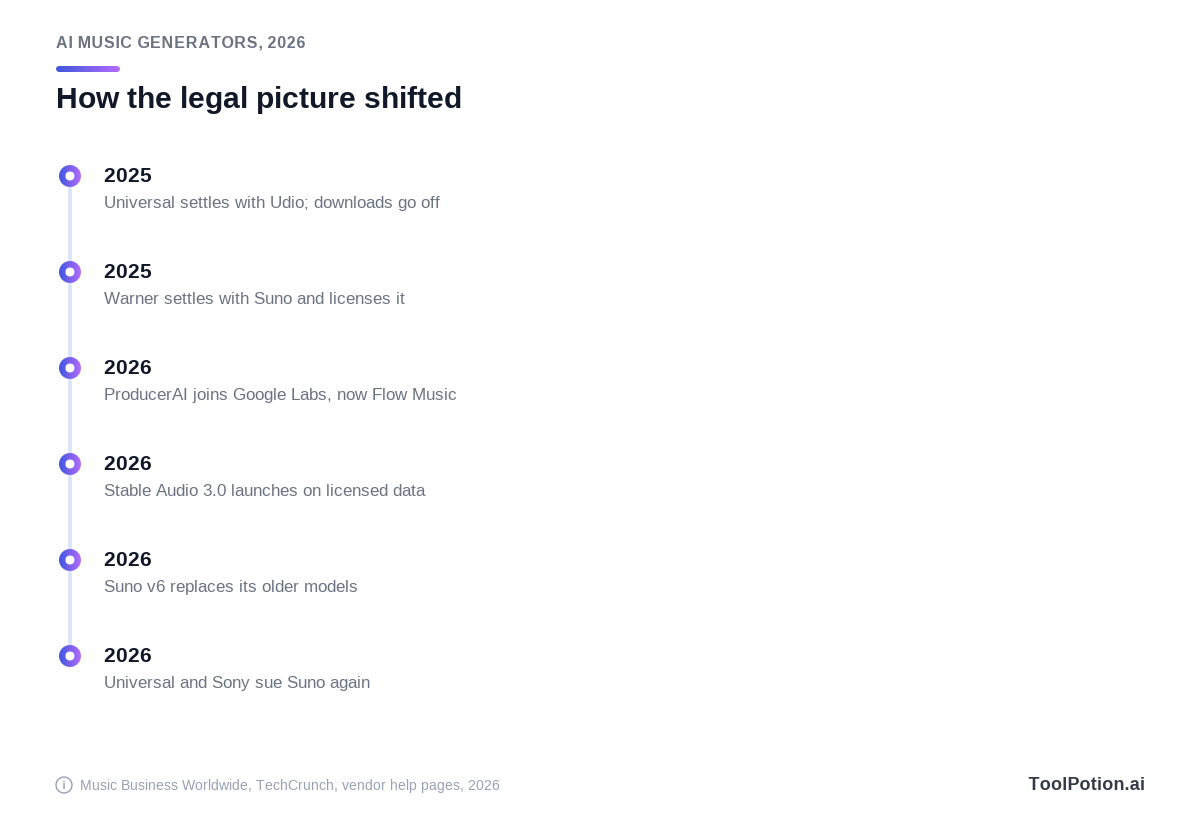
Then came the part that isn't settled. When Suno launched its v6 models, it said they were trained from scratch with Warner Music Group, BMG and Believe. Universal and Sony sued Suno a second time in Boston federal court in 2026, claiming v6 is built on the output of earlier models trained on their recordings. They call that laundering (Music Business Worldwide). Suno's chief product officer said at launch that v6 was trained from scratch, and the company disputes the suit. The suit's claims are allegations in a complaint, not findings. For a buyer, the practical reading is simple: the rules for what these tools may produce are still moving, so don't build a business on one vendor's terms staying put.
Stability AI went the other way. Its Stable Audio 3.0 models, announced in 2026, are described as built on fully licensed data, and the medium and large versions can make compositions up to 6 minutes 20 seconds long (TechCrunch). ProducerAI, the music app behind Flow Music, joined Google Labs in 2026 (TechCrunch), and Google's Lyria 3.5 arrived in Flow Music with tracks from 30 seconds to 3 minutes and a feature for repainting one section of a song (The Decoder).
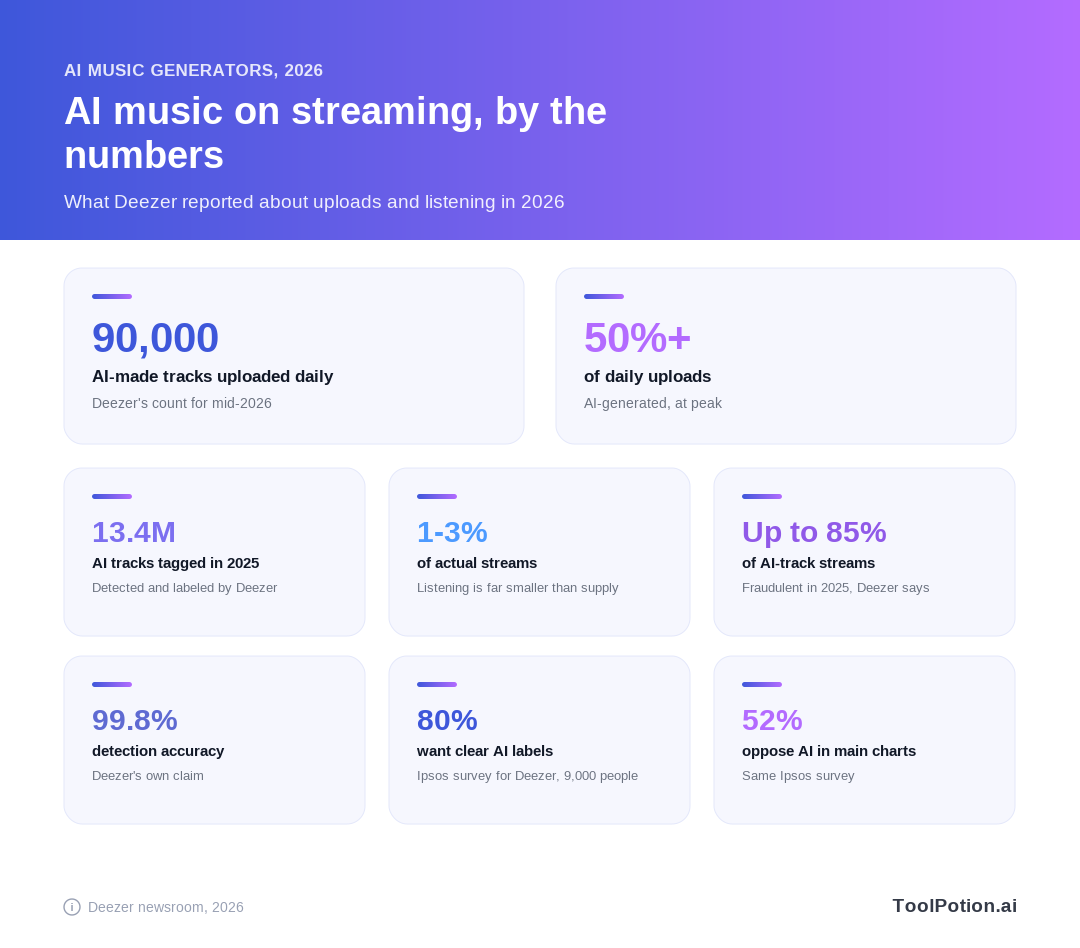
Meanwhile the supply side exploded. Deezer says about 90,000 AI-generated tracks were uploaded to its service each day in mid-2026, more than half of daily uploads, yet AI music is still only 1 to 3 percent of what people actually stream (Deezer). It also reports that up to 85 percent of streams from fully AI-generated tracks were fraudulent in 2025. If you plan to release what you make, you're entering a crowded and increasingly policed shelf.
Who owns the output, and what the plan decides
Ownership trips people up because three different things hide inside it. There's the license the vendor gives you, there's whether you hold the copyright, and there's whether a distributor or platform will accept the file. The first is a plan setting. The other two aren't.
Suno is the clearest case, so use it as the model. On the free plan, Suno says it keeps ownership of the songs you make and you may use them for non-commercial purposes. On Pro or Premier, if you were subscribed when a song was created, Suno says you're considered the owner (Suno help). The pricing page agrees: free has no commercial rights, no monthly downloads and no stem separation, while Pro (from $8 a month on annual billing) adds commercial rights and 20 downloads a month, and Premier (from $24) raises that to 60 (Suno pricing).
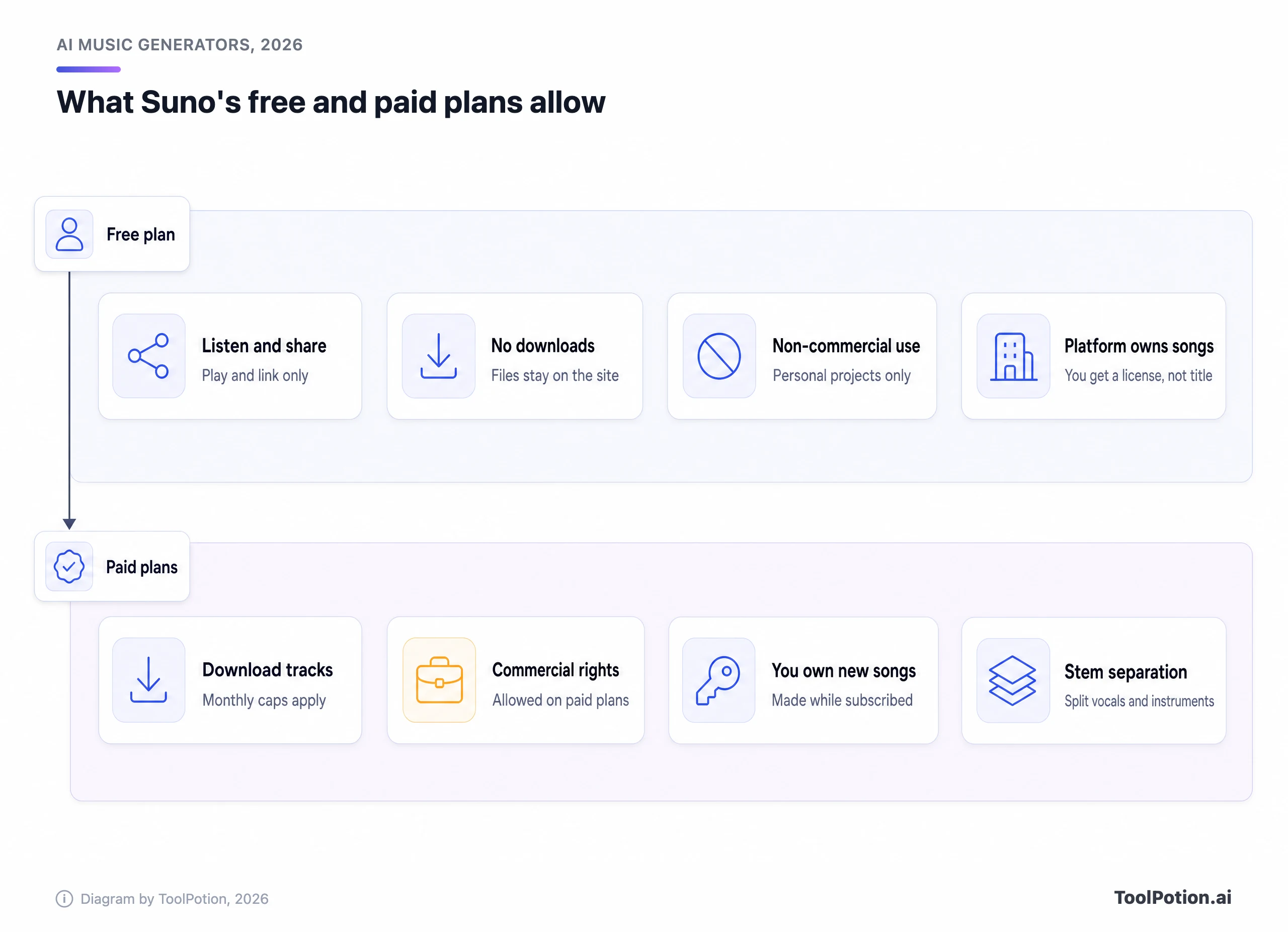
Read that as a license, not a copyright guarantee. US law protects human authorship, and the US Copyright Office's 2025 report on the copyrightability of AI outputs keeps human authorship central, so a fully generated track may not qualify (US Copyright Office). It's the reason to write your own lyrics or edit the audio yourself. A paid plan fixes the license. It doesn't fix the authorship.
AIVA draws the line more bluntly than anyone. Its free plan says the copyright is owned by AIVA, with no monetization and a credit required. The Standard plan (€11 a month billed annually) allows limited monetization on YouTube, Twitch, TikTok and Instagram but still leaves the copyright with AIVA. Only the Pro plan (€33 a month billed annually) says the copyright is yours (AIVA pricing). If you want to register a composition, that's the only tier worth looking at.
Google Flow Music's paid plans carry commercial rights. Google's help page says a Google AI Pro subscription includes the Plus plan with 10,000 monthly credits (about 2,000 songs) and commercial use rights (Google One Help). It doesn't spell out the same for a free account, so treat free output as personal use until Google says otherwise. Udio is the odd one. Its Help Center says downloading of audio, video and stems has been disabled since its Universal partnership, and we found no announced return date (Udio Help Center). You can create and share inside the app, but you can't take files out.
Plans change constantly, so use the table as a starting checklist and confirm on the live pricing page before you pay. Where a cell says "Not listed," we couldn't read a clear statement from the vendor.
From prompt to master: where each tool fits
Every generator runs the same basic loop, and the tools differ mainly in which steps they handle well. You write or generate lyrics, describe a style, generate a few takes, fix what's wrong, split the result into stems, and master it. Most disappointment comes from expecting step three to deliver the output of step six.
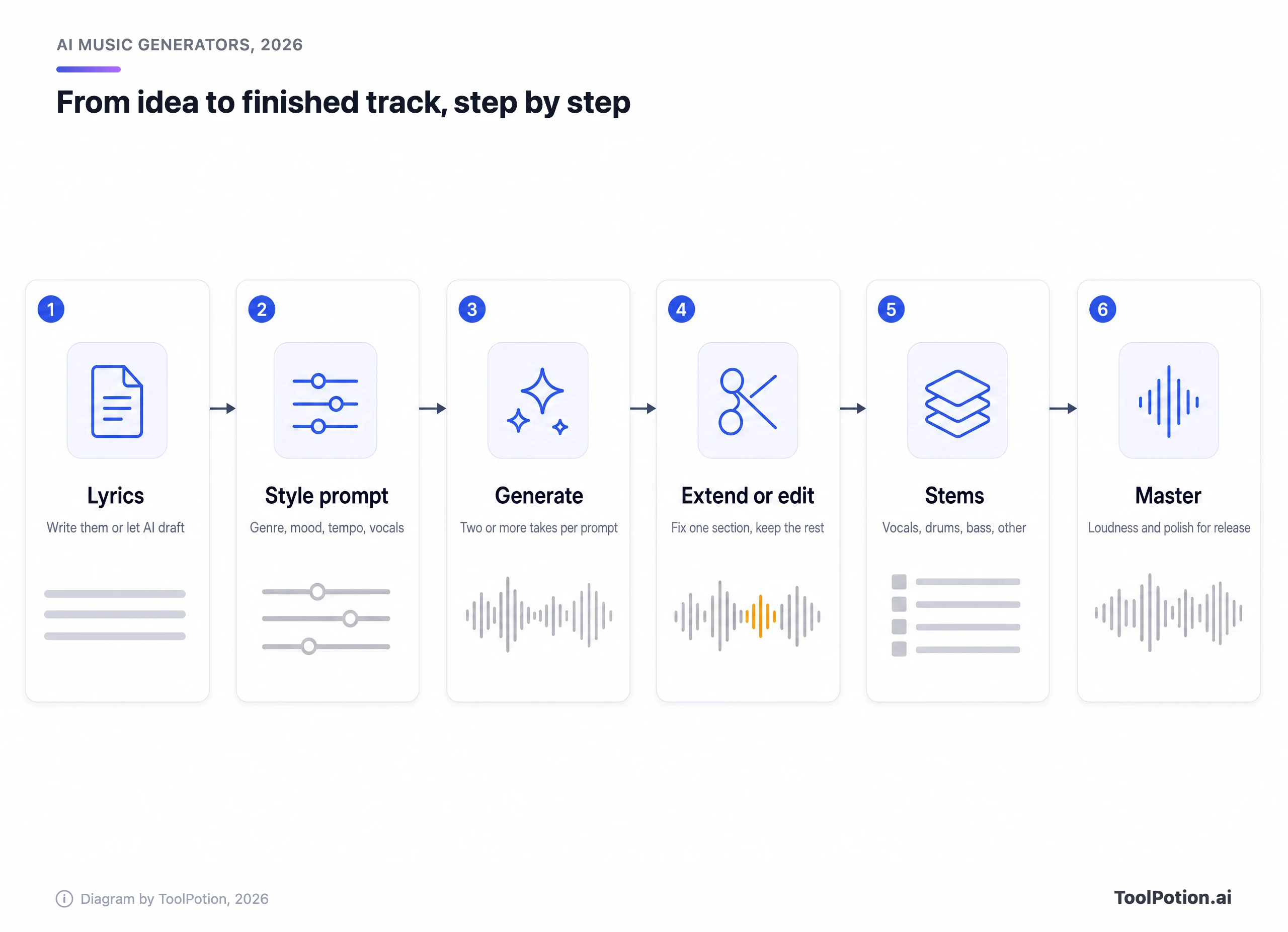
The editing step improved the most this year. Suno's v6 FAQ says you can edit part of an existing song in plain language and change one section while keeping the rest (Suno help), and Google's Lyria 3.5 added section repainting, as noted above. Both are a real answer to the old complaint that a single bad verse meant starting over.
Stems matter if you finish in a DAW. Suno's free plan has no stem separation, Pro has two stem types and Premier three, and Premier adds Suno Studio with MIDI, effects and automation. Google's Flow Music plan page lists MP3, WAV, M4A and stem downloads among its features. For length, Lyria 3.5 tops out around three minutes, AIVA's Pro plan runs to 5 minutes 30 seconds, and Stable Audio 3.0's larger models reach 6 minutes 20 seconds. Suno's pages we could read don't state a maximum, so check before you plan a long piece.
Mastering is a separate job. A generated song usually needs loudness and polish before release, and mastering services such as LANDR exist for exactly that, as the reviews cover.
The best AI music generators in 2026, reviewed
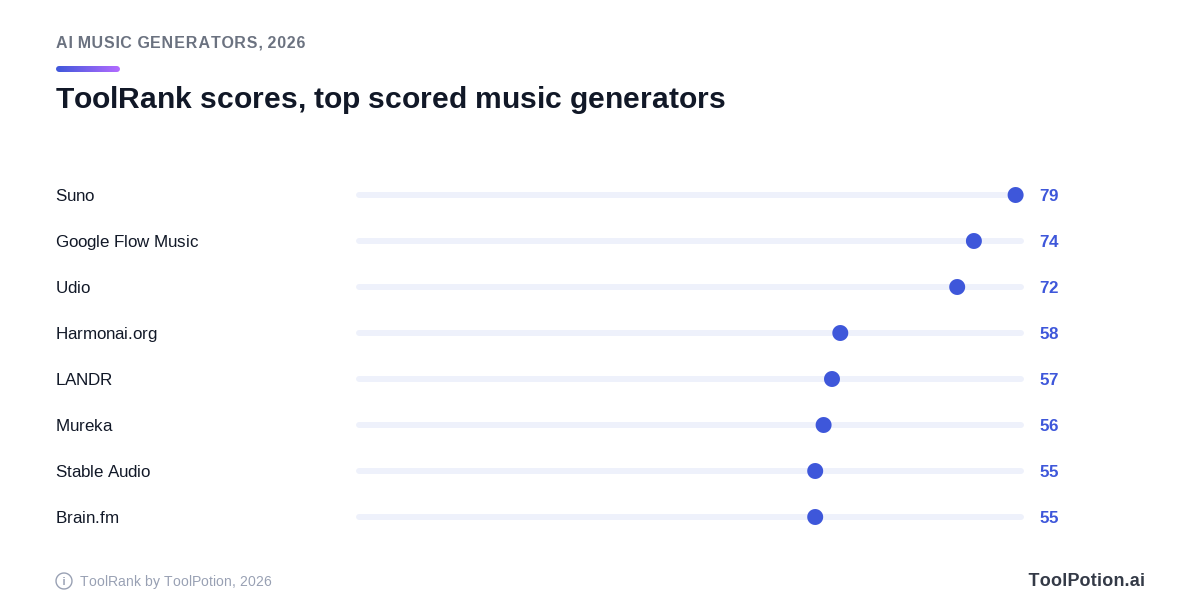
The ToolRank scores below come from our Top 150 AI Music Generators board. The gap after the top three is wide, so the leaders deserve most of your attention.
Suno: best overall
Suno is #1 on the 2026 board with a ToolRank of 79, in the strong tier. It turns a text prompt or your own lyrics into a full song with vocals, and its tool set now covers a beat maker, stem separation, MIDI export and a multitrack editor in Suno Studio. The v6 launch retired every earlier model, so older songs stay in your library unchanged but new versions use the new models. Free accounts get only v6-mini, while Pro and Premier add v6 and v6-wild (Suno help). The catch is the legal cloud above, plus the download caps. At 20 downloads on Pro, a heavy user burns through them fast.
Google Flow Music: best Google-backed studio
Google Flow Music sits at #2 with a ToolRank of 74, also strong. It's the current name for ProducerAI, which joined Google Labs in 2026, and it runs on Google's Lyria model. You can remix, personalize tracks and make accompanying music videos, and the work is organized into songs, playlists and projects. Its plans are credit based, with roughly 600 songs a month on Starter, 2,000 on Plus and 6,000 on Member per the plan page. The weak spot is clarity on the free tier, where commercial rights aren't spelled out.
Udio: downloads still off
Udio slipped from #2 to #3 on the 2026 board, scoring 72 (strong). It creates songs from text prompts and lets you upload audio for AI-assisted editing, but with downloads disabled it works as a closed studio, not a production tool. If you only want to play with ideas and share links, that's fine. If you need files, look elsewhere until the licensed relaunch actually ships.
Harmonai: for people who like open tools
Harmonai.org is #4 with a ToolRank of 58 (solid). It's the open-source audio lab from Stability AI, which releases open-source generative audio tools, so it suits people who want to work with the tools themselves rather than click Create on a finished app. Expect to bring your own workflow.
LANDR: best for finishing tracks
LANDR holds #5 with a 57 (solid), though it doesn't write songs. Its AI mastering engine works online or as a plugin inside your DAW, and it adds distribution to 150-plus streaming platforms, 70-plus plugins and a stem separation tool. Pair it with any generator on this list that gives you decent audio, and you have a release pipeline.
Mureka: a Suno-style rival with commercial rights
Mureka is #6 with a 56 (solid). It generates songs and lyrics in 30 to 120 seconds and exports MP3, WAV and MP4, and its listing says commercial rights are included. That's attractive on paper. Verify the exact terms for your plan before you rely on them, since we couldn't read its pricing page directly.
Stable Audio: best for long, licensed-data tracks
Stable Audio moved from #6 to #7 on the 2026 board, with a 55 (solid). The new 3.0 models use licensed data, run up to 6 minutes 20 seconds in the medium and large versions, and ship small and medium as open weights, while the large model is API or self-hosting only, with an enterprise license required for companies above $1 million in revenue (TechCrunch). It's the pick if provenance matters to your client more than polished vocals.
Brain.fm: not a song maker at all
Brain.fm is #8 at 55 (solid), tied with Stable Audio. It generates functional music for focus, relaxation and sleep, with no lyrics and long tracks. That's a different product. If your goal is a work soundtrack for yourself rather than a song to release, it's the better fit than any full-song generator here.
Kits AI: for vocals and voice work
Kits AI is #9 with a 54 (solid). It focuses on voice: custom AI voices, singing generators, a vocal remover, stem splitting and AI mastering for vocal outputs. If you clone or convert a real singer's voice, get that person's consent and check local law first, because the rules on voice likeness differ by country. Using voices a vendor has licensed is the safer route.
AIVA: best for owning a composition
AIVA is #10 at 53 (solid). It generates tracks in more than 250 styles and lets you download MIDI, so you can reshape the result in your DAW. Its tiered ownership terms, covered above, are the clearest on the board. The tradeoff is that it's pitched as a composition assistant, so don't expect Suno-style sung songs.
SOUNDRAW and Mubert: background music with simpler licensing
SOUNDRAW fell from #8 to #11 (52, solid) but stays a good choice for video makers. Its directory entry says its AI is trained only on in-house music, and it exports WAV and stems for editing. Mubert dropped from #5 to #13 (52, solid) and makes royalty-free tracks from prompts with commercial licensing on higher tiers. Both suit the person who needs a clean 90-second bed under a video, not a hit single.
How to choose
Start with where the track will end up. If it stays on your laptop or in a draft, any free tier will do and you can shop on sound. If it goes into a monetized video, a client deliverable or a streaming release, pick a paid plan with written commercial rights, and keep a note of the plan, the date and what you edited yourself.
Next, decide whether you need vocals. Suno and Flow Music make sung songs. AIVA, SOUNDRAW and Mubert are pitched at tracks and beats for projects. Then check length, since a three-minute ceiling is fine for a pop song and too short for a game level.
Last, think about your tolerance for legal noise. Tools with licensing deals or in-house training data carry less risk of a sudden change than those still in litigation, though no vendor can promise a lawsuit-proof future. The decision tree below turns this into a three-question shortlist.
About ToolRank
ToolRank is ToolPotion's independent ranking for AI tools, and placement on a board can't be bought. Every score and tier in this guide comes from the live Top 150 AI Music Generators board, and you can browse every other leaderboard on the ToolRank index. The full directory is in all AI music generators.
Rising and newer names worth watching
Just outside the top 25, a few entries are worth a look. LANDR Composer (#26) generates chord progressions, basslines and melodies as a plugin. MuseGen (#27) adds genre, BPM and structure control. Beatoven.ai (#29) targets royalty-free background music and sound effects. Soundverse (#34) combines a song generator with voice cloning, and AI Music Maker - Fadr (#35) is strong on vocal removal and remixing.
If you work with sung vocals specifically, our boards for AI tools for writing song lyrics and separating vocals from music show which neighbors rank highest. Working musicians can also browse the Top 250 AI Tools for Musicians, and a broader view is in Top 25 Audio, Voice & Music.
Frequently asked questions
Can I use AI-generated music commercially?
On most tools you can on a paid plan, and on most you can't on a free one. Suno's free plan is non-commercial and Pro and Premier include commercial rights, and AIVA only gives you the copyright on its Pro plan. Always read the plan terms for the exact date your song was created.
Do I own the copyright to an AI-generated song?
Not automatically. A vendor can say you own the output, but US copyright law protects human authorship, and the US Copyright Office keeps human authorship central, so fully generated music may not be eligible. Writing your own lyrics or editing the audio gives you a stronger claim.
Why can't I download from Udio?
Udio disabled downloads after its partnership with Universal, and its Help Center says downloading of audio, video and stems has been disabled. We found no announced return date. Songs stay playable and shareable inside the app.
Which generator has the longest tracks?
Among the figures we could verify, Stable Audio 3.0's larger models reach 6 minutes 20 seconds, AIVA's Pro plan reaches 5 minutes 30 seconds, and Flow Music's Lyria 3.5 tops out around three minutes. Suno's documentation we read doesn't state a maximum.
Which generator is easiest for a beginner?
Suno's own description says no music experience is required: you describe a song or paste lyrics and press Create. Expect to generate a few versions before one feels right.
Do I still need to master AI tracks?
Usually, yes, if you're releasing them. A generator gives you a finished-sounding mix, but loudness and tonal balance for streaming are a separate step, which is why mastering services like LANDR sit alongside the generators.