Adobe Creative Cloud sits at #1 on our 2026 board of AI tools for marketing and creative agencies, ranked but not yet scored. Right behind it, Luma and Higgsfield tie at 76 (strong tier), and eight of the top ten make or edit images or video. The board ranks 1,129 tools for this industry and publishes the top 250, and its upper end is dominated by production tools.
Production capacity is the easy part to buy. The hard questions are commercial. Whose terms let you hand an AI-made asset to a client? Who pays if it infringes something? Can the vendor train its models on a client's unreleased product shots? And when a job that took 40 hours now takes 25, what goes on the invoice?
This guide follows an agency's workflow from pitch to report. It separates the full suites from the point tools, quotes prices only where we read them on the vendor's own page, and ends with two starter stacks and a checklist for putting AI work in front of a client. For everything beyond the top 25, browse all marketing and creative agency tools in the directory.
The top 25 agency AI tools right now
- # 1Top PickAhrefsAI AppAhrefs is an AI marketing platform designed to enhance brand visibility across search, AI, and social media. It provides tools for SEO, content marketing, and competitive intelligence, helping marketers optimize their online presence effectively.75ToolRankStrong
- # 2Runner UpRecraft AIAI AppRecraft is an AI platform for generating and editing images, vector graphics and design assets. Recraft Studio combines Recraft's own models like V4.1 Flash with other frontier models for photorealistic images, editable vector art, mockups and custom styles, plus tools for upscaling, background removal and vectorizing existing images.74ToolRankStrong
- # 3Third PlaceJasper AI Marketing PlatformAI AppJasper is an AI platform designed for marketing teams, enabling them to orchestrate intelligent agents for end-to-end workflows. It enhances content creation, maintains brand consistency, and automates marketing processes, delivering measurable impact and efficiency.72ToolRankStrong


- 4Microsoft DesignerAI AppMicrosoft Designer is an AI-powered graphic design application that enables users to create professional-quality social media posts, invitations, digital postcards, and other graphics. Start with an idea and let the AI assist in generating unique visual content quickly and efficiently.72ToolRankStrong
- 5Luma AI (luma.ai)AI AppLuma Layers is an AI-powered platform that creates videos from text or images. It offers multiple models and templates for editing, ensuring privacy and transparency in credit costs before creation.71ToolRankStrong
- 6Hailuo AIAI AppHailuo AI is an AI video generator and prompt tool that turns a short piece of text into a polished AI video. It is aimed at creators who want to produce engaging visuals quickly.69ToolRankStrong
- 7SimilarwebAI AppSimilarweb is an AI-powered digital data company that provides real-time market intelligence, competitive insights, and consumer trends to help businesses grow. It offers tools for website traffic analysis, app performance, and competitive benchmarking.69ToolRankStrong
- 8BrandwatchAI AppBrandwatch is an AI-powered social media management and consumer intelligence suite that helps businesses understand their consumers and engage effectively across social platforms. Trusted by half of the Forbes 100, it offers tools for influencer marketing and data-driven content strategies.67ToolRankStrong
- 9ComfyUIAI AppComfyUI is a node-based AI creation engine for visual professionals, giving control over every model, parameter, and output by chaining models and processing steps on a visual canvas for images, video, 3D, and audio.65ToolRankStrong
- 10Muse ImageAI AppMuse Image is an advanced AI image generator by Meta Superintelligence Labs. It allows users to create, edit, and remix visuals using natural language prompts and agentic reasoning, making it ideal for creators and marketers.64ToolRankStrong
- 11Xunfei HuiwenAI AppXunfei Huiwen is an intelligent content creation platform that integrates AI writing, topic selection, image matching, typesetting, polishing, and publishing functions. It can generate general manuscripts in 30 minutes and double the efficiency for in-depth articles. The platform is suitable for various scenarios, including enterprise WeChat official accounts, Toutiao, and news outlets, aiming to unleash creativity and simplify content creation.61ToolRankStrong
- 12CaptionsAI AppCaptions is an AI video generator and editor that turns footage or ideas into fully edited, ready-to-share videos. It is built for content creators making social videos, ads, tutorials, and podcast clips.61ToolRankStrong
- 13ElevenLabs Video EnhancerAI AppElevenLabs Video Enhancer uses AI to upscale, sharpen, and denoise videos, enhancing quality effortlessly. It integrates voice for dynamic storytelling, making it ideal for creators and enterprises seeking high-quality video production.60ToolRankStrong
- 14Artlist StudioAI AppArtlist Studio is an AI-powered video production platform that offers creators full visual control over every stage of filmmaking. It integrates seamlessly with other Artlist tools, enabling high-end production with AI-generated video, image, music, and voice assets.59ToolRankSolid
- 15Vizard.aiAI AppVizard.ai transforms long-form videos into engaging, viral clips for social media using AI. Effortlessly generate over 30 short, social-ready videos from a single long video in one click. Ideal for creators, businesses, and marketers seeking to maximize content reach and engagement.59ToolRankSolid
- 16Relevance AIAI AgentAn enterprise-grade platform for building and running specialist AI agents and AI workforces across sales, support, marketing, and HR, with orchestration, evals, governance, and 1,000+ integrations.58ToolRankSolid
- 17Supermetrics Marketing Intelligence PlatformAI AppSupermetrics is a leading marketing intelligence platform that helps agencies and brands connect, manage, analyze, and activate their marketing data efficiently. Trusted by over 200,000 companies, it offers tools to turn data into actionable insights and optimize marketing campaigns.58ToolRankSolid
- 18D-IDAI AppD-ID offers a self-service platform for AI-generated video creation, enabling users to create videos with animated avatars. Its Creative Reality Studio combines deep-learning technology with text generation for businesses and content creators seeking innovative video solutions.58ToolRankSolid
- 19AffinityAI AppAffinity offers professional photo, design, and layout software that is powerful, precise, and free forever. It integrates seamlessly with other tools, allowing creatives to work without limits and focus on their craft.57ToolRankSolid
- 20Lumen5AI AppLumen5 is an AI-powered video creation platform that transforms text-based content like blogs and articles into engaging videos within minutes. It simplifies video production for users without prior experience, offering a drag-and-drop interface and automated features for marketing, communications, and education.57ToolRankSolid
- 21Pippit AIAI AppPippit AI is a creative agent from CapCut for making videos, images, ads, and avatars from a prompt or reference, with tools to publish, analyze performance, and scale content in one place.57ToolRankSolid
- 22SubmagicAI AppSubmagic is an AI-powered tool that enables users to create captivating short-form videos quickly. With features like automatic captions, B-rolls, and smart edits, it helps save time and enhances social media reach effortlessly.57ToolRankSolid
- 23PreziAI AppPrezi is an AI presentation maker that creates studio-quality, interactive presentations from a prompt or uploaded file through a simple conversation, letting you refine slides by chat and present in a dynamic zooming format.57ToolRankSolid
- 24BoxAI AppBox is a cloud content management platform for storing, sharing, and securing enterprise files. Box AI adds content search, summarization, and Q&A powered by OpenAI, Anthropic, or Google models, plus Box Extract for pulling data out of documents and Box AI Agents for workflow automation. It serves regulated industries such as banking, government, and life sciences.57ToolRankSolid
- 25ArtlistAI AppArtlist is an all-in-one creative platform combining generative AI tools for images, videos, music, and voiceovers with a royalty-free catalog of music, SFX, and footage, all under safe commercial licensing.57ToolRankSolid




















How ToolRank works
ToolRank is ToolPotion’s proprietary ranking engine.
It continuously evaluates hundreds of signals across the open web — real traffic and popularity, audience and community strength, authority and longevity, adoption and engagement — processing millions of data points to place every tool where it has earned to be.
Every AI type is measured by its own tailored model: what proves traction for a SaaS app is not what proves it for an open-source framework or a creator channel. Missing a platform never counts against a tool — ToolRank judges the evidence that exists.
No paid placement. No self-reported numbers.
Quick picks
- For one suite that covers finishing work and the legal paperwork, choose Adobe Creative Cloud (#1). Adobe says it has never trained Firefly on user content, and it indemnifies eligible enterprise customers.
- Luma (#2, 76) is the pick for AI video that a team makes together, from concept to cut.
- Want many video models and a cinema-style studio in one account? Higgsfield (#3, 76), provided you read its training clause first.
- Small studios that want stock, generation and some legal cover on one invoice should look at Freepik (#9, 73), now sold as Magnific.
- Recraft AI (#6, 74) builds a reusable style from a client's own images and exports editable vectors.
- For copy in many client voices, Jasper (#11, 72), which climbed from #246.
Scores near the top are tight. The highest-scored entries sit within five points of each other (76 to 71), all strong tier, so treat the ranking as a shortlist rather than a podium.
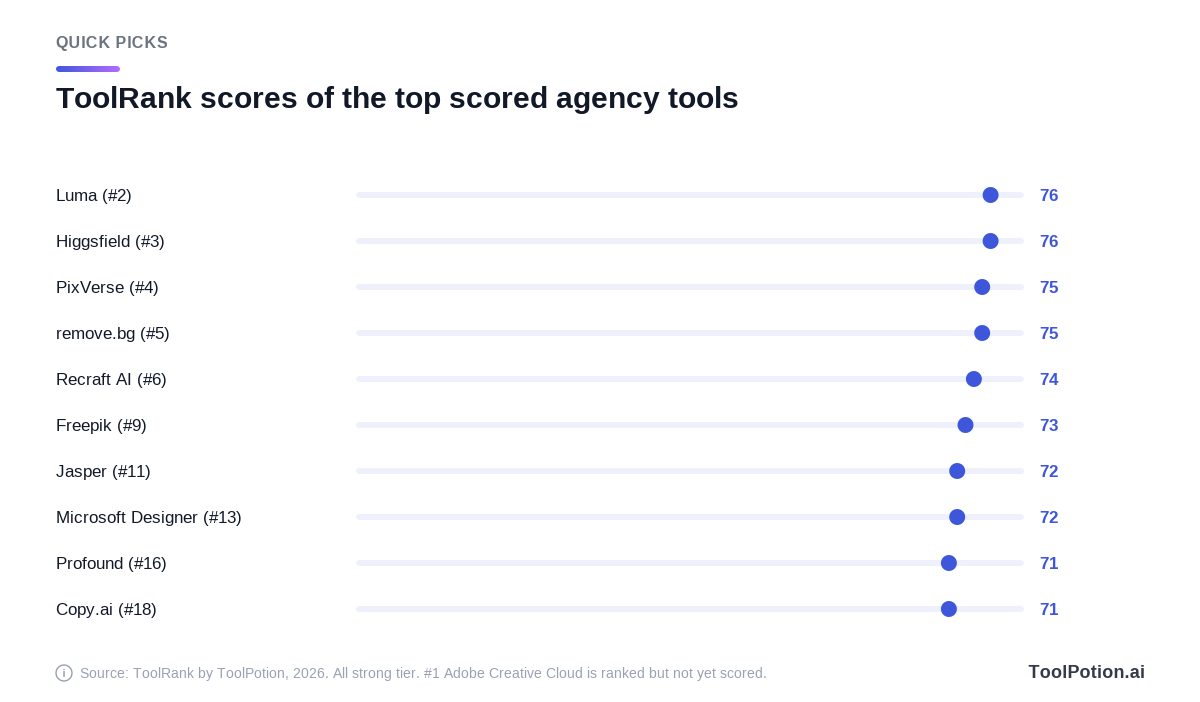
With a spread of 76 to 71, the differences that decide a purchase are in plans and terms, which is what the rest of this guide covers. Adobe Creative Cloud and eight other top-25 entries are ranked but not yet scored, so the chart leaves them out.
What changed for agencies in 2026
Agents moved into production. Luma's agents research, generate and refine across video, image, audio and text, and Boundless, an independent agency in Johannesburg, used them to make what Luma calls Mazda's first AI-produced commercial, a heritage film for the MX-5's return to South Africa. Luma says the job ran from initial brief to final approval in less than two weeks. PixVerse launched Growth Studio for campaigns at scale this year, and Klaviyo sells Composer, an agent that audits and builds email flows and campaigns from a prompt.
The big networks signed on. Luma announced that Serviceplan Group, which describes itself as Europe's largest independent, partner-led agency network, with more than 6,500 employees in 43 locations, is deploying Luma across strategy, creative development, production and delivery. Luma also lists a partnership with Publicis Groupe among its news this year. And Adweek reported that WPP opened Devon's Point, a 34,000-square-foot production hub in east London that puts AI-powered, virtual and human-led production under one roof.
Suites turned into model marketplaces. Luma's Plus plan includes "Luma and third-party image and video models," Adobe's Firefly plans reach partner models from Google and OpenAI, and Magnific lists Nano Banana, Seedream, Flux and others. Convenient, yes. It also complicates rights, because a vendor's promises about its own models don't automatically cover someone else's.
Brands pulled routine versioning in-house. Digiday reported that Wyndham now produces 15 times as many assets and has cut the time spent on concepting, production and approval by 75%, while consumer-health company Opella makes 20 times as many as before (Digiday). Both still hire agencies, for bigger and more traditional creative. Meanwhile the price of an hour came under pressure. WPP chief executive Cindy Rose said she expects "some short-term deflationary impact on pricing as AI tooling drives productivity gains" (Marketing Dive).
Disclosure got rules. The IAB published an AI transparency and disclosure framework for advertising this year, then a second version, and the European Commission published a voluntary code on marking and labelling AI content to support AI Act transparency duties that apply from 2026. Both are covered further down.
Creative production: one suite, a few point tools
Most agencies settle on one suite, where most production and the brand libraries live, plus a handful of point tools that each do one job well. On this board the suites are Adobe Creative Cloud, Luma, Higgsfield, PixVerse and Freepik (Magnific). The point tools include Recraft AI for design assets, remove.bg for cutouts, VEED for editing and subtitles, and single-model makers such as MiniMax's Hailuo AI (#24) and Meta's Muse Image (#25).
Where each type of tool fits is clearer as a pipeline. Watch the review stage, because that's where an agency's value and its liability both sit.
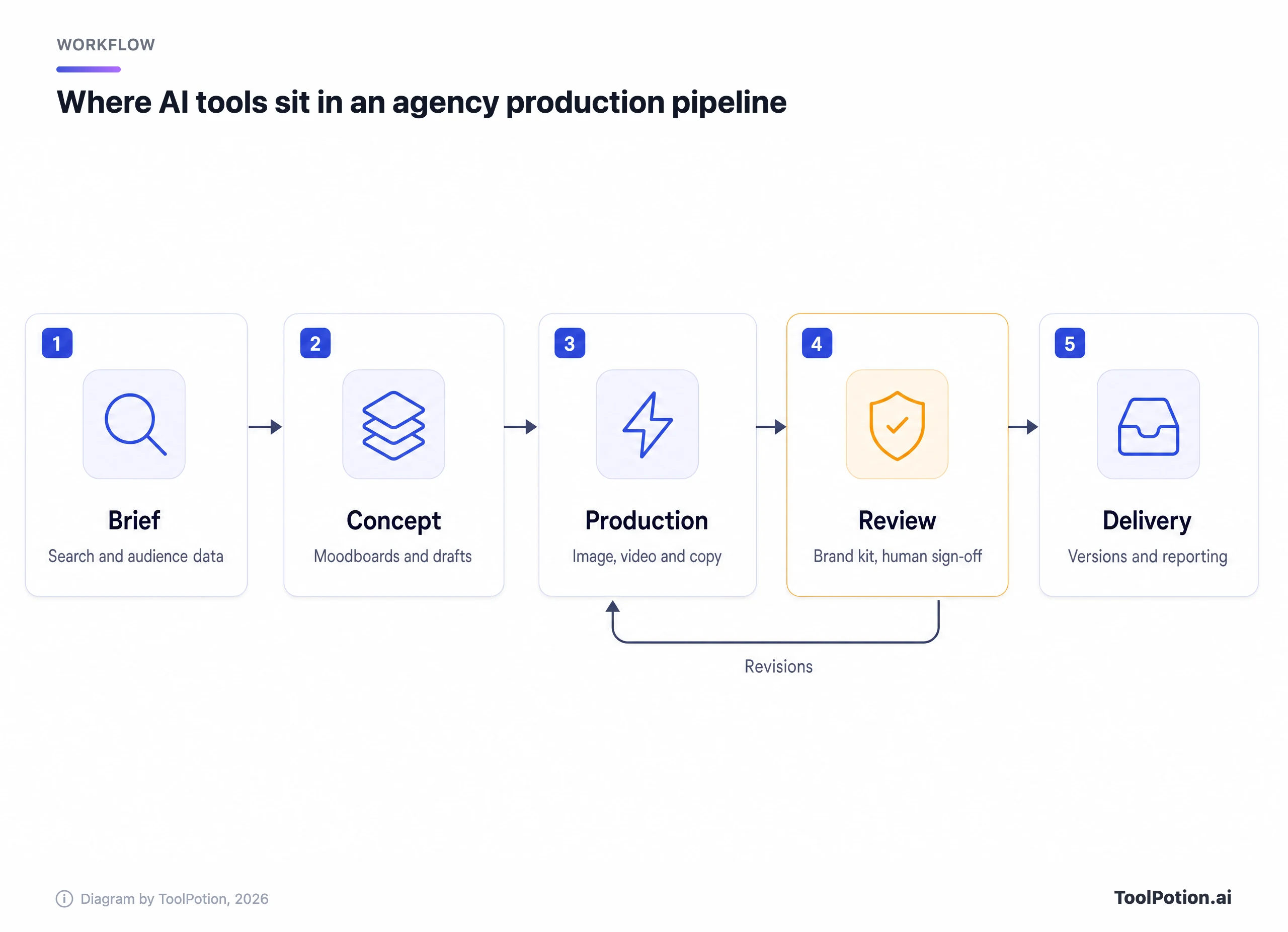
AI has compressed the middle of that pipeline the most. Briefs and delivery still lean on research and reporting tools. Review can't be handed to a model: someone who answers to the client signs off every asset, and rejected work loops back into production.
Adobe Creative Cloud: the finishing suite with the cleanest paperwork
It's #1 on the 2026 board and not yet scored. No other leader is both a full production suite and the file format your clients' in-house teams already open. Creative Cloud Pro bundles more than 20 apps, Photoshop, Illustrator and Premiere among them, with Firefly's generative AI. Adobe's teams plans add 1TB of cloud storage per user, company-owned libraries and the ability to reclaim assets when someone leaves.
Its rights story starts earlier than anyone else's, at the training data. Adobe says "we do not train and have never trained Adobe Firefly on user content," and that the models learn from licensed content such as Adobe Stock plus public-domain material (Adobe). Eligible enterprise customers can get IP indemnification for select Firefly outputs. The catch is that Firefly plans also reach partner models from Google, OpenAI and others, while the commercial-safety language names Adobe's own models. Firefly Pro for teams lists at US$19.99 per license a month.
Adobe also spread out this year. Its tools now run inside ChatGPT, Claude and Gemini, and it completed the purchase of Topaz Labs, whose upscaling now sits in Firefly and Photoshop. For a creative director, that means rough concepts can start in a chat window and still finish in a PSD.
Luma: agency video, built for teams
Luma is #2 with a 76, strong tier, up from #92. Its Ray video models, the Uni-1 image model (pitched as "brand intelligence at the model level") and Luma Agents share one workspace with third-party models such as Kling, Veo and Seedance. Serviceplan, Dentsu and Publicis Groupe are among the logos on its enterprise page.
Plus costs $30 a month for 10,000 credits and includes commercial use and edit access for guest collaborators. Pro is $90, Ultra is $300, and the Team plan (priced on request) adds shared credits, SSO and team-wide projects (Luma).
Read the standard terms before uploading a client's unreleased product. They let Luma use inputs and outputs to train its models, they allow commercial use only for outputs made during a paid plan that permits it, and they make you indemnify Luma against claims over your inputs and outputs (Luma). Luma's enterprise page, by contrast, says nothing you create there is used to train models.
Higgsfield: many models, loose terms
Higgsfield ties Luma at 76 and jumped from #34 to #3. It's a studio wrapped around other companies' models (Seedance 2.5 gets top billing) plus its own tools: Cinema Studio 4.0, Ads Studio, a Marketing Studio, and plugins that run it from ChatGPT or Claude.
Its terms are generous on output and loose on input. Higgsfield claims no ownership of outputs, doesn't restrict commercial use, and says you "may transfer or sublicense your rights in Outputs to your clients." It can also train on your content, inputs and outputs unless you're under an Enterprise Agreement (deleting your content stops future use), and it "does not guarantee the uniqueness, originality, or exclusivity of any Output" (Higgsfield). Enterprise adds a shared workspace with approvals and comments, SSO, and "contract-backed indemnification". Its pricing page didn't show a US price we could confirm, so none is quoted.
PixVerse: cheap volume for social video ads
PixVerse is #4 at 75, strong, up from #28. It runs its own V6 model (1080p video with native audio) next to Seedance, MiniMax and GPT Image models, and Growth Studio is its offer to marketers who need many ad variants. Standard costs $10 a month, Pro $30 and Premium $60, all watermark-free, with a top tier at $249 that drops to $149 a month billed yearly (PixVerse).
Use it for high-volume social cutdowns, not hero spots. Its public pages don't mention indemnity or a training opt-out, so check its terms before confidential client footage goes in.
Freepik (Magnific): stock, models and team-level cover
Freepik climbed from #667 to #9 with a 73, strong tier, and its pricing page now reads "Magnific (formerly Freepik)". One subscription mixes a stock library of more than 250 million assets with image, video and audio generation across many models. A US snapshot of the page from earlier this year listed Premium at $20 a month and the Business plan, "for creative teams and agencies," at $69 per seat a month or $55 billed annually (Magnific).
The fine print is why it's on this list. Magnific says neither it nor its third-party model providers train on your inputs or outputs. The plan table lists "basic legal indemnification" on Business, with Enterprise adding indemnity defined by contract, and the site's FAQ says individual plans explicitly exclude AI output from cover. That FAQ also ties indemnity to Enterprise alone, so get the Business cover confirmed in writing before you rely on it. For a five-person studio, it's the cheapest route to vendor-backed legal cover among the platforms reviewed here.
Recraft AI: brand-locked design assets
Recraft is #6 at 74, strong. Drop in a client's images and it builds a reusable style, then generates editable vectors and mockups in it, which is closer to how designers already work. The enterprise page lists brand styles, palettes and templates applied across every asset, SOC 2 Type II certification, SSO, and a setting that lets teams opt out of data use for model improvement.
Never use the free plan for client work. Those images belong to Recraft, appear in a public gallery and aren't licensed for commercial use. Paid plans give you full ownership and commercial rights, and you keep both after cancelling (Recraft).
Set the five platforms side by side and one thing is obvious. All of them allow commercial use on a paid plan, so that's not the question to ask a vendor.
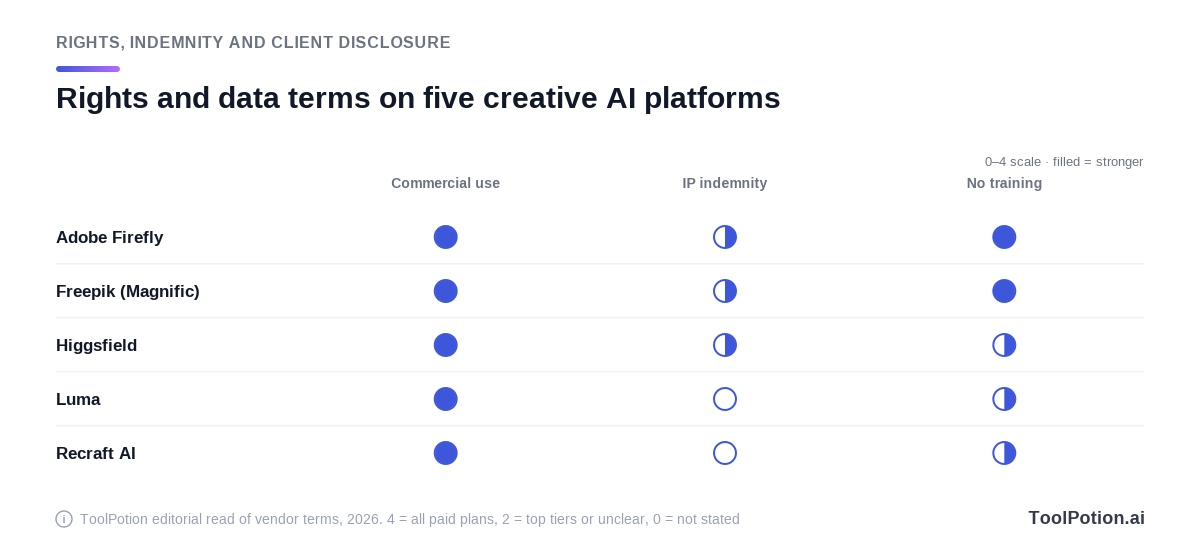
Indemnity and training are where they split. Only Adobe and Magnific keep your content out of training on every plan, and only Magnific extends some indemnity below the enterprise tier. Luma and Recraft don't state any on their public pages.
remove.bg, VEED and Picsart: the daily workhorses
remove.bg (#5, 75) does one job, background removal in seconds, with an API and a Photoshop extension. Its site footer shows it's a Canva brand, run by Canva Austria. VEED (#10, not yet scored) is the browser editor social teams use for subtitles and for translation into more than 125 languages, and its enterprise page lists a Brand Kit for logos, fonts and colors, a Review Mode and comment threads for client feedback. Picsart (#14) lists support for three or more brand kits on its Pro plan and ten or more on 5x Pro, which suits teams juggling several client identities.
Copy, search and strategy
Below the creative leaders, the board fills with tools for the work around production: writing, search visibility and research.
Jasper: one brand voice per client
Jasper jumped from #246 to #11 and scores 72, strong. It has moved well past a writing app. The homepage lists more than 100 agents for marketing tasks, Jasper IQ for brand rules, Brand Voice for tone and features for getting cited by AI answer engines. Pro is $69 per seat a month, or $59 billed yearly, and includes 2 Brand Voices (Jasper).
That limit is the agency problem. A shop with eight retained clients needs eight voices, which means the Business plan, priced on request, where IQ customization is unlimited. Budget for it before you pitch Jasper as the answer to "can you write in our voice?"
Ahrefs and Profound: getting clients cited by AI answers
Clients now ask why ChatGPT recommends a competitor. Ahrefs (#7) answers with Brand Radar AI, which its pricing page lists from $199 a month, on top of SEO plans that run from $129 (Lite) to $449 (Advanced), each tracking a handful of AI prompts. Profound (#16, 71) is built only for answer engines. Its pricing page lists Starter at $99 a month and Growth at $399, plus an Agency Growth plan with 400 credits a month per client workspace.
If AI visibility is a service line you sell, Profound's per-client structure matches how you bill. If it's one slide in a monthly report, Ahrefs already covers it.
For research and pitching, Similarweb (#19) now tracks brand visibility across AI chatbots alongside its traffic data, and Brandwatch (#23) is the consumer-intelligence and social-listening suite, with an AI layer called Iris. Clay (#15) suits new-business prospecting and has a free plan with 500 actions a month. Copy.ai (#18, 71) climbed from #325, but it now sells a go-to-market platform for go-to-market teams, so it fits creative copywriting less well than its name suggests.
Campaign ops and reporting
For ecommerce clients, Klaviyo (#8), which says it's trusted by more than 205,000 brands, covers email and SMS. Its free plan covers up to 250 active profiles and 500 emails a month, enough to build and test flows before a client commits. Klaviyo says its Composer agent "uses your brand, creative, business context" to draft flows and campaigns, which helps agencies that run retention for several stores at once.
Reporting is where agencies leak hours. Supermetrics (#35) pipes ad and analytics data into Looker Studio, Sheets and Power BI, and now into ChatGPT, Claude and Copilot too. Its pricing page lists Starter from $55 a month and Growth from $222, less when billed yearly, and says agency pricing is customized by scale.
A few leaders cover the edges. Framer (#12) builds client websites and meters its AI features in credits, with 500 to try on the free plan. And Microsoft Designer (#13, 72) is folding into Microsoft 365: Microsoft's AI image generator page now opens inside Microsoft 365 Copilot, so agencies on Microsoft 365 should check what their plan already includes before buying another image tool.
Rights, indemnity and disclosure
Start with ownership, because it's weaker than most contracts assume. The U.S. Copyright Office concluded in 2025 that AI outputs can be protected only "where a human author has determined sufficient expressive elements," which can include human arrangement or modification of the output "but not the mere provision of prompts" (U.S. Copyright Office). A raw generated image can be licensed to your client and still be something neither of you can stop others from copying. Human edits, selection and arrangement strengthen the claim.
Indemnity usually runs the wrong way. Luma's standard terms make the customer defend Luma against claims arising from inputs or outputs, and Higgsfield's put rights clearance on you. Among the platforms reviewed here, vendor-backed cover appears only at Adobe (eligible enterprise customers), Higgsfield Enterprise and Magnific's Business and Enterprise plans. If your client contract warrants that deliverables don't infringe, on most plans you're carrying that risk alone.
Six things decide who carries the risk on an AI-made deliverable, and the vendor controls only some of them.
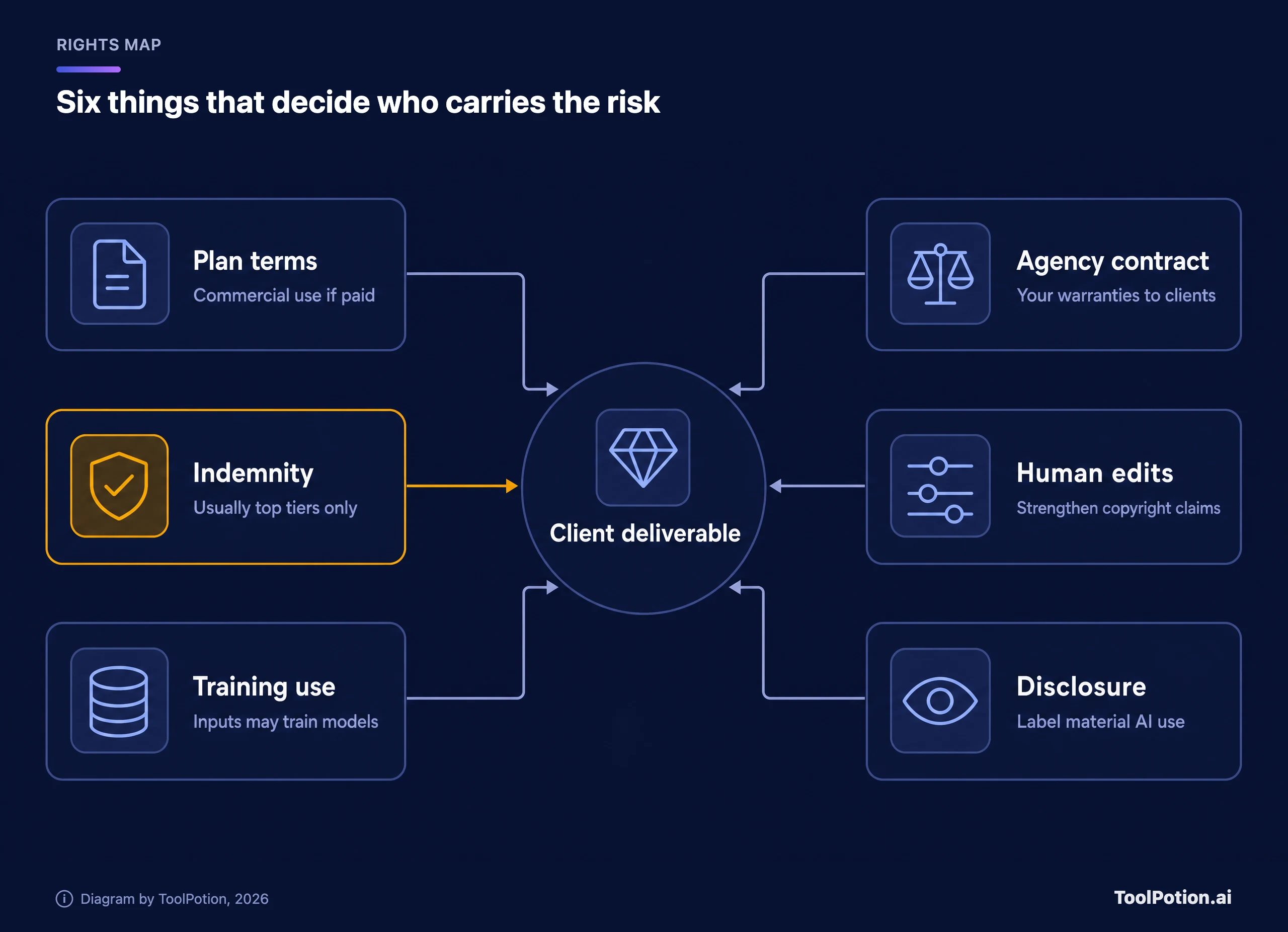
Two of the six stay with the agency whatever plan you buy: what your contract promises, and how much human work goes into the asset. Training use is the quiet one. On Luma's and Higgsfield's standard terms, a client's unreleased product shots can become training data, which is a confidentiality problem before it's an IP one.
Disclosure is lighter than many clients fear. The IAB framework takes a "risk-based, materiality-driven approach that avoids blanket labeling," and says disclosure is required "only when AI materially affects authenticity, identity, or representation in ways that could mislead consumers," so routine production and clearly stylized creative can run unlabeled (IAB). Its second version adds practical protocols covering synthetic voices and digital twins. In Europe, deepfakes and AI-generated text on matters of public interest must be clearly labelled under the AI Act transparency duties that apply from 2026 (European Commission).
If a campaign uses a real person's face or voice, get written consent and check the likeness law where it runs. Then turn the rest into a gate that every tool passes before it touches client work.
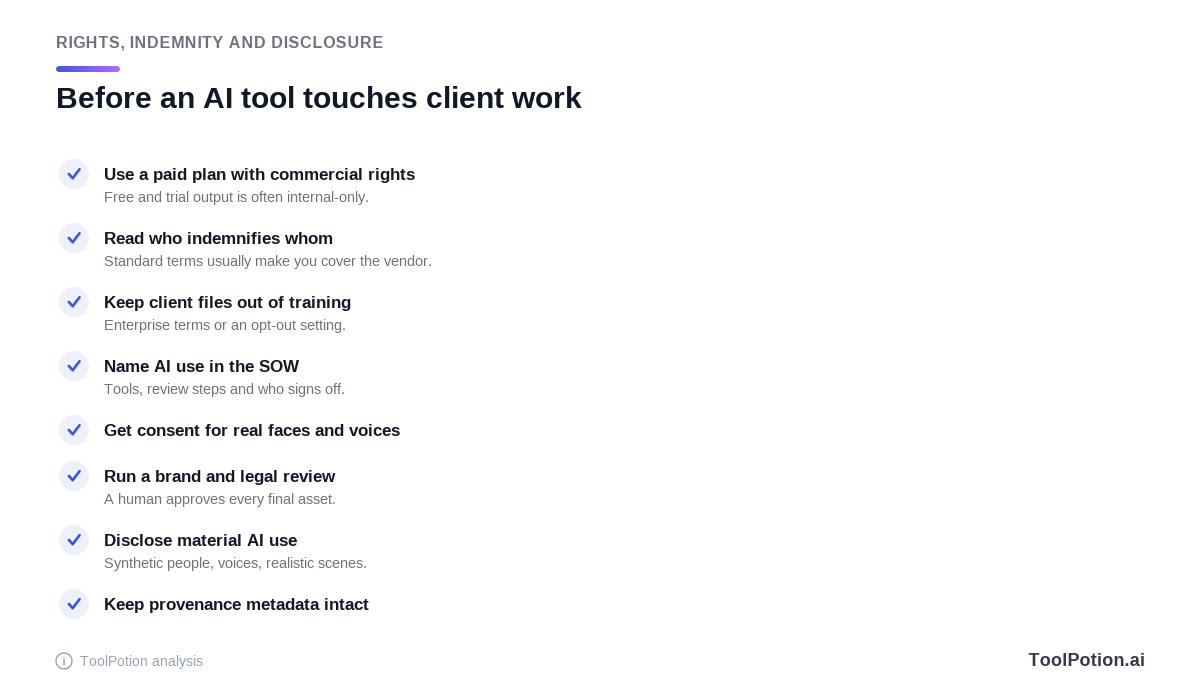
Write the answers into the statement of work. It's the place to record which tools you use, how review works and who signs off, so nobody discovers the AI at delivery.
Pricing work when AI cuts the hours
Bill by the hour and every hour AI removes comes off your invoice. That's why the pricing argument got louder this year. Horizon Media's Bob Lord called FTE-based pricing "the old system" and predicted clients would stop paying for it within five years (Adweek), and Rose at WPP expects agency pricing to deflate in the short term. For most agencies the fix is to price the output: a fixed fee per project, a retainer tied to deliverables, or a rate per asset or variant.
Plug in your own numbers. The gap between the two money lines is what you give away by staying hourly.
At the defaults (240 billed hours a month, 30% removed, $120 an hour), hourly billing loses $8,640 a month, while a fixed fee keeps $8,040 after $600 of tools. The model is crude, and clients will still ask for a share of the savings, as Rose expects. Better to share a saving you negotiated than one your billing method gave away.
Starter stacks for a small and a mid-size agency
These are starting points built from the leaders above, with US list prices only where we could verify them. Swap any line for what your clients already use.
| Stage | Small agency (5-20 people) | Mid-size agency (50-200 people) |
|---|---|---|
| Creative suite | Magnific Business, $55/seat/mo billed annually (earlier-this-year snapshot) | Adobe Creative Cloud for teams, enterprise terms for indemnity |
| AI video | Luma Plus, $30/mo, or PixVerse Pro, $30/mo | Luma Team or Enterprise |
| Design assets | Recraft AI, paid plan only | Recraft enterprise: brand styles, SSO |
| Copy | Jasper Pro, $69/seat/mo | Jasper Business, custom pricing |
| Search and AI visibility | Ahrefs Lite, $129/mo | Ahrefs Advanced, $449/mo, plus Profound |
| Email and reporting | Klaviyo free plan, Supermetrics Starter, $55/mo | Supermetrics agency pricing |
The small stack is built around one plan with legal cover, because a 10-person shop can't absorb an infringement claim. The mid-size stack pays for enterprise terms where confidentiality matters most: video, and anything trained on a client's brand assets.
How to choose
Start from what your clients buy, not from a demo reel. A branding studio and a performance-social shop need different suites, and the deciding question is often whether a client contract asks for indemnity. Three questions get most agencies to a name.
Whatever the tree suggests, run one real brief through the plan you'd actually buy, and read that plan's terms rather than the enterprise page. For a deeper comparison of video tools, see our guide to the best AI video generators. Neighbouring boards cover the roles inside an agency: marketers, brand managers, video editors and social media graphics.
About ToolRank
ToolRank is ToolPotion's independent ranking of AI tools, and placement can't be bought. Each entry gets a score from 0 to 100 and a tier, and a few entries, Adobe Creative Cloud among them here, are ranked before they're scored. Browse every list on the ToolRank leaderboards, or go back to the full agencies leaderboard.
Rising and newer names to watch
The big climbs this year are Freepik (#667 to #9), Jasper (#246 to #11) and Copy.ai (#325 to #18). Muse Image, the first image model from Meta Superintelligence Labs, climbed from #729 to #25 with a 62, and Meta says using it in Meta AI is free for everyday creation.
One name needs a double-check. Luma AI (luma.ai) rose from #743 to #21 with a 69, and it isn't the Luma reviewed above. Its own site says it "is not related to Dream Machine by LumaLabs". If a freelancer says they work in Luma, ask which one.
Just outside the top 25, ComfyUI (#26) is the node-based route for studios that want full control over models and workflows. Affinity (#37), now owned by Canva, is free for individuals, according to its site, though its Canva AI tools need a Canva premium plan.
Frequently asked questions
Can a small agency get IP indemnity for AI work?
Yes, but rarely on self-serve plans. Magnific's Business plan lists basic legal indemnification for AI content. Adobe limits its cover to eligible enterprise customers and "select" Firefly outputs, and Higgsfield to Enterprise contracts.
Is free-tier output safe to deliver to clients?
Usually not. Recraft owns images made on its free plan. Luma allows commercial use only for outputs made on a paid plan, and anything generated during a Luma trial is for internal evaluation only.
Could a competitor get the same AI image as our client?
It's possible. Higgsfield's terms warn that other users may receive output that is "similar or possibly identical" to yours. For logos and key visuals, treat generated work as a starting point and add enough human design to make it distinct.
Do we have to tell clients we used AI?
Your contract decides that, so read it. Consumer-facing labels are a separate test tied to whether AI could mislead people about who or what is real. Some brands already add AI disclosures in markets that require them, as Opella does, per Digiday.
Should we pass AI tool costs on to clients?
Treat them like the software you already absorb. A line item for AI invites the client to ask for the saved hours too. Pricing per deliverable folds tool costs into a number the client has already agreed to.