Short version for 2026: if you need a file you can put in a client video or an ad, ElevenLabs Music is the cleanest buy. Suno makes the more capable song tool and its paid plans carry commercial rights, but you only get them on tracks you download, and Universal and Sony are suing it again. Udio, for now, can't give you a file at all.
That last point is new, and it's why older comparison posts are wrong. After the record labels sued Suno and Udio in 2024, both companies spent 2025 and 2026 rebuilding their products around licensing deals. The rules for who can download, who can sell and who can post to Spotify changed along the way.
Here's where each service stands today, what the plans cost in US dollars, what each allows commercially, and what to use if you'd rather not carry any legal risk.
Where the three stand right now
Suno is the most active of the three. It settled with Warner Music Group in 2025, then signed BMG and Believe this year, and in the same stretch it launched v6, which it describes as developed with those partners. v6 comes in three flavors: a flagship v6 and an experimental v6-wild for paid users, and v6-mini for everyone (Suno). Suno says it will retire its earlier models as v6 rolls out. It also added download limits by plan, which we cover below. Suno said when it announced the Warner deal that its community had grown to nearly 100 million music makers, so these rule changes reach a lot of people.
The unresolved part is Universal and Sony. They filed a second complaint against Suno this year in a Boston federal court, covering 60,202 recordings and coming after their 2024 suit, arguing that v6 was built on the output of earlier models trained on unlicensed music. Suno says v6 was trained from scratch on data that excludes Universal and Sony content (Music Business Worldwide). Those are allegations and a denial, not findings. A court hasn't decided either way.
Udio took the other road. It settled with Universal in 2025 and with Warner shortly after, and the price was its downloads. Udio's help center says downloading of audio, video and stems has been disabled, and the page was last updated this year (Udio help center). You can still make songs and share them through udio.com links. Sony, the one major label without a deal, is still suing Udio, according to Music Business Worldwide. As far as Udio's own blog and help center show, the licensed platform the deals promised hasn't launched yet, so we can't say when exports will return.
ElevenLabs Music sits apart from the lawsuit drama. ElevenLabs says its music is built with artists, labels and publishers and cleared for broad commercial use, with the rights varying by plan (ElevenLabs). It doesn't name those partners on the page, so treat that as the vendor's claim. What you can verify is the plan table and the terms, and those are unusually specific.
How the lawsuits reshaped the products
The pattern is the same everywhere. The labels sued over training data. The settlements turned into licensing deals. The products got tighter on what leaves the platform, because a licensed model needs controls on where its output goes.
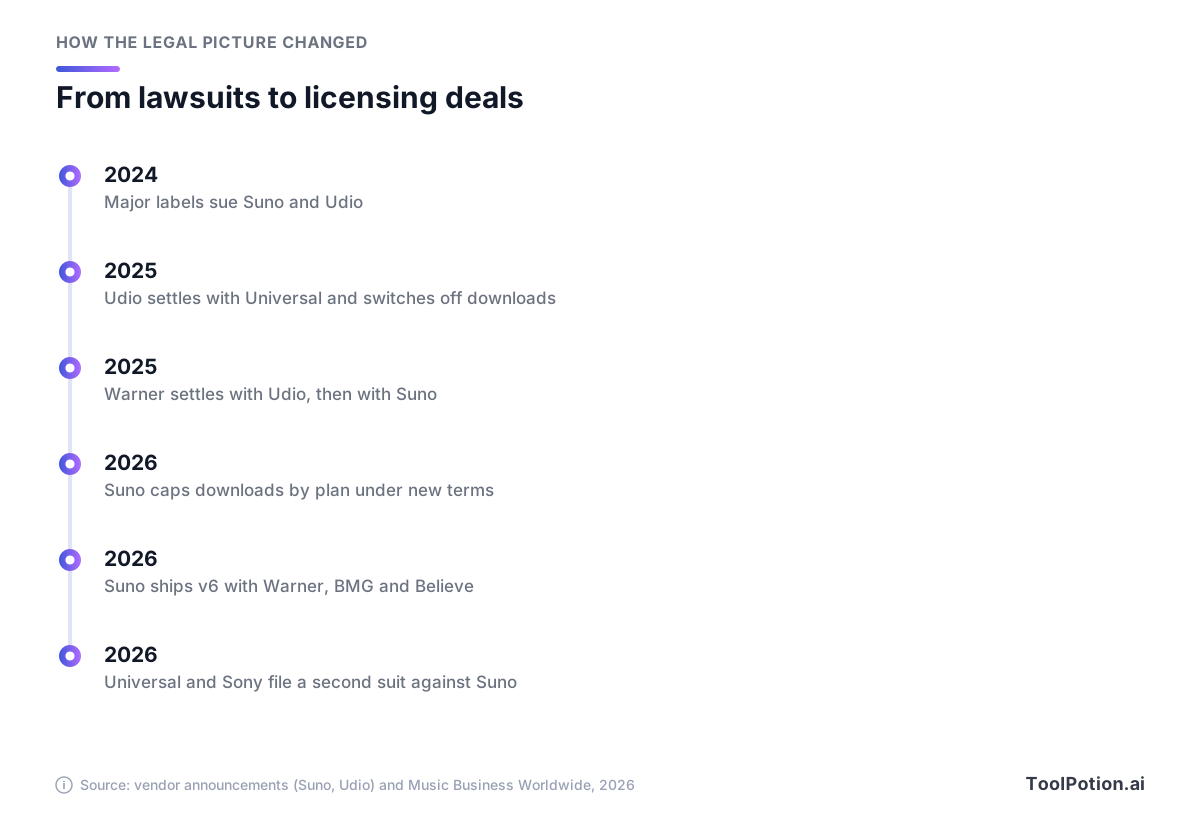
Read the timeline as a cause and effect chain. Udio's switch-off of downloads came with its Universal deal. Suno's download caps and watermarking followed its Warner deal, and Suno says the limits exist to make it harder for bad actors to mass-export music (Suno). We found no label lawsuit against ElevenLabs Music, which is part of why its terms read like a normal software license.
Plans, prices and rights side by side
Prices below are US list prices for monthly billing. Suno and ElevenLabs we read on their own pricing pages, with ElevenLabs confirmed on a US-crawled copy. Udio's pricing page only loads in the browser and we couldn't confirm its US dollar prices, so its rows show credits instead.
| Plan | Price | Commercial use | What limits you |
|---|---|---|---|
| Suno Free | $0 | No, personal only | 7 lifetime trial downloads for existing free users |
| Suno Pro | $8 | Yes, on downloaded songs | 20 downloads a month, 2,500 credits |
| Suno Premier | $24 | Yes, on downloaded songs | 60 downloads a month, 10,000 credits, unlimited Studio exports |
| Udio Standard | Not confirmed | Moot: no downloads | 2,400 credits a month |
| Udio Pro | Not confirmed | Moot: no downloads | 6,000 credits a month |
| ElevenLabs Free | $0 | No, personal only | About 11 minutes of music |
| ElevenLabs Starter | $6 | Yes, no streaming release | About 33 minutes of music |
| ElevenLabs Creator | $22 | Yes, includes Spotify and Apple release | About 134 minutes of music |
| ElevenLabs Pro | $99 | Yes, includes Spotify and Apple release | About 667 minutes of music |
Sources: Suno's pricing page and download announcement, ElevenLabs' Music page and pricing page, and Udio's help center for credits.
Two things in that table are easy to miss. First, Suno's cheapest paid plan is also its most limited on downloads: 20 a month is fine for a creator posting a few videos and tight for anyone making music in volume. Second, ElevenLabs charges by minutes generated, not by tracks kept, so a few extra takes eat into the allowance. The plan page lists about 33 minutes on Starter. The legal exhibit in ElevenLabs' music terms lists lower monthly generation caps (17 minutes on Starter), and a limited-time credit bonus was running on higher plans when we checked, so treat the minute counts as approximate.
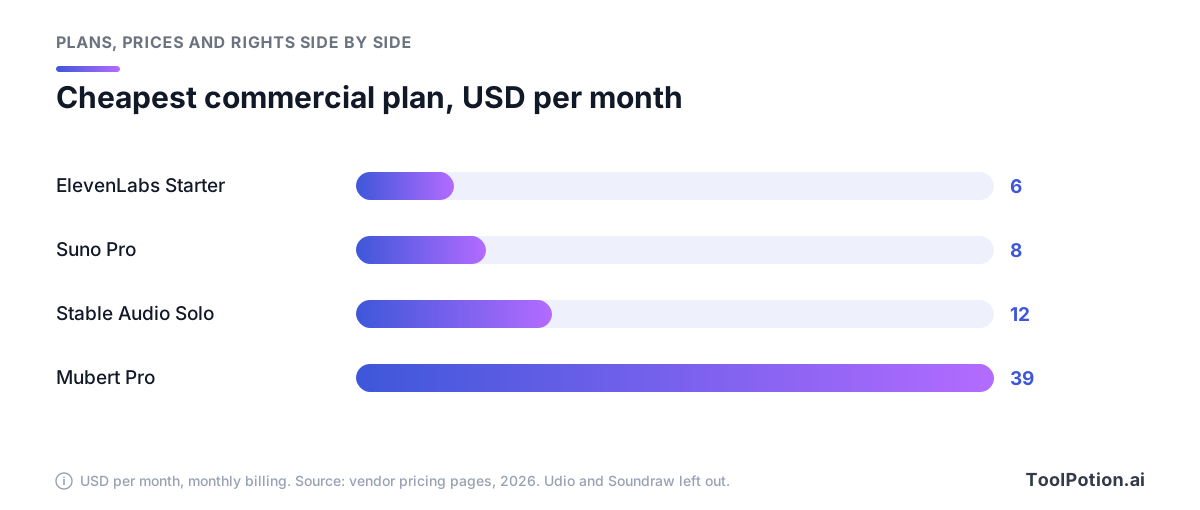
Cheapest isn't the same as best. The chart ranks only entry prices for plans that include commercial use. Mubert sits at the top for reasons we get to in the alternatives section. Soundraw is missing because we couldn't confirm its US dollar price.
Commercial rights come in layers
Commercial rights are not one yes or no. They stack. Whether the model's training data was licensed is the first layer, and it's the one you can't see or control. Your plan's terms are the second, and that's where you have a choice. After that comes the file you actually saved, and then wherever you post it.
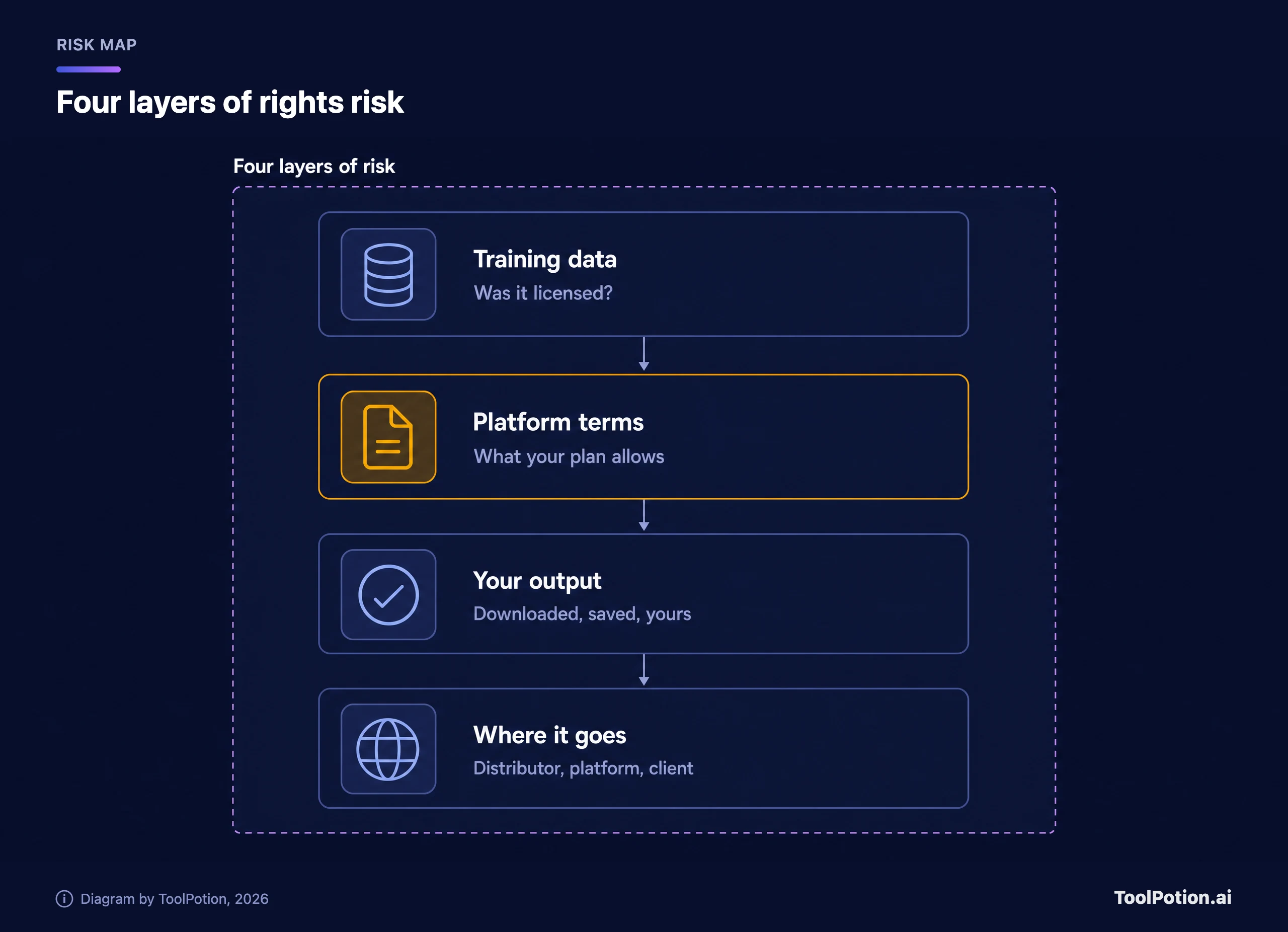
Suno's terms show how specific the second and third layers have become. Commercial use is allowed only for output you've obtained as a permitted download, in line with your tier's allowance, and not for songs you never downloaded. The right to a given download is perpetual, so cancelling later doesn't pull it back. Free accounts are limited to personal, non-commercial use, and so are remixes made with Suno's remix feature, whatever your plan (Suno terms). Suno also says it can add a fingerprint or watermark that records the tier and whether the file was a permitted download. It says it screens uploads with third-party tools and never allowed prompts for specific artists. That is useful to know if a distributor ever asks how a track was made.
ElevenLabs draws the line somewhere else. Self-serve plans allow online and offline commercial use except for film, TV and Studio Games. The legal terms also list radio as excluded. Enterprise plans allow all of it (ElevenLabs). Its music terms also ban prompts that name artists, songwriters, song titles, labels or big chunks of existing lyrics, (ElevenLabs Music terms). ElevenLabs' general terms of use also warn that your output may not be unique and may match what other users receive. If you want exclusivity, no tool here promises it, and that's worth knowing before you build a brand around one jingle.
Use the checker to test your own case. It encodes the rules above, and the vendors change them often, so confirm anything that matters on the terms page itself.
One more caution. Suno's terms say it makes no promise that any copyright will vest in the output. Owning the download license and owning a copyright aren't the same thing, and that matters if you ever need to stop someone copying your track.
Stems, vocals, length and editing
On features, Suno is ahead of the other two for people who want to work on a track after generating it. Stem separation comes in three modes: Auto Split can break a track into up to 12 stems, Split from Mix pulls out one element and gives you everything else as a second file, and Advanced Split can search close to 100 instruments. The first two are on Pro and Premier, the third on Premier only (Suno). Premier also includes Suno Studio, which now has MIDI, automation and plugin design, and exports multitracks and stems at 32-bit/48kHz without download limits.
Suno v6 also lets you edit part of a song in plain language, swap one lyric, or build a mashup from several sources (Suno). Premier also raises the upload limit to 30 minutes.
ElevenLabs Music v2 focuses on long-form composition, mid-song genre changes and inpainting: select a section and regenerate only that part. It supports English, Spanish, French, German, Japanese and others. Stems start at 2 and 4 on Starter and Creator and reach 6 on Pro, and the plan page puts lossless WAV on Creator and up (ElevenLabs). If you already pay for ElevenLabs voices, it lives in the same credit pool, as the ElevenLabs AI Voice Generator does.
Udio's strengths are on the editing side, where it offers extend, remix, inpainting and Styles. But with stems and audio downloads disabled, those tools have nowhere to send the result.
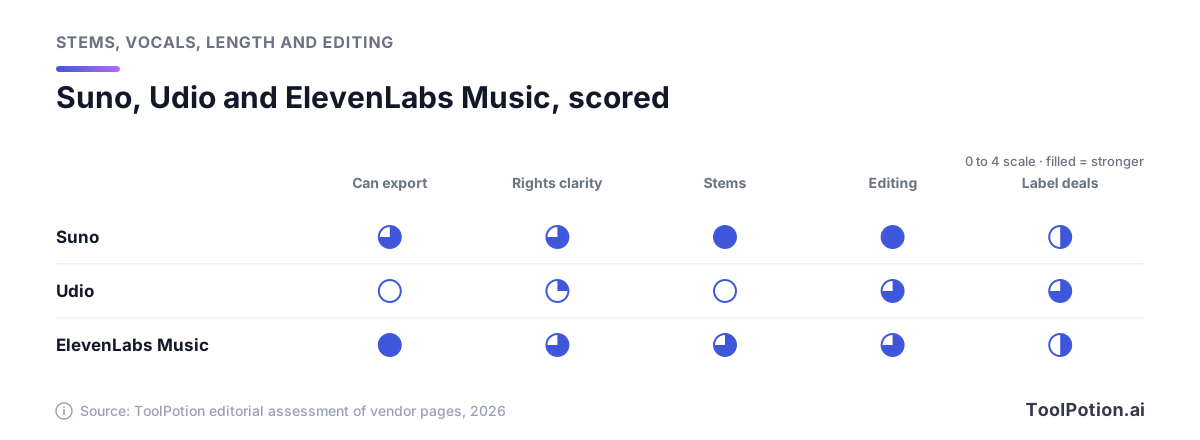
The scorecard is our judgment from the vendor pages, not a listening test. Suno wins on stems and editing depth. ElevenLabs wins on a clean export and plain rights. Udio loses because export is off, and its rights score is low for the same reason.
From prompt to published track
The order of operations matters more than it used to. Pick the tool after you know where the track is going, because the use case decides which plan you can legally buy.
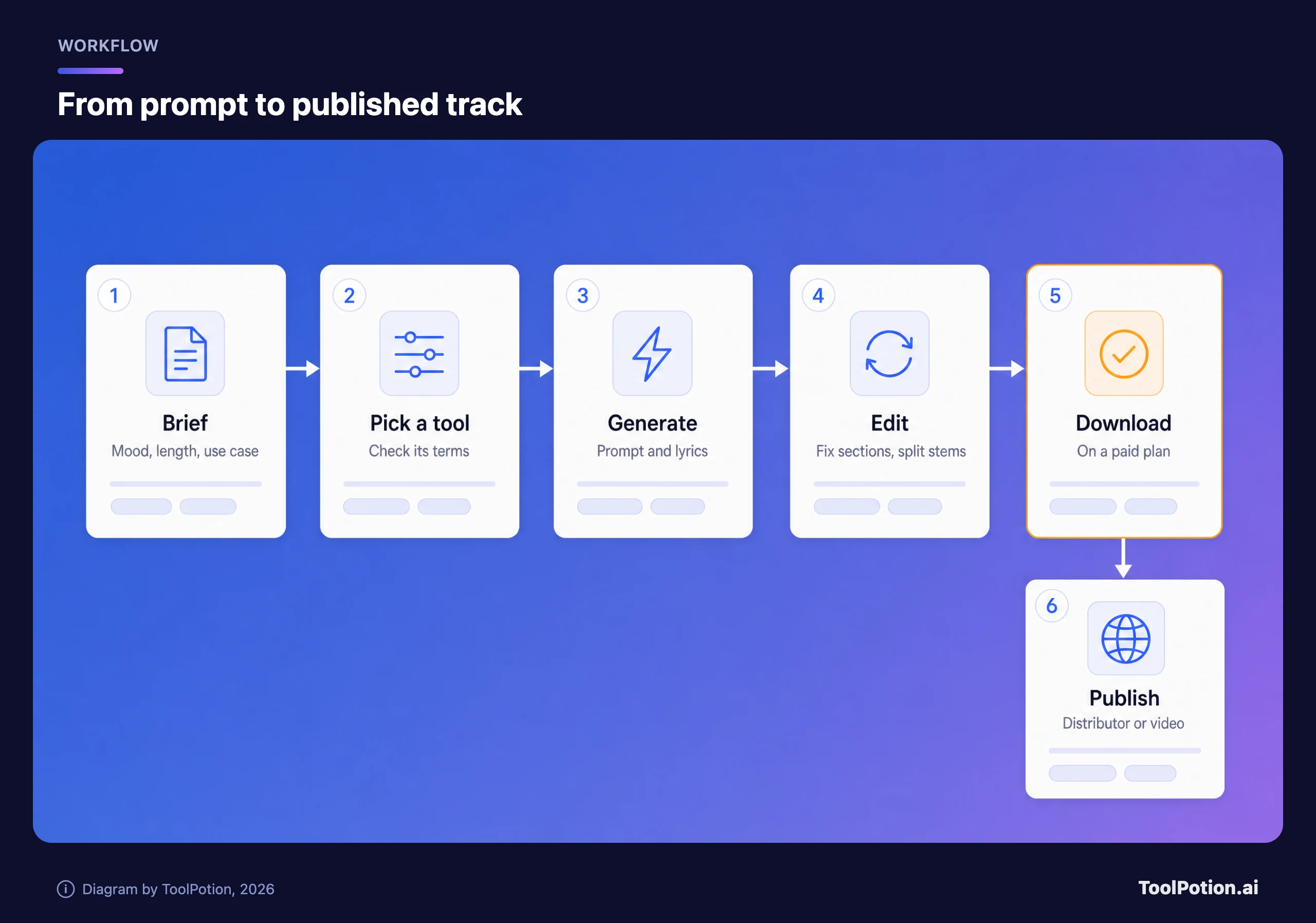
Step five is the one people skip. On Suno the license attaches to the download, so generate freely but download only the keepers, and count them against your monthly cap. On ElevenLabs the meter runs on generation, so keep takes short while you're auditioning.
For release to streaming services, check the distributor before you pay anyone. Suno says Believe and TuneCore earlier said they wouldn't distribute music from models that didn't meet their standards, including Suno's models at the time, and that tracks from its new industry-partner model will be eligible through them (Suno). That's Suno's account of a deal, so confirm the current rules with whichever distributor you use. For video work, our guides to AI video editors and the AI video editors board cover where the music will actually land.
Safer options for royalty-free use
If the point is a license you can defend, a tool trained on its own catalog, or sold under simple commercial terms, removes most of the legal noise. None of these make vocal songs the way Suno does. They are better for background music, video beds and loops.
| Tool | Entry paid price (USD) | What the vendor says about rights |
|---|---|---|
| Soundraw | Creator plan, price not confirmed in USD | Trained only on music it makes in-house. Monetization on streaming platforms allowed, and tracks stay licensed for life after you cancel |
| Stable Audio | $12 Solo | Commercial license on paid plans. Free is personal and non-commercial. Tracks run up to 6 minutes |
| Mubert | $39 Pro | Pro is the commercial tier. The $14 Creator plan is non-commercial, and no tier allows streaming release or Content ID registration |
| AIVA | EUR 33 Pro, annual billing | Pro owns the copyright to you; lower tiers keep it with AIVA and limit monetization |
Sources: Soundraw, Stable Audio, Mubert and AIVA's pricing page. AIVA prices in euros.
The Mubert line deserves a second look. Its mid-priced plan sounds like the sensible choice and isn't commercial, and even the Pro tier forbids putting tracks on Spotify or registering them in Content ID. It's built for apps, ads and client work, not for releasing songs. Soundraw makes the strongest commercial statement of the four. Its archived page shows euro prices and we couldn't confirm a US dollar figure, so check the price on the page before you subscribe.
For a wider look, browse the audio, voice and music board or the AI audio editors board, and our roundup of audio editors. If you only need stems from music you already own, a splitter such as AudioShake is a different tool for a different job.
Which one to pick
Pick by use case, not by who has the best demo.
- A YouTuber or podcaster who wants songs with vocals and a cheap start should take Suno Pro and download only what they publish.
- A marketer making ads, branded video or app audio should take ElevenLabs Creator, which includes Spotify and Apple release and lossless WAV, and avoid it for film, TV and radio unless they go Enterprise.
- A producer who wants to rework tracks in a DAW should look at Suno Premier because of Studio and the stem modes.
- Anyone whose client demands a warranty about training data should skip all generative song tools and use a library-style option such as Soundraw.
- Udio is worth a look only as a place to experiment until it ships exports again.
Volume changes the answer, so run your own month. Suno counts downloads. ElevenLabs counts minutes.
If you're comparing how vendors meter usage in general, our guide to credits, seats and tokens explains why a cheap plan can still run dry.
Frequently asked questions
Can I monetize Suno songs on YouTube?
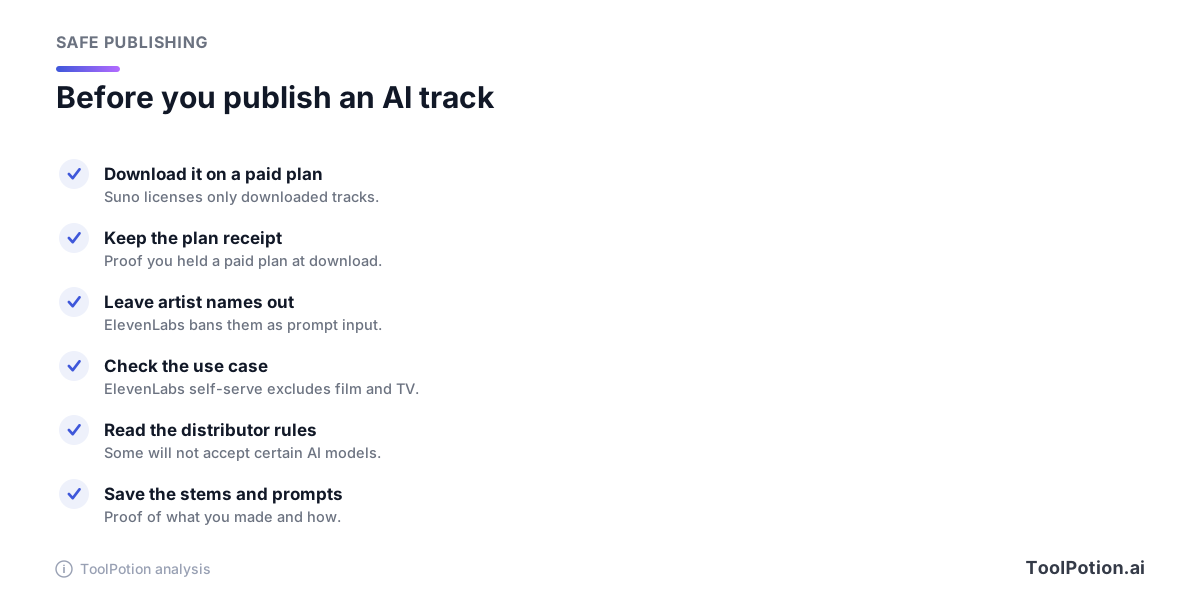
On a paid plan, yes, for songs you've downloaded. Free-tier output is personal use only, and so are remixes made through Suno's remix feature. Keep the plan receipt and the downloaded file.
Why did Udio turn off downloads?
It was part of the settlement and licensing deal with Universal. Udio said downloads were unavailable during a transition while it prepared a licensed platform. Its Warner deal later resolved that lawsuit too, and Udio told users the same transition terms still applied.
Is ElevenLabs Music safe for client work?
For ads, branded content and video it is the clearest of the three, as long as you're on a paid self-serve plan. Film, TV and Studio Games need an Enterprise agreement, and the output may resemble what other users get.
Do I own the copyright to AI music?
Not necessarily. Suno's terms say it gives no assurance that copyright will vest in any output, and ElevenLabs says outputs may not be unique. A commercial license lets you use the file. It doesn't guarantee you can stop others from copying it.
Will the lawsuits change my rights later?
Suno says rights on a downloaded track are perpetual, even if plans or allowances change. The lawsuits could still change the products you buy next, as the Udio download switch-off showed. Download and keep what you plan to publish.