Pick Lovable if you're a non-developer who wants a working web app with the least friction. Pick Bolt if you want fast, browser-based scaffolding (mobile included, through Expo) and you'll watch your token meter. Pick Replit if you want a full workspace, or you're a developer who'd rather have a shell than a chat box.
That's the short answer, and it holds up better than most hot takes because the three have converged. All of them turn a prompt into a hosted app with a database behind it. The real differences sit in how they bill you, where your code can go afterwards, and what happens when the AI gets stuck.
Prices and limits below come from each vendor's own pages and docs as they stand in 2026. These products change plan details often, so check the live page before you pay.
How each one charges you
This is where people get surprised, so it comes first. Each tool meters something different, and the unit decides how a bad afternoon feels.
Lovable sells credits. Its Pro plan is $25 a month and starts at 100 credits, with Business at $50 for the same starting tier (Lovable docs). The free plan gives you 5 build credits a day, capped at 30 a month. A credit isn't a flat price per message. Plan Mode costs 1 credit per message plus any research it runs, and Lovable's own examples show the range: "Make the button gray" costs 0.50 credits, adding authentication costs 1.20, and a landing page with generated images costs 2.00. Unused monthly credits expire after two months, and top-ups on Pro are $15 for 50 credits (Lovable credits docs).
Bolt sells tokens. The free plan allows 300K tokens a day and 1M a month. Pro is $25 a month and starts at 10M tokens with no daily limit, and unused tokens roll over for one more month (Bolt pricing). A smaller project uses fewer tokens because Bolt has less code to read, so every message gets pricier as the project grows. That's a quiet tax on success.
Replit is the odd one out. Core is $20 a month ($18 if you pay yearly) and includes $20 toward more powerful models, while Pro is $100 a month with $100 toward the top models (Replit pricing). Beyond the free mode, Replit uses what it calls effort-based pricing. Paid work is charged per checkpoint based on how complex the request is, so a simple fix costs less than a big build. Replit says it asks for confirmation before a paid action starts, and you can set budget limits that act as hard caps (Replit billing docs).
One thing to watch on Replit: the same credits also pay for published apps, storage and databases. In the paid path, Plan Mode can run up charges even when it changes no code. The table lines up every paid plan so you can compare them side by side.
For a beginner, Lovable's model is the easiest to reason about because you can open a reply's menu and see what it cost. Replit's spend caps are the best safety net. Bolt's token meter is the hardest to predict, mostly because project size feeds into it.
What you can actually build
All three can produce a front end, a backend and a database from chat. The marketing pages say "full-stack" and for once that's fair. The differences show up in the backend choice.
Lovable hosts your app and includes Cloud, a built-in backend with a database, storage, authentication, realtime and functions. Its docs say Cloud is built on Supabase's open-source foundation (Lovable docs). You can also connect your own Supabase project on new projects, but you pick one or the other up front. The docs say migrating from Supabase to Cloud isn't supported, and moving from Cloud to your own Supabase means exporting data and rebuilding the schema.
Bolt creates a built-in database when your project needs one. It doesn't add a login screen by default, so you have to ask for sign-up and sign-in. Supabase is an option only on Pro or Teams plans, and only if you choose it when you start the project, with no supported way to migrate an existing Bolt database later.
Replit runs a managed PostgreSQL database for Agent projects, plus App Storage for files, and its docs show Agent building native mobile apps, data dashboards and slide decks as well as web apps.
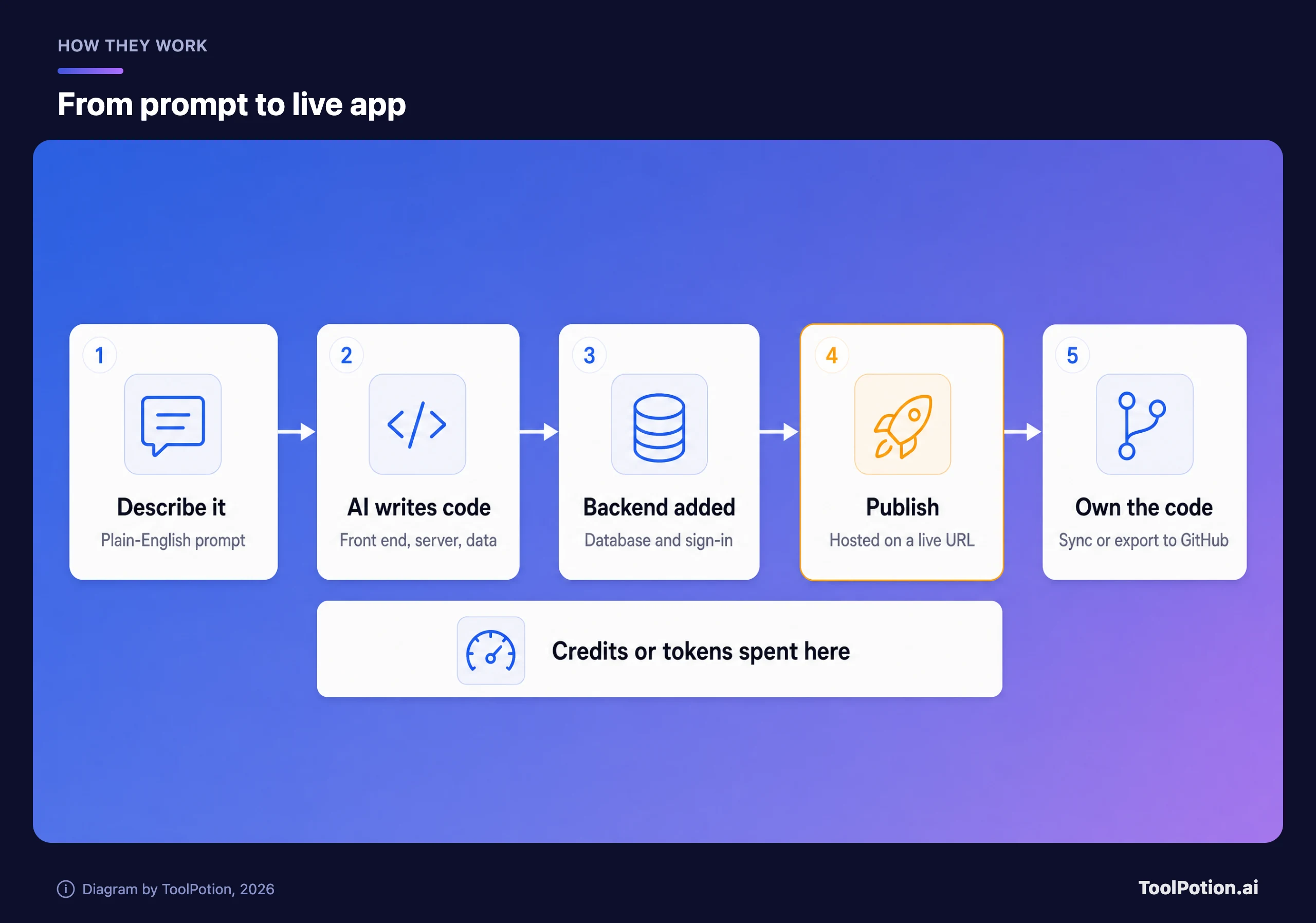
In practice, the first working version of a simple app takes any of them a handful of prompts. The pain starts later, with the third and fourth feature, which is also where your credits go.
Hosting, domains and who owns the code
Hosting is included on all three. Lovable says your plan doesn't cap visitors or bandwidth, and running the app draws on credits, with a monthly grant that Lovable itself labels a temporary offering. Custom domains need a paid plan there. Bolt offers hosting on the free plan with up to 333K web requests a month, and Pro lifts that to 1M and adds custom domains. On Replit, the Starter plan includes one free published app that goes down after 30 days, and everything beyond that is billed by usage out of your monthly credits.
Ownership is the question that matters most if you plan to outgrow the tool. Lovable states plainly that you own your code and what you build. GitHub sync is on every Lovable plan, including Free.
Bolt's GitHub integration creates a private repository on a main branch and commits every time you make a change that doesn't break the project. It checks GitHub every 30 seconds for outside changes. If both sides change at once, Bolt keeps your changes and overwrites the GitHub version, so don't edit the same file in both places, according to Bolt's GitHub help page.
Replit's version control is Git underneath, with a visual Git pane, a full shell and checkpoints from the Agent. You can import a repository from GitHub, and the shell takes a personal access token for pushes. When you re-import an Agent-built app from GitHub, database values and secret values don't come with it, according to Replit's import docs.
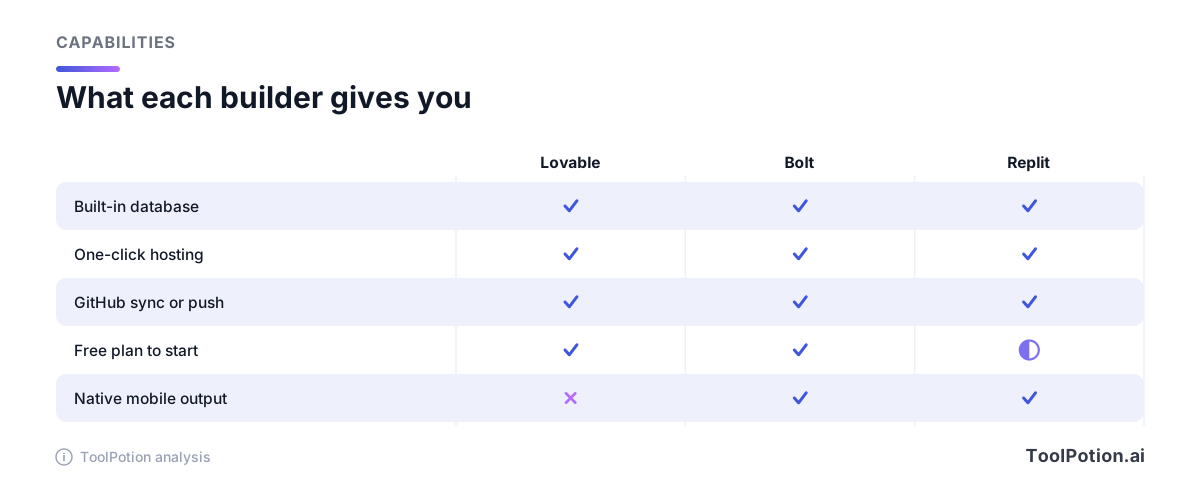
The practical advice is the same for all three. Connect GitHub on day one, even if you never plan to leave. A repo is your only real backup.
Phones and the new Google Play option
Mobile is where Lovable stands apart, because it's the only one of the three that doesn't build native apps. Replit's docs describe a Mobile app type in Agent, with previews in a simulator or emulator and on your own phone through Expo Go. Publishing to the App Store goes through a TestFlight flow and needs an Apple Developer Program membership (Replit docs).
Bolt gets there through Expo. Its help center says that when you ask for a mobile app, Bolt uses Expo to build for iPhone and Android, with publishing to TestFlight and the App Store or to Google Play beta and the Play Store. Say so in your very first prompt, because web projects don't switch to mobile easily (Bolt help center).
Lovable's own FAQ is blunt. It builds web applications and doesn't generate React Native projects. If you want an installable app, the docs point to a Progressive Web App or to wrapping your published URL with a tool such as Capacitor outside Lovable (Lovable docs). Lovable also ships an iOS and Android app, but that's for building from your phone, not for producing an app.
There's also a news item that changes the math for personal tools. Google Play now lets people build and run private, vibe-coded Android apps. You make the app in Google AI Studio and launch it on your own device through Play with your normal Google account. These apps don't appear in Play search, and only the creator can open them. Sharing with a few friends or family is planned for the coming months, and the first rollout is limited to US users aged 18 and up (TechCrunch).
TechCrunch's report doesn't mention Lovable, Bolt or Replit, and it describes AI Studio as the building tool. Still, it matters for this comparison. If what you want is a private app for yourself or your family, you may not need any of the three. If you want something other people will use, you're still in app builder territory.
Where each one gets stuck
Every AI builder has the same failure mode. Something breaks, you ask the AI to fix it, the fix breaks something else, and you ask again. Each round costs credits or tokens.
Bolt's own help center is blunt about this. It says repeated clicks on "Attempt fix" waste tokens, and that if automatic fixes fail you should stop and investigate the error yourself. Its other tips apply to every tool here: use Plan mode to agree on a fix before changing code, ask for logging around the failing area, and roll back to a previous version instead of re-prompting, because restoring a version costs no tokens (Bolt help center).
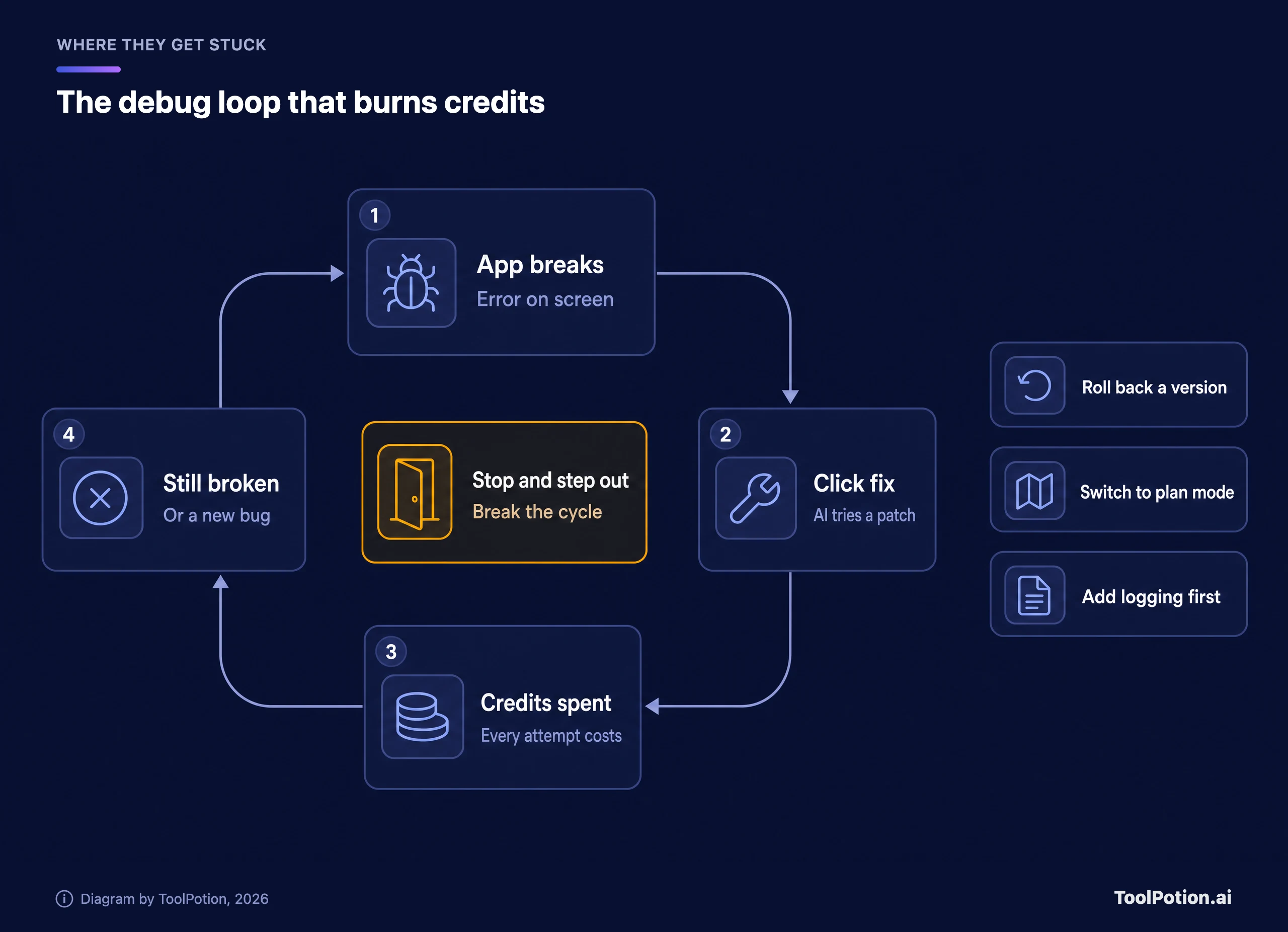
Lovable's Plan Mode, at 1 credit per message, is built for the same job, and checking the per-message cost in the history helps you see a loop forming. Replit's budget limits stop a runaway session before it empties your balance, though the docs note that once you hit a limit, usage-based services are blocked until the next cycle or until you raise it.
The honest pattern across all of them is that small, specific prompts beat big vague ones. Ask for one change, test it, and move on. A vague "make it better" is the most expensive sentence you can type.
Security basics before you share a link
A generated app that works in preview isn't the same as a safe app. The usual trouble is the database. A table without row-level security rules can be open to anyone who can reach the API, and switching RLS on with no policies makes the API return nothing until you write some.
Lovable runs a quick scan automatically every time you publish. It flags tables without per-record access control, rules that let everyone through and other issues. A deeper scan you start manually checks for leaked secrets in code and server code that bypasses database rules. If you paste an API key into the chat, Lovable detects it and tells you to store it in Secrets. Lovable also says these tools can't guarantee complete security and recommends a professional review for apps that handle sensitive data (Lovable docs).
Bolt has two checks. A database security check flags things like an open permission or a missing RLS policy on any plan, and a project security audit reviews your code and database on paid plans, with neither using your tokens. Replit's Security Center scans project dependencies for known package vulnerabilities, but its docs describe that as a package-level check and not a review of your database rules, so verify those yourself.
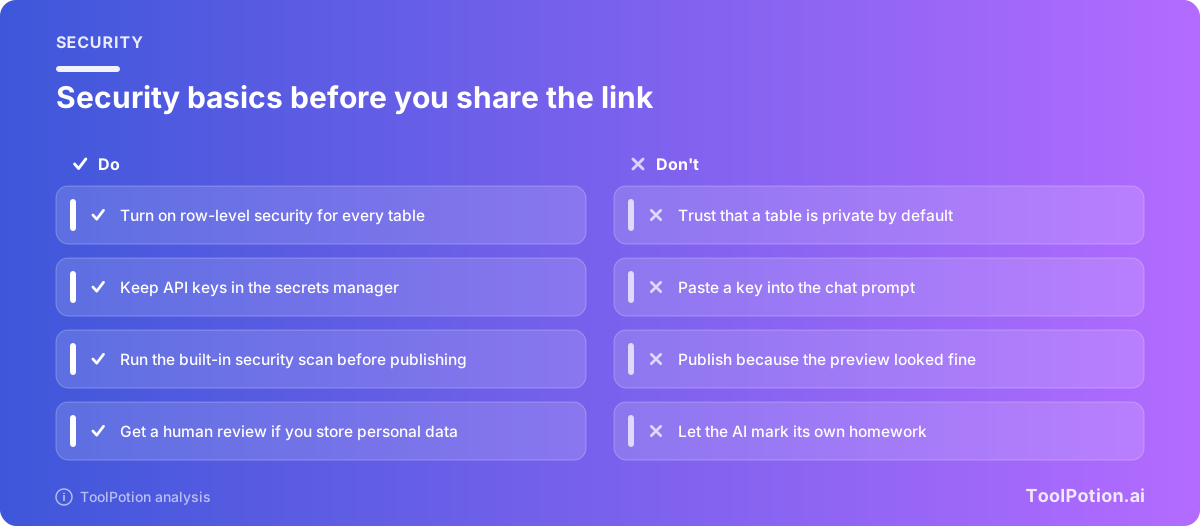
Two rules cover most of the risk. Never put a secret key anywhere the browser can see it. And don't store other people's personal data in a generated app until someone who reads code has looked at it.
Matching the tool to the job
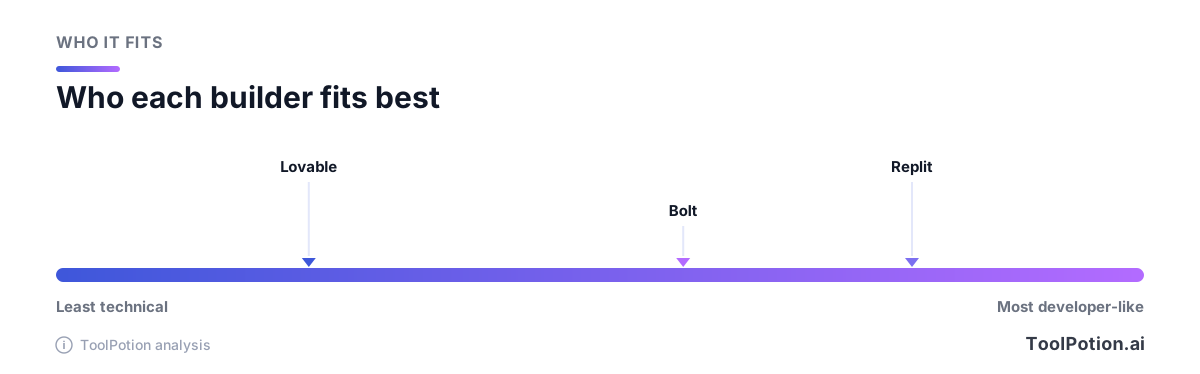
The placement above is our editorial read, not a benchmark. For a non-developer founder, Lovable is the gentlest start. You describe the product, get a hosted app with accounts and a database, and see what each message cost. Look through Made with Lovable to see what real projects look like.
For a designer prototyping, the winning feature is cheap iteration. Bolt's free tier and rollbacks suit throwaway experiments, and Lovable's GitHub sync lets a developer pick up the work later. If the prototype has to live on a phone, Bolt's Expo route is worth a look.
For a developer who wants speed, Replit gives you a real workspace and a shell, with Replit Agent doing the scaffolding. If you want a different flavor of builder altogether, look at Anything, Rocket or Softgen.
Still undecided? This chooser walks the same reasoning in three questions.
If your answer was close, don't agonize. An hour of building on a free tier will teach you more than another hour of reading reviews. Our ranked list of AI app builders, the AI app builders hub and the longer roundup of twelve of them cover the wider field.
A sane way to start
- Build the same small app in two tools on their free tiers, and compare what each one cost you.
- Connect GitHub before you write feature two.
- Turn on row-level security and run the built-in scan before you share any link.
- Set a budget cap or watch the per-message cost, and stop after two failed fixes.
- Decide early whether you need a native phone app, since that rules out Lovable.
Frequently asked questions
Which is cheapest?
On entry price, Replit Core at $20 a month is the lowest, with Lovable and Bolt Pro both at $25. But the units differ, so the monthly bill depends on how often you hit snags more than on the sticker price.
Can I use these without knowing how to code?
Yes, all three are built for that. You will still hit moments where reading an error message or checking a database rule saves you money, so expect to learn a little.
Do I own what I build?
Lovable's pricing page says you own your code and outputs, subject to third-party rights in the underlying AI models. Check the terms of the others before building a business on them.
Is Bolt in our directory the same as Bolt.new?
The builder many people mean is Bolt.new. Our directory lists it as Bolt.new and as the Bolt AI Builder page we link above. Don't confuse either with the unrelated desktop assistant that also uses the Bolt name.
Do I need Supabase?
No. Lovable and Bolt both include their own databases, and Replit has a managed PostgreSQL one. Choose Supabase if you want your backend in an account you control directly, and pick it before the first build because moving later is awkward.