A traveler asks an AI agent to find a flight and book it. The agent finds the flight. Then it hits a wall that didn't exist a year ago: United says it won't let personal AI agents book on its airline, and while agents can still show its flights, they can't finish the purchase (The Verge). eBay, meanwhile, has written a ban on exactly this kind of shopping into its user agreement, and by the look of it started enforcing it on browsing too (The Verge).
Both moves are recent and still being clarified, so this guide sticks to what each company has said on the record. After that comes the part you can use: what still works, which route to take, and how to keep an agent from costing you money or miles.
What United blocked, and what it left alone
United announced that it is banning AI agents from making flight reservations on a traveler's behalf, citing security risks and the chance that such actions could break federal rules (CBS News).
The airline's own wording is specific. Sharing account credentials with "personal, third-party, AI assistants can expose sensitive information, and actions taken by these tools may result in unintended purchases, account changes, or use of MileagePlus miles." United says it is taking steps to restrict access "directly within our digital platforms and indirectly via travel agencies and aggregators," and it is updating its booking and ticketing policies to match (CBS News).
The ban covers the transaction, not the search. Agents can still show you United flights, according to The Verge, but they can't finish the booking. The airline's second argument is regulatory: using an agent to check in, for example, could violate federal rules that require travelers to verify in person that their bags hold nothing banned (CBS News). The Verge's subhead puts it more bluntly, as agents being unable to attest that you don't have explosives in your bags (The Verge).
CEO Scott Kirby was blunter about the commercial side, as The Verge relays from the Wall Street Journal: "To be honest, I don't want to create another middleman." United also left a door ajar: "As third-party AI agents advance, we see the opportunities they present," it said, but it wants "established protections for travelers first."
There is one primary source we could open. United's contract of carriage now defines an "AI Agent" as software that takes autonomous or semi-autonomous action to "discover, search for, book, purchase, ticket, service or manage" United products, "whether or not Passenger or another individual supervises or approves its actions" (United contract of carriage). The page we could load showed that definition but not the rules that use it, so we can't say what exactly is prohibited. Still, the wording is wider than "no checkout." We wouldn't assume that an agent browsing United for you stays welcome, or that you pressing the final button makes an agent's work on United's site acceptable to the airline.
What United hasn't said is how it will detect an agent, or which of the many tools that might qualify it is actually stopping today. We couldn't find that detail in any of the coverage we read, so treat any claim about a specific blocked product with suspicion. United isn't alone among airlines, either: The Verge reported earlier this year that Delta is preventing agents from booking tickets for users (The Verge).
eBay put the ban in its terms, then closed the door
eBay's user agreement already forbids "any robot, spider, scraper, data mining tools, data gathering and extraction tools, or other automated means" to access its services, and its list of examples is explicit: "buy-for-me agents, LLM-driven bots, or any end-to-end flow that attempts to place orders without human review." The exception is "the prior express permission of eBay" (eBay User Agreement).
For a while, browsing was a gray zone. Then a reader told The Verge that his Meta Muse agent, which had curated a daily digest of watch listings for several weeks, suddenly reported it was blocked from eBay. The Verge reproduced the failure, and in some cases Muse sent users to outside sites that mirrored eBay listings (The Verge).
eBay wouldn't say whether it had imposed new limits. A spokesperson said the company takes "a selective approach to how they access and interact with our marketplace," has restricted access "in certain cases, including unauthorized scraping and training on our data," and is in talks with potential partners. So the accurate headline is the one The Verge used: eBay appears to have shut the door.
Four locks, and only one of them is the contract
When people hear "banned by terms of service," they picture a legal footnote. In practice a site has four places to stop an agent, and the contract is only the one you can read.
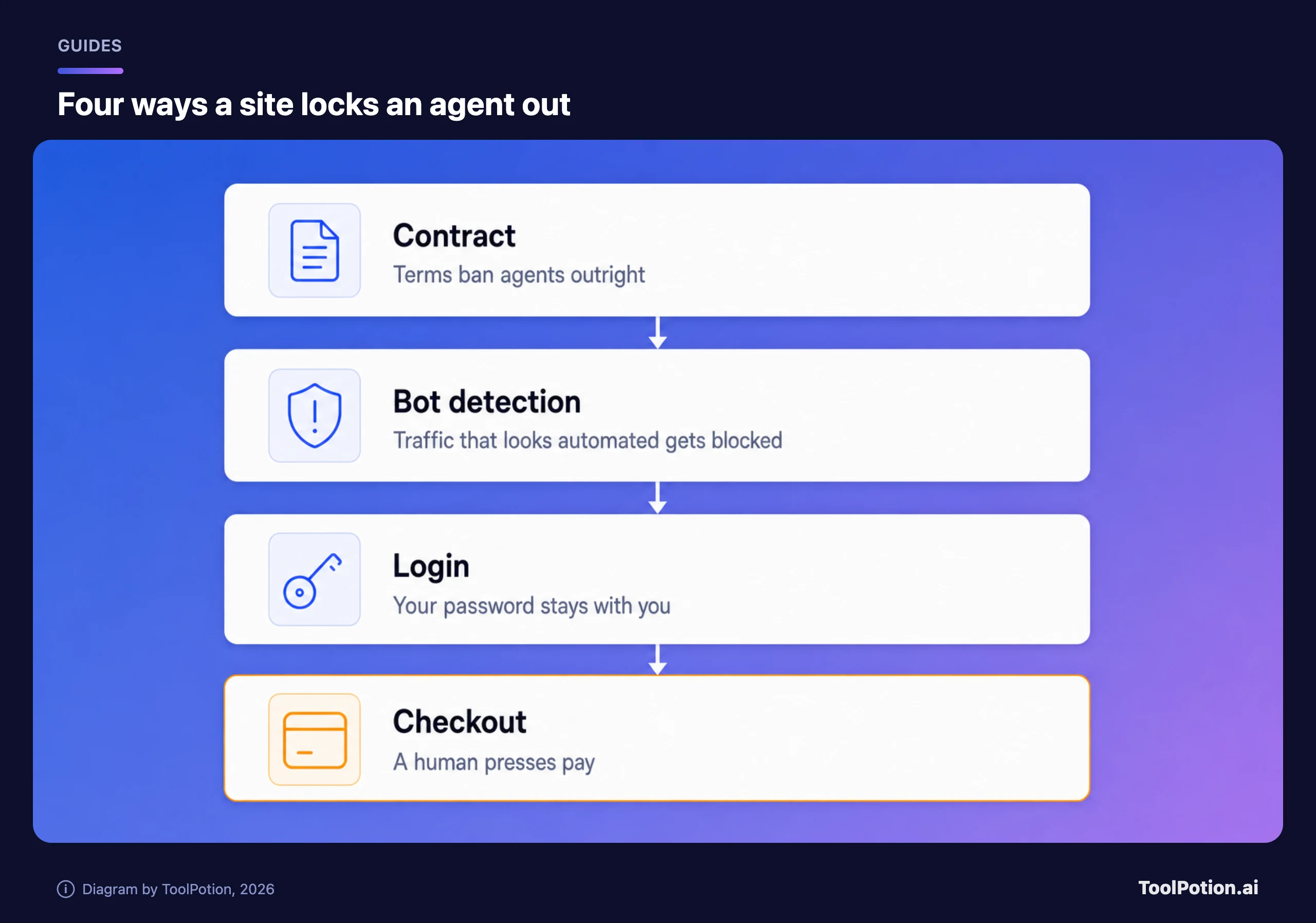
Bot detection is the one users actually feel. Chris Canal, CEO of the AI safety evaluator EquiStamp, told The Verge that "there are all kinds of things that are set up not even to block agents, but to block in general bots or programs that are trying to scam or hack," and that agents trigger those same safeguards (The Verge). Reddit reports in that story describe Google blocking some Muse accounts for "suspicious activity," and checkout trouble at Walmart despite its Meta partnership.
Which means a failed booking doesn't always mean a policy. Sometimes the agent just looks like a scammer's script. We'd keep that in mind before assuming any given site has declared war.
The reasons given, and the ones that weren't
The stated reasons are safety and compliance. They're reasonable on their face, and for United the attestation point is the strongest one on the table: a federal rule that wants a person to confirm something is hard to satisfy with software that has no body to stand at a counter.
The unstated reasons are about control. Henry Harteveldt, an aviation analyst at Atmosphere Research Group, told CBS that United doesn't want to add "yet another, and potentially even more powerful, intermediary" on top of Google search, metasearch sites and online travel agencies. In his words, "Flight searches cost airlines money," and he expects United wants to avoid the expense of a surge in AI bot searches (CBS News).
Amazon's long fight with Perplexity shows the other motive, though here the claim comes from one side. Perplexity responded that Amazon doesn't want agents roaming its store because it won't get as many human eyeballs in front of its ads. Amazon's position is that outside shopping agents "should operate openly and respect service provider decisions." An appeals court overturned an order that had stopped Perplexity's agents from shopping on Amazon, and Amazon has since filed an amended complaint (The Verge).
We think the safety argument is real for airlines. For eBay we can't find one: its spokesperson talked about preserving "the trusted end-to-end experience" and about unauthorized scraping, and the partner talks suggest the door isn't welded shut. Both motives can coexist. A company can have a genuine security worry and a commercial reason to be the only one holding the customer.
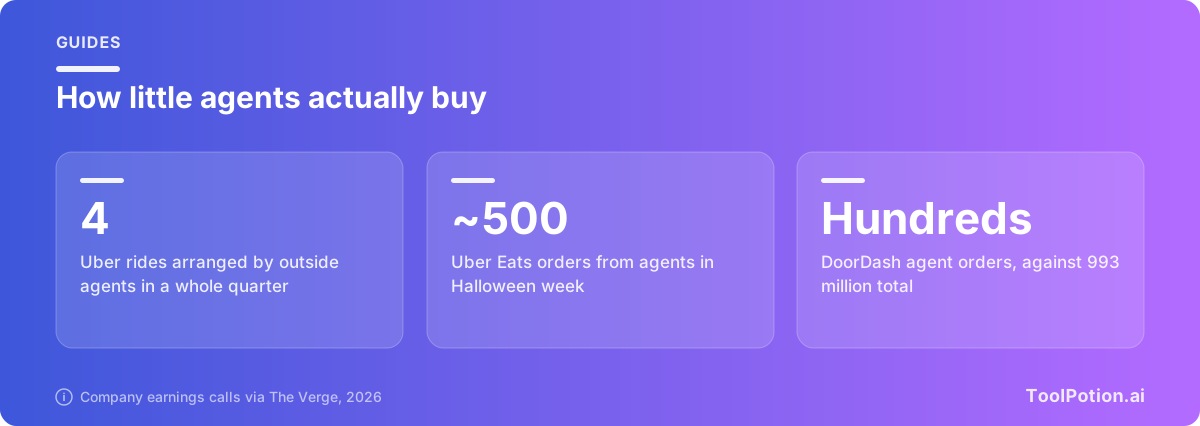
There's also a scale point that cuts against panic. Uber said outside agents arranged four rides in a whole quarter, and DoorDash said it fulfilled only "several hundred" agent orders against 993 million total (The Verge, The Verge).
Which agents this touches
The coverage names Meta's Muse, OpenAI's Dots, xAI's Grok and Instinct as agents users have seen blocked across top sites, along with Perplexity's shopping agent in the Amazon dispute (The Verge).
It does not say that ChatGPT's agent, Claude in Chrome or Gemini in Chrome were singled out at United or eBay, and we won't pretend it does. The rules are written against the behavior (automation completing a purchase without a person), so any of them can run into the same wall. For what each browser agent can and can't finish, our AI browsers guide goes tool by tool, and the individual pages for Claude for Chrome, Gemini in Chrome and Perplexity Computer list their current features.
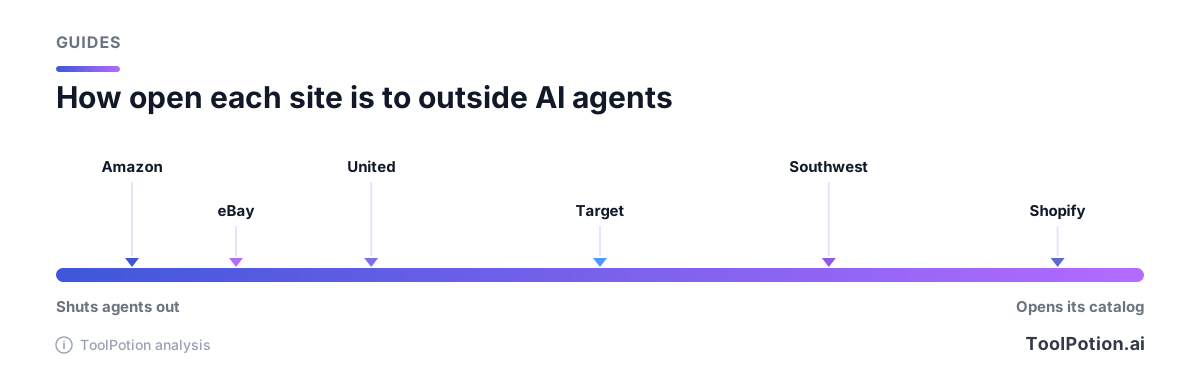
The placement above is our editorial reading of press reports, not a measurement, and sites change their stance without announcing it. Amazon is placed from The Verge's description of it blocking outside agents entirely, Target from its mixed browsing results, and Southwest from a single CBS line. Cars.com and Amtrak, per The Verge, may be quietly blocking agents too.
Who is going the other way
Southwest has made its flight inventory viewable to ChatGPT users (CBS News). Shopify opened a catalog of more than a billion listings so shoppers can connect any agent through their Shop account, with one-click checkout inside the conversation and a rule that buyers approve each purchase (The Verge).
Meta, instead of fighting Amazon, signed partnerships with Walmart, Gap, Sephora and Best Buy so Muse can shop there. Its stated view: "Turning away a personal agent means turning away the customer behind it" (The Verge).
OpenAI is working both ends. It is rolling out verified "Business Agents" in ChatGPT, so a brand's own agent answers shopping questions, initially for eligible US e-commerce and online service businesses (The Verge). And it hired Francis Davidson, founder of the travel agent Odessia, and TechCrunch says "this looks like an acqui-hire" (terms weren't disclosed). OpenAI confirmed the hire, Odessia has already been shut down, OpenAI hasn't announced a travel product, and it counts Booking.com, Expedia and KAYAK as customers or partners (TechCrunch).
Read that as a hint, not a launch. Nobody outside OpenAI knows what the Odessia hire becomes. If it's a booking agent, we'd expect it to arrive through partner deals like the ones above, not through a click-by-click bot that an airline's defenses have to guess about.
What happens to your protections when an agent books
This is the part nobody in the coverage answered, so we'll be careful. The federal credit card rules summarized by the FTC limit your liability for unauthorized charges to $50, and let you dispute billing errors, including charges for things "you didn't accept or weren't delivered as agreed," if you write to the issuer within 60 days of the bill (FTC).
Whether a purchase your own agent placed counts as authorized is the open question. We haven't seen a regulator or card network rule on it, and we aren't lawyers. What we can say is narrower and still useful. At eBay, an order placed through "any end-to-end flow" without human review is, by eBay's own text, a breach of the agreement, and we haven't read eBay's buyer-protection terms closely enough to say what that does to a claim. At United, the airline lists "unintended purchases, account changes, or use of MileagePlus miles" as the harms, which tells you where the argument would start if something went wrong.
Two habits cover most of the risk. Pay with a credit card, because the dispute rules above are written for them. And keep the final pay click yourself, which at least makes plain that you authorized the order; whether that settles a dispute is your issuer's call, not ours. Our guide to AI agents and your bank login covers why banks are blocking agents from accounts altogether.
A setup that works today
Here's the routine we'd follow, in order. It assumes you want the agent's speed on the boring part and your own hands on the part with money in it.
- Ask the agent to build a shortlist: three or four flights or products with prices, times, baggage rules and links. This is the part every site still allows.
- Open the links yourself, in your own browser session, and sign in there. Don't hand the agent your airline or marketplace password.
- Book on the site. If you use a miles account, check the total in miles before you confirm, since that is the exact harm United names.
- Pay by credit card, then compare the confirmation email with the agent's summary line by line (dates, airports, fare class, the name on the ticket).
- For a task a site officially supports, such as a Shopify store through Shop or a retailer on a partner list, let the agent go further, with a spending cap or per-order approval on.
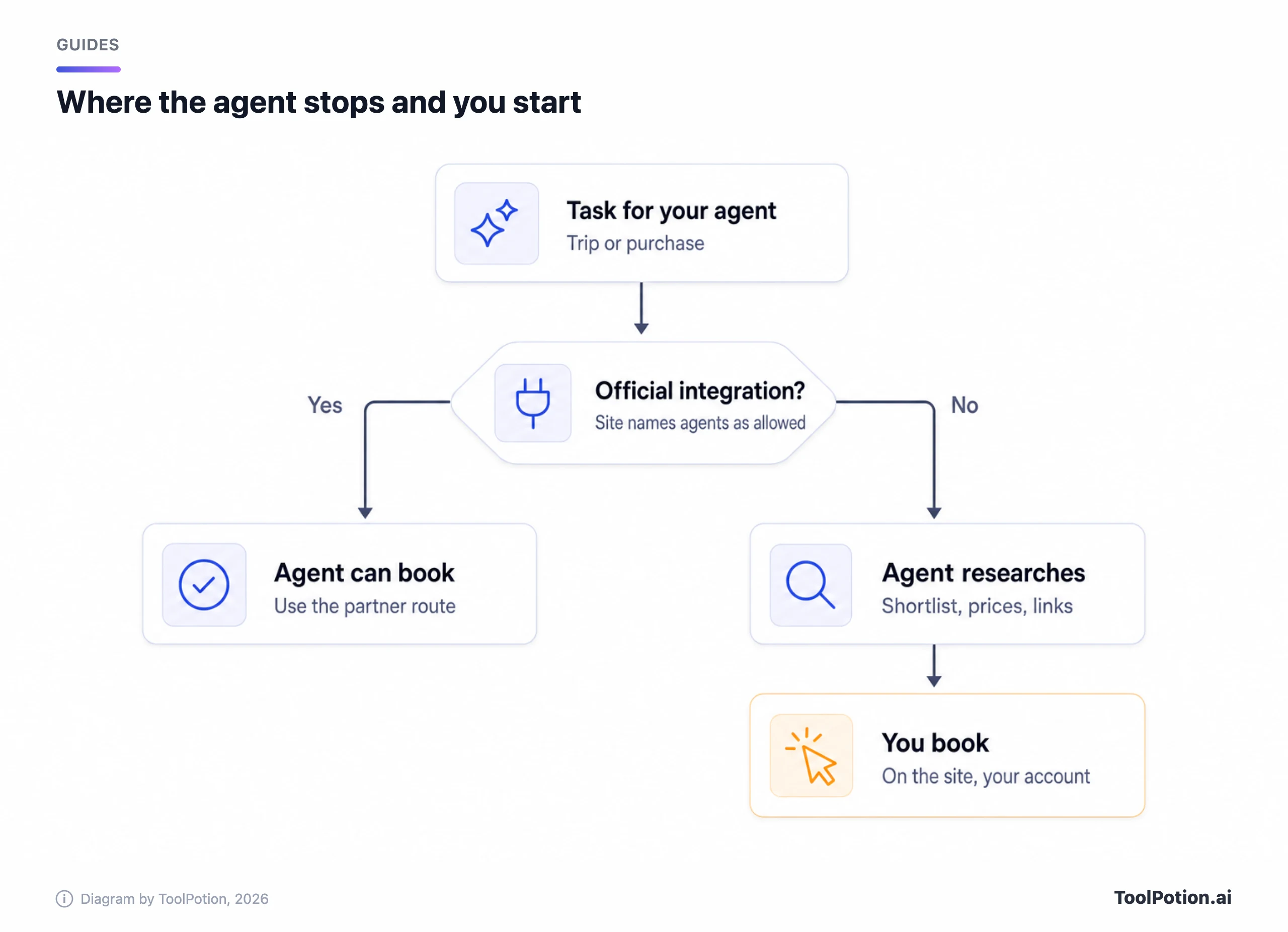
If the site isn't on a partner list, assume the agent researches and you buy. That costs you a few clicks. It doesn't cost you a booking that gets cancelled or an account that gets flagged.
For the research half, our boards list the tools people actually use: the Top 50 AI travel planners, the Top 100 AI shopping assistants and the Top 250 AI agents. If you want a broader start on delegating, how to start delegating safely walks through permissions.
Prefer an assistant that shows its work. We'd pick the one that lists each step and asks before paying over one that promises a finished trip. We'd also skip any tool asking for your airline login to "save time." United's statement names shared credentials as its first concern, and eBay's agreement bans automated flows that order without review, so a tool that needs your password is walking into both.
Where we think this goes
Our expectation is a split. Retail will mostly open through catalogs and partner programs, because Shopify and Meta have already shown that a partner route is cheaper than a lawsuit, and Amazon is the outlier that can afford to stand alone. Airlines will go slower. United's attestation argument gives it cover, and Southwest's opposite choice shows there's no industry line yet.
We doubt a blanket ban survives contact with customers who simply want it to work, but we also doubt the free-for-all of 2025's demos comes back. The likelier outcome is permission lists: agents that identify themselves, get named in the terms, and take on some of the liability. If a major airline signs one, our view of the whole fight changes.
Uber's CEO, Dara Khosrowshahi, put the current stage plainly: "It is just very, very early." Merchants selling into this should read our guide to agentic commerce for sellers. Everyone else should watch one thing: whether United's updated booking policy names an approved route or only a ban.
Frequently asked questions
Can I still use an AI agent to search United flights?
Yes. Per The Verge, agents can still show you United flights. What they can't do is complete the booking on your behalf (The Verge).
Will my United fare show up on Kayak or Google Flights?
Aviation analyst Henry Harteveldt told CBS that United fares will stay bookable through aggregators such as Kayak, Hopper and Google Flights, although United says it is restricting access indirectly through travel agencies and aggregators too (CBS News). Booking there yourself, without an agent, is the route the ban doesn't target, though United hasn't said how it will police aggregators.
Is eBay's ban on buy-for-me agents new?
The clause sits in the current user agreement (eBay). The Verge reports it was added in an update, but the browsing block that users noticed appears to be more recent, and eBay hasn't confirmed it (The Verge).
What if my agent buys something wrong?
Start with your card issuer's dispute process and keep the order emails. Whether an agent-placed order is treated as unauthorized isn't settled in anything we've read, so don't count on the $50 cap applying. This isn't legal advice; your issuer can tell you how it treats the case.
Will OpenAI's Odessia hire change this?
Not yet. OpenAI confirmed the hire but has announced no travel product. It works with Expedia, Booking.com and KAYAK already, so any booking feature is more likely to run through partners than through a bot on an airline's own site.