AI shopping agents now decide which products a shopper sees long before anyone decides where the shopper pays. That's where agentic commerce stands in 2026, and it tells a seller where to spend the next few weeks: on product data first and checkout plumbing second.
Last year's pitch was simple. You'd ask a chatbot for trail shoes and it would buy them. Some of that shipped. Google, Microsoft and Meta now let US shoppers check out inside their AI apps, and Shopify switched eligible US stores on by default. The biggest name went the other way. OpenAI retired ChatGPT's Instant Checkout earlier this year and now sends buyers to the merchant's own site (OpenAI). Most shoppers still use AI to research and press the buy button themselves.
This guide maps what's live, decodes the protocols and payment rails, shows what shoppers trust, and ends with a checklist and a 30-day plan. Shopify gets the most detail because that's where most of the switches already exist.
What's actually live in 2026
ChatGPT is a discovery surface. Ask it for a product and you get carousels with prices, reviews and comparisons, but the purchase happens on the seller's site or app. OpenAI's merchant page says shopping is live for US users, that Shopify and Etsy catalogs are already integrated, and that there are "no fees for purchases made on your site or app" (OpenAI). Other merchants apply to share a product feed and wait their turn on a waitlist.
Google pushes hardest on checkout. Its Universal Commerce Protocol (UCP), built with Shopify and co-developed with Etsy, Wayfair, Target and Walmart, puts a buy button on eligible listings in AI Mode and the Gemini app, paid with Google Pay (Google). It's US-only for now. Google says Australia and Canada follow next year, and at its developer conference it announced Universal Cart, a cart that tracks prices and stock across stores.
Microsoft Copilot runs Copilot Checkout on Copilot.com in the US. PayPal, Stripe and Shopify onboard merchants, and Shopify merchants are enrolled automatically, with an opt-out (Microsoft Advertising). Meta joined in recent weeks with Muse, a personal agent that can "open a browser, fill out forms" and pay with a one-time card from Stripe's Link (Meta). Shopify's Meta channel offers direct checkout to shoppers in the US, Canada and Mexico.
Perplexity sells through PayPal's Instant Buy, and Shopify's own guide says those orders are managed through PayPal rather than your Shopify admin. Amazon is the outlier, and it's worth watching even if you never sell there. It folded its Rufus assistant into Alexa for Shopping this year. The assistant can auto-buy an item when it hits a target price and use Buy for Me to purchase from other brands' sites, and Amazon says Rufus helped over 300 million customers in 2025. Outside agents get the opposite treatment. Amazon's robots.txt disallows ChatGPT-User, OAI-SearchBot, GoogleAgent-Shopping, Perplexity-User, Copilot and Meta's agent.
For the four surfaces where in-chat checkout is the open question, here's the state of play.
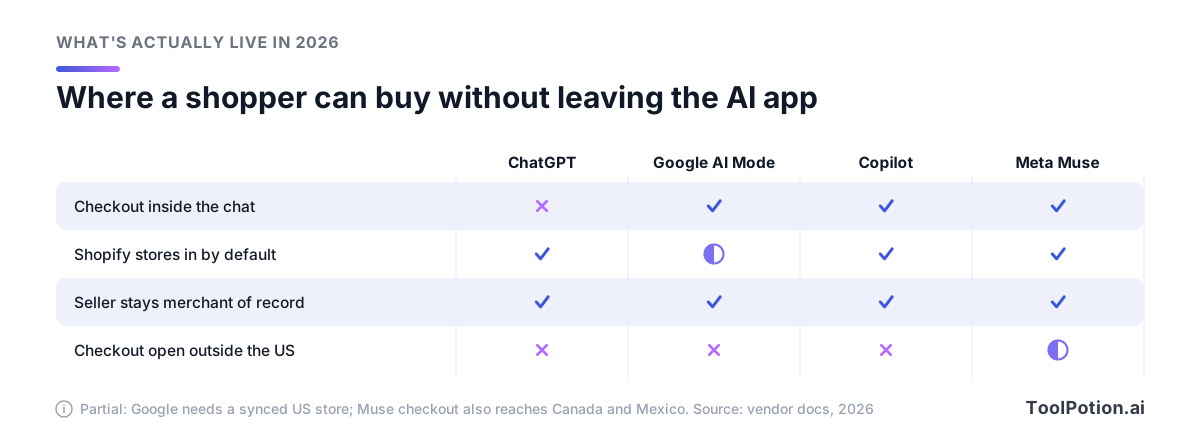
The pattern is clear. Everyone except OpenAI wants to host the checkout, and every one of them, OpenAI included, leaves you as merchant of record, responsible for shipping, returns and support. Retailers are building their own on-site agents as well. The AI shopping assistants board tracks that side.
The year checkout-in-chat stalled
OpenAI launched Instant Checkout with Stripe and the Agentic Commerce Protocol (ACP) last year, with Etsy sellers first. It never scaled. Forrester analyst Emily Pfeiffer told CNBC that roughly 30 Shopify merchants were live on it. Walmart, which made about 200,000 products buyable inside ChatGPT, found conversion rates three times lower for products sold in ChatGPT than for shoppers sent to its own site (CNBC). Etsy called its purchase volume relatively low.
We've found that the initial version of Instant Checkout did not offer the level of flexibility that we aspire to provide, so we're allowing merchants to use their own checkout experiences while we focus our efforts on product discovery. (OpenAI)
Google, Microsoft and Meta kept building anyway. The timeline below puts the launches a seller should know in order.
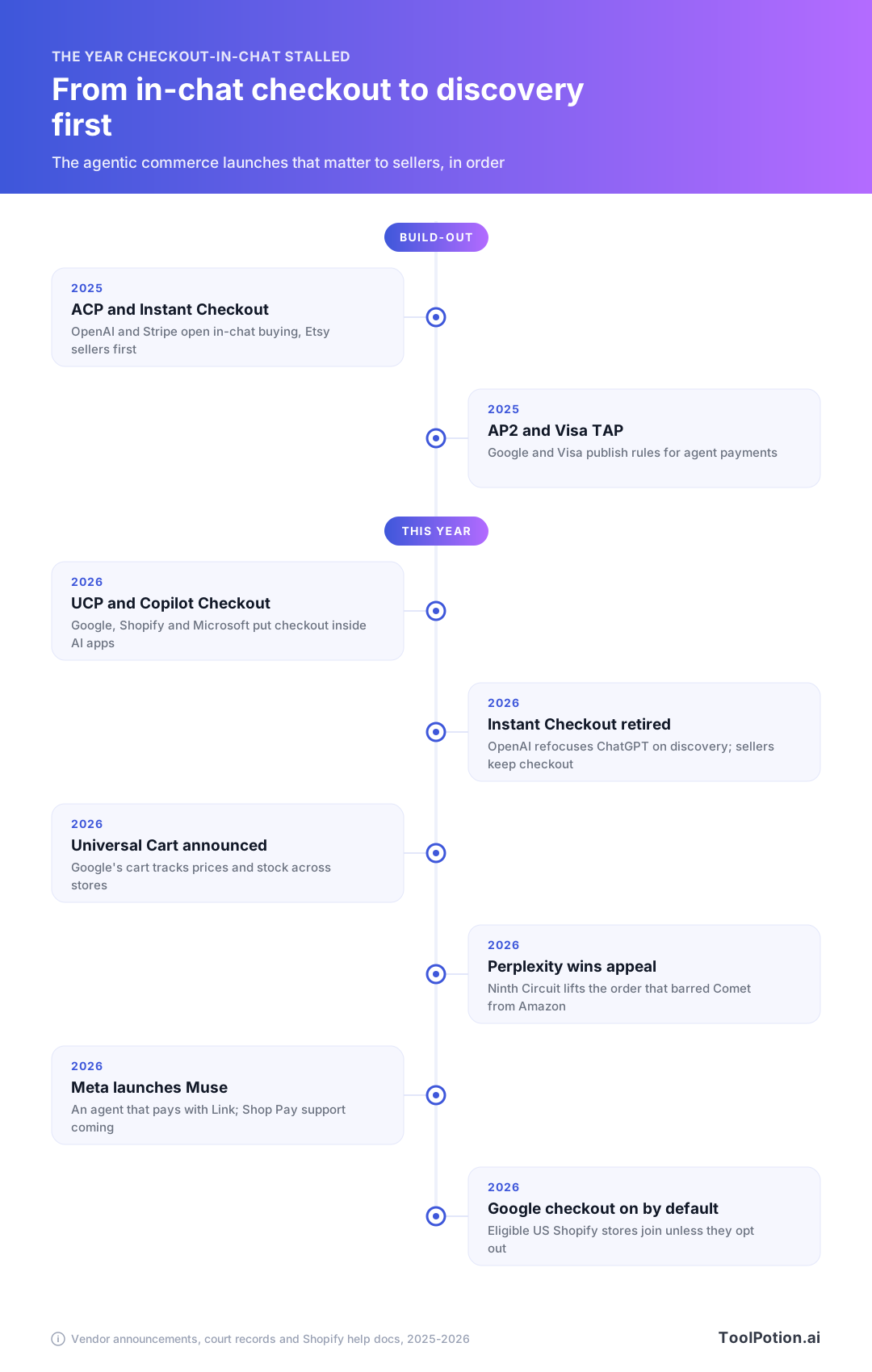
So agent buying didn't die. It changed hands. Forter, which screens orders for online merchants, counted agent-placed orders at 4.4 times their level at the start of its study window once Muse launched. OpenAI accounted for 82% to 93% of weekly agentic orders in the weeks before Muse arrived, and agents spent 14% less per order than human shoppers, a gap Forter says Google's single-item checkout partly skews (Forter). Those are growth multiples from a small base. Forter doesn't publish absolute volumes.
The legal fight over outside agents is still open too. A district court barred Perplexity's Comet browser from shopping on Amazon, then the Ninth Circuit vacated that injunction, holding that, under that statute, "It is the user who 'accesses' Amazon's computers" with the assistant's help (Ninth Circuit). The ruling turned on the federal computer-fraud statute, and the opinion says Amazon can still regulate access through its terms of service. The case goes on.
How an agent picks a product and closes the sale
An agent can only recommend what it can read. Every surface starts from structured product data: your feed, your catalog through a platform like Shopify, or whatever its crawler pulls from your pages. After that, an order takes one of two paths.
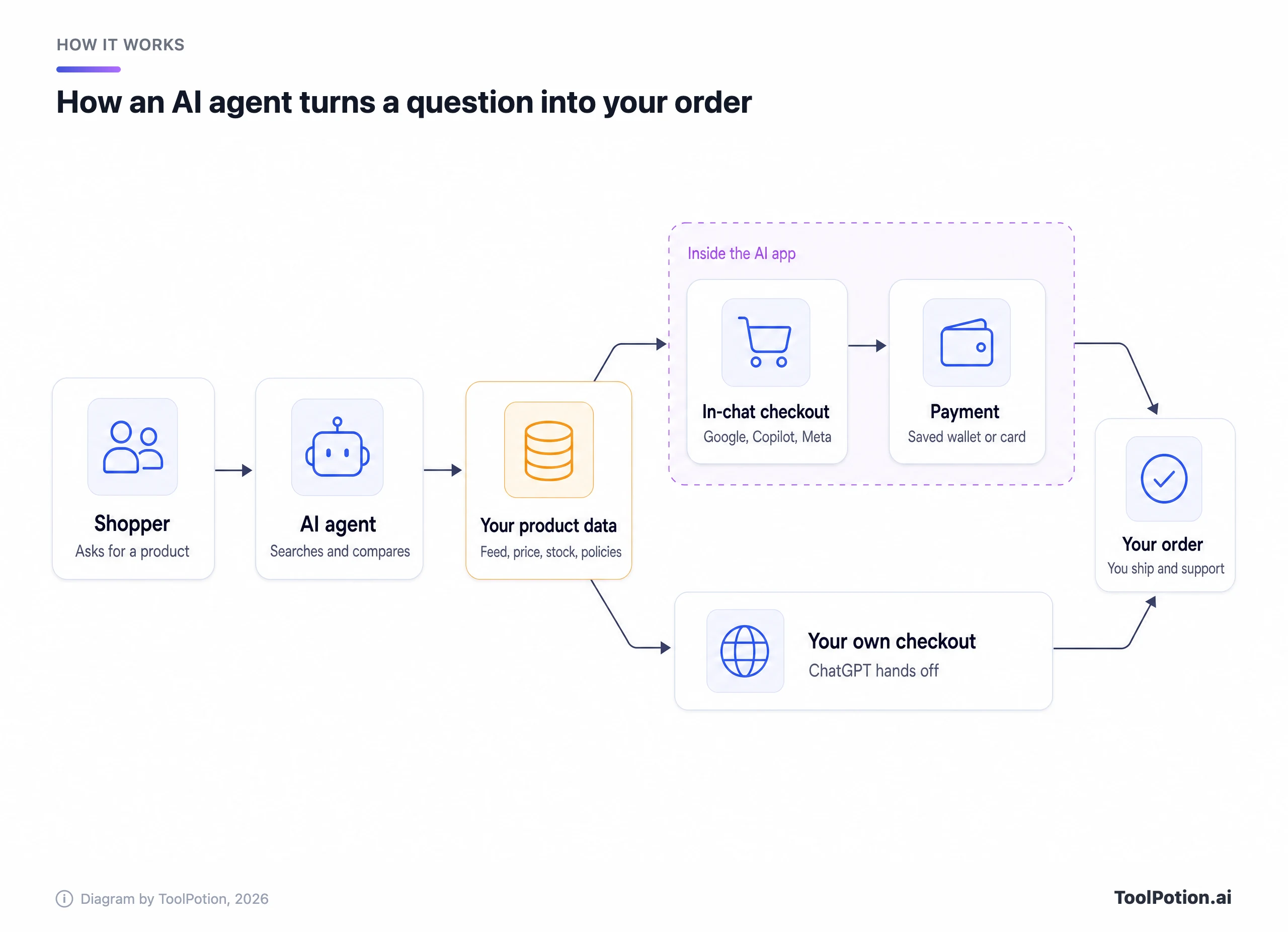
The left half is where sellers win or lose. OpenAI is unusually specific about how ChatGPT orders merchants selling the same item: by "availability, price, quality, and whether they are the maker or primary seller of that item", using "structured metadata from first-party and third-party providers" (OpenAI Help). Its merchant page adds that richer data helps products surface with more accurate information when shoppers compare options. Google, for its part, says opting into native checkout "does not influence how we rank your offers". Checkout integration won't buy you placement. Data might.
Shopify gives the clearest view of what a platform measures. Its agentic storefronts dashboard includes a search preview that shows how products might rank in AI channels, with listing-quality indicators for description completeness, image coverage, reviews, variant data and store policies. Shopify describes the preview as the raw output of Shopify Catalog search, so treat it as a smoke test rather than a promise of placement in any one AI channel.
The right half matters less than the headlines suggest. With in-chat checkout, the AI app collects the shipping and payment details and hands you an order. Without it, you get a referral to your own checkout. Either way the shopper becomes your customer, and you own the post-purchase experience.
The protocols and payment rails, decoded
Every agentic commerce pitch drops five acronyms in the first minute. Most sellers never touch them directly, because the platform or payment provider does. It still helps to know which layer each one lives in.
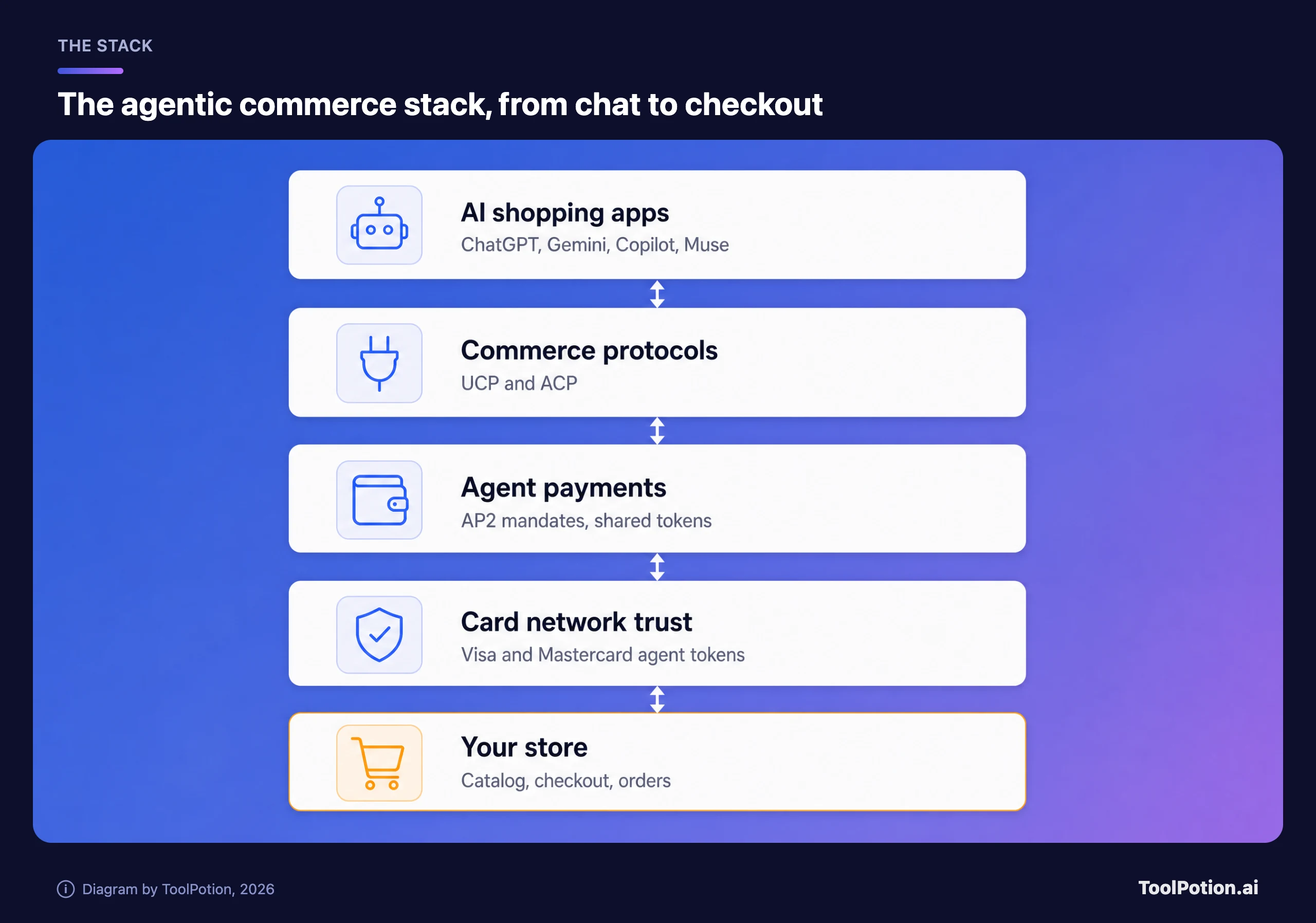
UCP and ACP are the commerce layer: how an agent reads a catalog, builds a cart and submits an order. UCP belongs to Google and Shopify and has more than 20 endorsers, including Visa, Mastercard, Stripe and The Home Depot. ACP belongs to OpenAI and Stripe. Its public repo still labels the spec beta, Meta took a seat on its technical steering committee this year, and Microsoft uses it for Copilot Checkout. Stripe now supports both, and its docs list "UCP or ACP" as the protocol for selling through agents. If you're on Shopify, the platform does the protocol work for you. Stripe merchants can reach both through Stripe's agentic commerce tools.
Agent payments sit underneath. Google's Agent Payments Protocol (AP2) records what a shopper authorized as signed mandates, and Google handed it to the FIDO Alliance this year, where Mastercard contributed its Verifiable Intent framework. Stripe's Shared Payment Tokens let an agent pass a buyer's credentials with a spending cap and an expiry date, and they cover cards plus buy-now-pay-later from Klarna and Affirm. The card networks add their own trust layer: Visa's Trusted Agent Protocol, built with Cloudflare on HTTP message signatures, and Mastercard Agent Pay. Mastercard has also started testing a US score that tells issuers how likely it is that an agent initiated a transaction.
Two things are worth knowing about all of this. It's early. Visa's developer pages still describe Intelligent Commerce as "in the process of development and deployment", and Visa CEO Ryan McInerney told an investor conference this year: "We are seeing adoption for shopping, but not yet for autonomous payments." And it's converging on one idea. A merchant should be able to tell a verified agent from a scraper, and an issuer should be able to prove what the shopper approved.
Shoppers research with AI but rarely let it pay
The demand side explains why checkout stalled. Shoppers lean on AI for research, then stop at the payment step.
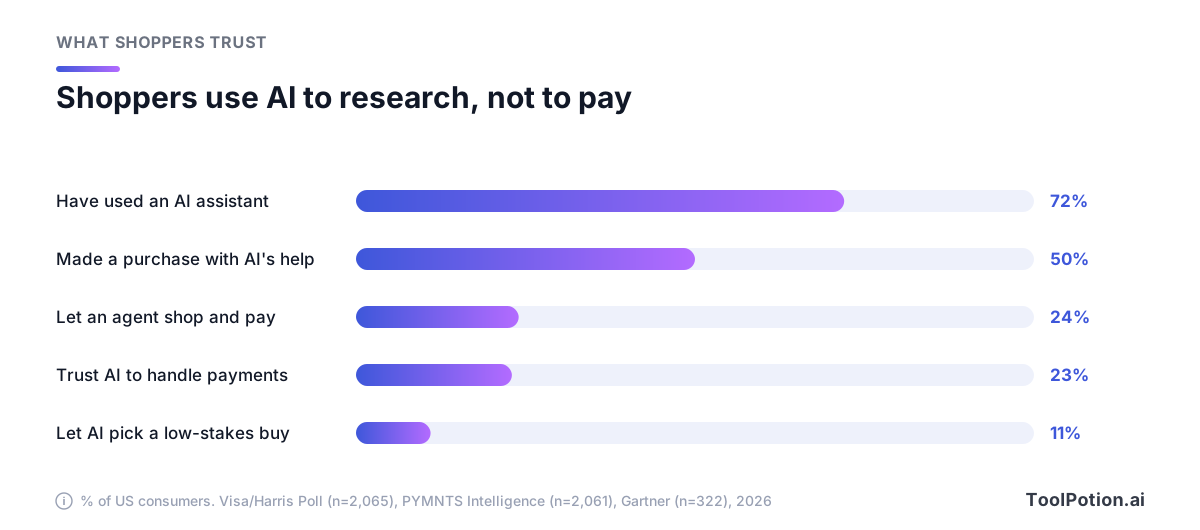
Visa's own survey, fielded by Harris Poll with 2,065 US consumers, found 72% have used an AI assistant but only 23% trust generative AI to handle payments for them (Visa). PYMNTS Intelligence, surveying 2,061 US consumers, found half have made a purchase with AI's help and 24% would let an agent shop and pay. Gartner's number is the starkest: willingness to let AI make the purchase decision topped out at 11%, even in low-stakes categories like household supplies.
Traffic data from the merchant side agrees. Adobe Analytics data on more than a trillion visits to US retail sites, as reported by Digital Commerce 360, showed AI-referred traffic up 138% year over year in a reading earlier this year, and those visitors converted 54% better than non-AI traffic, a reversal from the year before. Bain puts the scale in perspective. AI is up to a quarter of referral traffic for some retailers but still under 1% of total traffic.
One more number belongs on every seller's wall. In a separate Gartner survey of shoppers who used AI for a recent purchase, 54% said they had to double-check all the information the AI gave them. Gartner's verdict: "Accuracy is now a brand issue." When an agent quotes your old price or the wrong return window, it's your store the shopper remembers.
The agent-ready store checklist
Everything below comes from what OpenAI, Google and Shopify document as inputs. None of it needs a new protocol, and all of it helps on every surface at once.
Start with identity. OpenAI's product feed requires nine fields (item_id, title, description, url, brand, seller_name, image_url, availability and price) and rejects rows with an unrecognized availability value (OpenAI feed spec). Add GTINs or MPNs wherever they exist. A title like "Blue shirt" loses every comparison to "Linen camp-collar shirt, men's, navy".
Then freshness. The same spec says to "update the feed when a sale starts or ends", and OpenAI's setup guide recommends a full file daily plus API updates through the day. A stale price hurts more in AI answers than in search results, because the agent repeats it as fact.
Policies need the same care. Google requires return policies in Merchant Center for UCP checkout, calling them a merchant-of-record requirement, and wants at least one customer-service contact (Google for Developers). Shopify's agentic storefronts expect your terms of service, privacy policy and return and refund policy to be filled in. Put the same terms in schema.org markup on your site (MerchantReturnPolicy and shipping details) so every surface reads one answer.
The table shows where each fix is read.
| What agents need | OpenAI feed | Google Merchant Center | Shopify |
|---|---|---|---|
| Live stock | availability | availability attribute | Synced through Shopify Catalog |
| Return terms | accepts_returns, return_deadline_in_days | Return policy settings, returns attribute | Settings > Policies |
| Reviews | star_rating, review_count | Not covered here | Listing-quality indicator |
| Buyer questions | Raw Q&A lists not part of the feed | question_and_answer | Answer in descriptions |
| Checkout opt-in | is_eligible_checkout (checkout retired) | native_commerce(checkout_eligibility) | Direct checkout toggle per channel |
Reviews and answers matter because an agent can quote them straight back to the shopper. Google says a lululemon test of its new conversational attributes showed a 50% incorporation rate in AI Mode recommendations, and its related_product attribute now covers accessories and substitutes. If your descriptions are thin, the product description generators board lists the top-ranked tools, and the review response board covers the reply side.
Finally, let the agents in. OpenAI says sites that opt out of OAI-SearchBot "will not be shown in ChatGPT search answers". Check your CDN's bot settings as well, since a blanket bot rule can block AI crawlers without anyone deciding to. You don't need an llms.txt file. Google says its AI features need no special AI text files or markup, and none of the shopping programs covered here documents reading one.
Your brand also needs to show up in the answer itself. Google's Merchant Center now has AI performance insights that compare your share of voice across AI Mode and AI Overviews, and Business Agent lets US stores with at least 50 approved free listings put a branded chat on Search. For the wider toolset, see the tools for optimizing for AI search.
Score your store against ten checks. The first four carry double weight, because without them an agent can't show you at all.
If you score under 6, leave the channel settings alone for now and fix the feed. Switching on more channels with thin data puts weak listings in front of more shoppers.
Your first 30 days, starting with Shopify
What to do first depends on where your store runs. Pick yours.
For US merchants on Shopify, much of the work is checking switches that are already on. Shopify says agentic storefronts are "active by default for eligible stores" and lists ChatGPT, Google AI Mode, Gemini, Microsoft Copilot and Meta as channels (Shopify Help). Direct checkout in Google, Copilot and Meta is on by default too, with no fees beyond standard payment processing. Orders land in your admin with channel or referrer attribution.
Here's how the month breaks down.
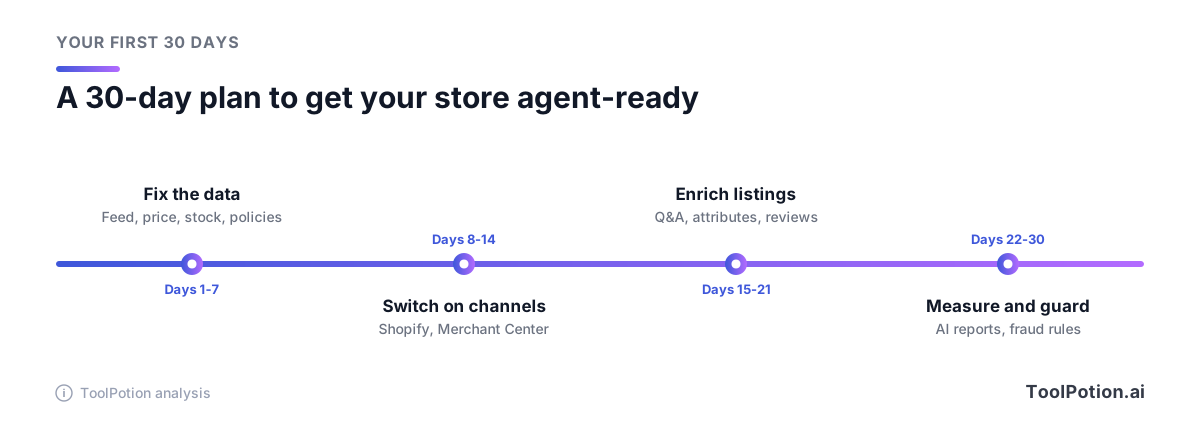
- Days 1-7: open Sales channels > Agentic and note which channels are live. Run the search preview on your 20 best sellers and fix what the listing-quality indicators flag. Complete every page in Settings > Policies.
- Days 8-14: confirm the Google & YouTube channel syncs automatically, then set return and shipping policies in Merchant Center so they match your site exactly. Decide per channel whether direct checkout stays on.
- Days 15-21: enrich. Add GTINs, variant details, buyer Q&A and accessories, and ask recent customers for reviews.
- Days 22-30: measure what came in (next section) and ask your payment provider how it labels agent orders.
Not on Shopify? WooCommerce points merchants to Stripe's Agentic Commerce Suite for ACP and says agentic checkout is coming to its Stripe extension. Shopify's Agentic plan opens Shopify Catalog to brands that don't run a Shopify store, which gets them into the same AI channels. Etsy sellers mostly ride on Etsy's own deals with Google, Microsoft and OpenAI. Our guide to AI for e-commerce and the top AI tools for e-commerce sellers cover the rest of the seller toolkit.
Measuring agent orders, and the fraud question
Google Analytics 4 added an AI Assistant default channel this year. A new "ai-assistant" value is assigned automatically when the referrer matches a recognized assistant such as ChatGPT, Gemini or Claude, according to Google's Analytics help center. ChatGPT also tags its outbound links with a utm_source value of chatgpt.com. Shopify's agentic reports break out sales, orders, sessions and conversion per AI channel, counting referral sales and direct-checkout sales together.
The blind spot is native checkout. When the purchase happens inside Google's AI surfaces, Search Engine Land reported that certain custom pixels and client-side Google Analytics tracking aren't supported. The order shows up in Shopify with its channel, but your onsite funnel never sees the visit. Compare Shopify's channel report with GA4 every month instead of trusting either alone. Cloudflare's AI Crawl Control, available on all plans, shows which AI crawlers hit your site and how often, which is the earliest sign that an agent is reading you.
Fraud is the open problem. Federal Reserve Governor Christopher Waller asked at Sibos this year, "Who is on the hook if an agent makes the wrong purchase?" (Federal Reserve). He added that fraud models will need recalibrating "to account for agent payment patterns". No agent-specific chargeback rates appear to be published yet, and a principles paper from six banks warned that liability is unclear and that dispute processes don't involve every party in the chain.
The practical move is to ask your payment provider or fraud tool how it treats agent orders before volume arrives. Stripe has previewed bot-abuse prevention in Stripe Radar designed to separate legitimate agents from fraudsters, Mastercard is testing a score for the likelihood that an agent started a transaction, and Visa's protocol lets a site verify a signed agent. The fraud detection board ranks the wider field.
Some sellers can wait. Stores outside the US gain little from checkout settings today, since nearly every in-chat checkout is US-only. Google's UCP checkout excludes subscriptions, personalized goods, pre-orders, used items and age-restricted products. And if your margin depends on cart upsells, an in-chat checkout skips your cart page entirely. Those sellers should still fix their data, because discovery reaches them anyway.
Frequently asked questions
Do I have to pay to appear in ChatGPT shopping results?
No. OpenAI says product results are selected independently and "are not ads". Ads are a separate, labeled product shown to Free and Go users, and product-feed ads use the same feed with an is_ads_eligible flag.
Will turning on Google's in-chat checkout improve my ranking?
Google's UCP documentation says opting into native checkout doesn't change how your offers rank. Turn it on for conversion and convenience, and fix your feed for placement.
Can I stop AI agents from buying on my store?
On Shopify, yes, per channel, under Sales channels > Agentic. Blocking OAI-SearchBot in robots.txt also removes you from ChatGPT's answers. Amazon blocks outside agents outright, though the Ninth Circuit's ruling in its case against Perplexity shows the legal limits of that approach are still being argued.
Does an llms.txt file help AI shopping agents find my products?
There's no documented support from any major shopping surface. Google says its AI features don't need special AI text files. Your feed, structured data and Merchant Center settings carry the weight.
Is it safe to let shoppers pay inside an AI app?
You remain merchant of record in every program covered here. Payment runs through the AI app's checkout or a wallet such as Google Pay, and Meta's Muse uses one-time cards from Stripe's Link so the shopper's real card details stay hidden. Liability rules for agent mistakes are still being written, so keep your order and dispute records tidy.
I sell on Etsy. Do I need to do anything?
Etsy has partnerships with Google and Microsoft that let signed-in US shoppers buy select items in AI Mode, the Gemini app and Copilot Checkout, and its catalog is already integrated with ChatGPT. Your levers are the usual ones: specific titles, good photos, complete attributes and reviews.