Ring's own pages say the $249.99 Drone Cam records only while it flies and has no microphone. The $999.99 Rover Cam does have a mic, and it records whenever it rolls. Both facts sit on the product pages (Drone Cam, Rover Cam), and CNBC's launch report mentions neither.
Amazon's Ring unveiled both devices at a New York demo, and CNBC reported the details. Before anyone's cart fills up, here is what each device captures, where the video goes, who can ask for it, and the settings to touch first. We haven't used either one (neither device has shipped), so everything below comes from Ring's pages, its privacy notice and the reporters who watched the demo.
What the drone and the robot actually are
The Drone Cam is an indoor camera that flies. CNBC describes it as roughly textbook-sized, with two plastic-encased propellers, and says it flies up to eight minutes before returning to its dock. When a window, door or other Ring sensor trips, it follows a preset path; you can also launch it yourself from the app. During setup you carry it through your home to build a map. Ring says it records video at 2K with a 148-degree view and lights dark rooms with LED spotlights (not infrared).
The Rover Cam is a different animal. It repurposes Amazon's Astro: a screen on a two-wheeled base with an extendable camera mast, built for offices and warehouses. Ring says it maps up to 5,000 square feet on its own and works on a single floor, with no stairs. It has infrared night vision, a siren, a red light tower and two-way talk, with video up to 4K.
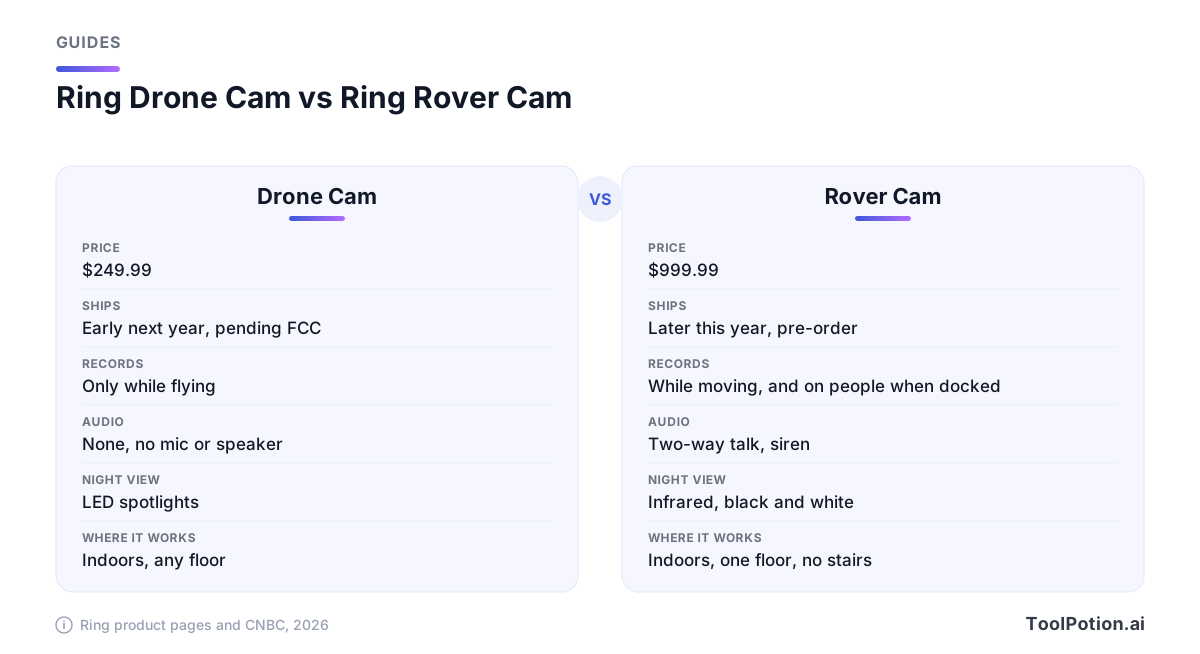
Neither is on sale yet. The Rover Cam is a pre-order, shipping before the year ends per CNBC. The Drone Cam is slated for early next year, and Ring's page carries a notice that the device has not been authorized by the FCC and can't be sold until it is. Treat the drone's date as a plan.
What gets recorded, and for how long
The two devices follow different rules. Ring says the Drone Cam records only while flying and stops when it docks. The Rover Cam doesn't record around the clock either, but it records when it detects people while docked and any time it moves, including patrols and Live View. That second rule is the one to read twice: a parked Rover Cam is still a person-triggered camera.
Ring told CNBC that privacy is the "default" mode for both and that each flashes an LED when it records. On the Rover Cam, one press turns off the mics, camera and motion detection, and the mast retracts. These are Ring's descriptions; we can't verify them.
Saved video lives in Ring's cloud and needs a Ring Protect plan. Both pages promise up to 180 days of history, and scheduled patrols need a subscription too. Each device comes with a 30-day trial. We'd cut that 180-day default down: a camera that wanders past bedrooms shouldn't hold half a year of footage by default. Under Ring's privacy notice, Ring keeps recordings for as long as your recording subscription runs, you can delete them any time, and anything you share to Neighbors stays with Ring.
Who can get at the footage
Four routes exist, and only one of them is yours to open or close.
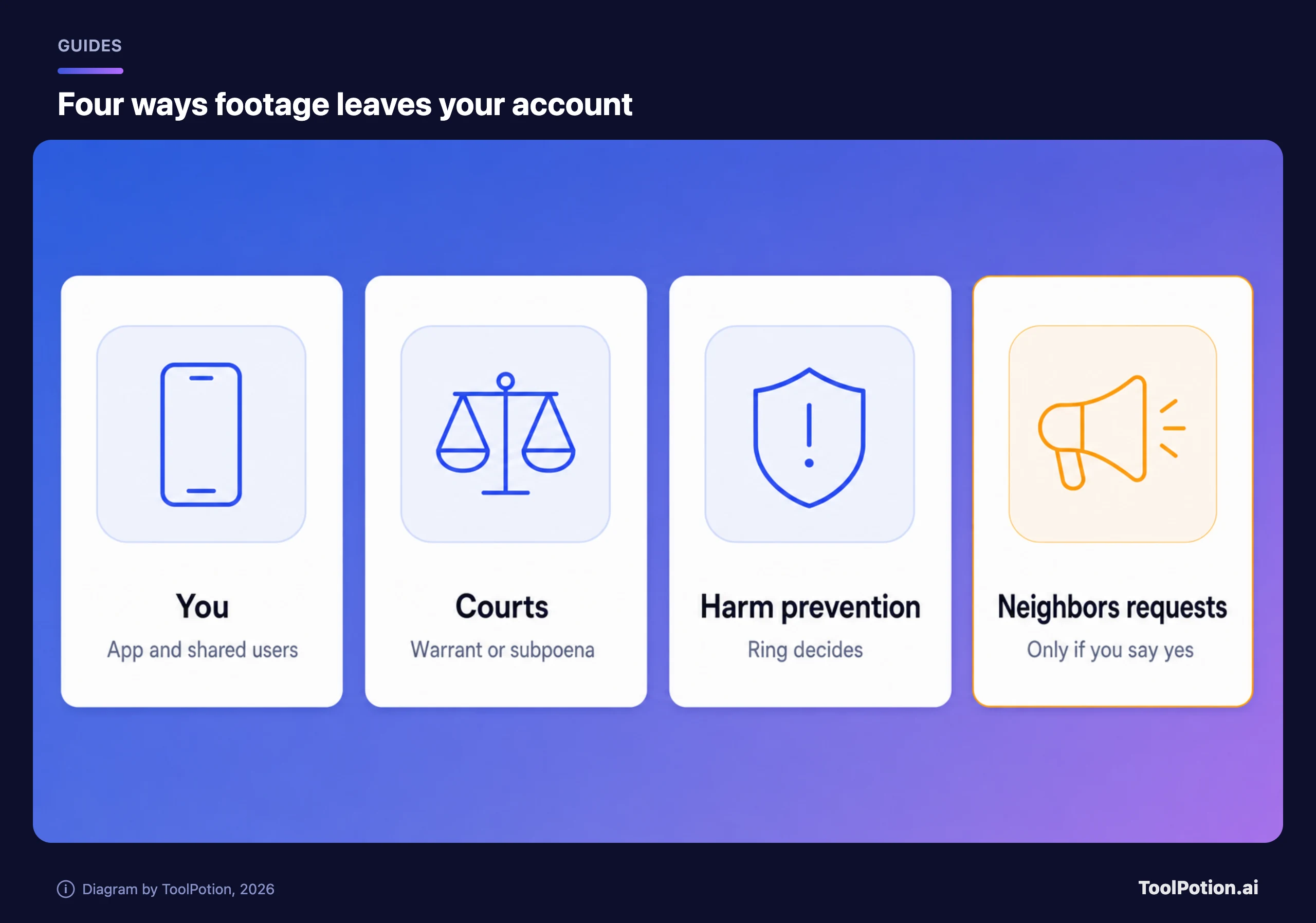
The legal door is the oldest. Ring's privacy notice says it may disclose personal information when required by a court order or subpoena, when it believes disclosure is necessary to prevent physical or other harm or financial loss, and in connection with an investigation of suspected or actual illegal activity. The harm and investigation clauses are Ring's own judgment calls, and we'd want them narrower. A 2024-era Reviewed explainer said Ring's Request for Assistance feature, which let police ask users for footage directly, had been deprecated, and that Amazon has confirmed it shares footage with police in emergencies and complies with warrants. Engadget separately reports that Ring ended its request-for-access feature for law enforcement in 2024, and that a later Flock Safety integration was cancelled before it reached the public. CNBC also reports the Flock integration was cancelled, but still describes Ring's privacy concerns as stemming primarily from its partnerships with police. We found no newer Ring page on law-enforcement requests (its old community-requests page now returns a 404), so treat the picture as 2024 policy plus this year's reporting.
Voluntary sharing is still open. CNN reports that users can share footage with police if officers ask through the Neighbors app. We'd default that to "no" and decide each time.
The encryption change, and what it leaves out
Earlier this year Ring announced TAKE, short for "throw away the key". Per Engadget, Ring protects videos with "unique, rotating encryption keys", sends a copy to "a secure enclave within the cloud", and uses it only to run the smart features a customer has turned on before deleting it. CNN reports Ring will roll TAKE out as the default on all its cameras and keep end-to-end encryption as an option. Ring founder Jamie Siminoff told CNN he thinks people will "feel more comfortable when they see a Ring camera, knowing that there's a default encryption on it." Ring's own TAKE help page is less tidy: it says TAKE reaches accounts gradually, that Ring will notify you when yours is eligible, and its setup steps have you tap "Turn On TAKE". Read together, "default" looks like a rollout goal, not something every owner already has.
Two limits. First, Ring's product pages for the Drone Cam and Rover Cam don't mention encryption at all. Ring's help pages say "All Ring cameras support TAKE" and that most Ring cameras support end-to-end encryption, with a list of exceptions that doesn't name either new device. Neither page names them as supported, either, so we'd call encryption on these two unconfirmed until Ring says so on their pages. A camera that moves through your rooms is the product where that sentence should already exist. End-to-end encryption also costs features: Ring lists Shared Users, Video Search, Familiar Faces and ring.com viewing among those that don't work with it. Second, CNN notes that encryption does nothing for people who are recorded without being Ring customers.
Neighbors, guests and people who never agreed
Indoor devices still record visitors, cleaners, babysitters and employees. A Rover Cam on a warehouse floor records workers all day. A drone flying past a window can capture a neighbor's yard, and Ring says it has built guardrails so the drone can't fly outside, with Siminoff telling CNBC that doing so would be illegal. Neither CNBC's report nor Ring's product page says how the guardrails work.
The practical answer is notice and routes. Tell the people who live or work there. Keep patrol paths out of bedrooms, bathrooms and any room with a window onto someone else's property. Some Ring features are switched off in Illinois because of state law (Ring's own footnote on video search), which is a reminder that recording rules differ by state. If you run a business, ask a lawyer about employee notice. We can't give that advice.
Settings to change before the first flight
Defaults are policy. What Ring ships turned on tells you more than the product page's adjectives, and for these two devices the defaults aren't fully published yet. Do this on day one:
- Open Control Center in the Ring app and check whether the device offers end-to-end encryption. If it does, decide which features you can live without.
- Shorten video storage below the 180-day maximum. Ring says a change applies only to recordings made afterward, so do it before the first patrol.
- Turn off sharing to Neighbors and decide ahead of time how you'll answer a police request.
- Build patrol routes that skip private rooms, and schedule patrols for when the space is empty.
- Turn on two-factor sign-in for the account, since one login now opens a camera that moves.
- On the Rover Cam, find the privacy button and test it before you rely on it.
Should you buy one?
For a home, we'd wait on the Drone Cam. Nothing has shipped, the FCC hasn't signed off, the listing shows no customer reviews, and eight minutes of flight is a short patrol. A fixed indoor camera covers a room for a fraction of $250, and a flying one adds a moving recorder, a map of your house in the cloud and a subscription.
The Rover Cam is for businesses with large open floors, and at $999.99 plus a plan we doubt a small shop gets its money back over a few fixed cameras. Anyone who wants plain cameras should compare other makers. Arlo is in our directory, as is Amazon Alexa if you're already in that ecosystem, and Google Nest sells indoor cameras too. We'd change our minds if Ring documents encryption on both devices and the first shipped units confirm the recording rules above.
For more on keeping data out of the wrong hands, see our AI tool data privacy framework and the guide to what always-listening recorders capture. Browse the Top 100 Security & Privacy tools, the Top 50 AI Privacy Tools and the Top 25 Robotics & AI Hardware. The Privacy Laws Hub lists rules by country.
Frequently asked questions
Does the Ring Drone Cam record audio?
No. Ring's page says it has no microphone or speaker, no siren and no two-way talk. The Rover Cam does have two-way talk and a siren (Ring).
Can the Ring drone fly outside?
Ring says no. It's built for indoor use between 41°F and 95°F, and Siminoff told CNBC the company added guardrails to keep it inside.
Will Ring give my footage to police?
Ring's privacy notice allows disclosure under court orders, subpoenas and some harm-prevention situations. Footage you choose to share through Neighbors is separate, and you can decline.
Does end-to-end encryption stop police access?
Ring's help page says no one else, including Ring services, can access end-to-end encrypted content (Ring). You lose features in exchange, and Ring's pages don't say whether these two devices support it.
Do I need a subscription?
For saved video history and scheduled patrols, yes. Each device includes a 30-day trial of Ring Protect.