
Description
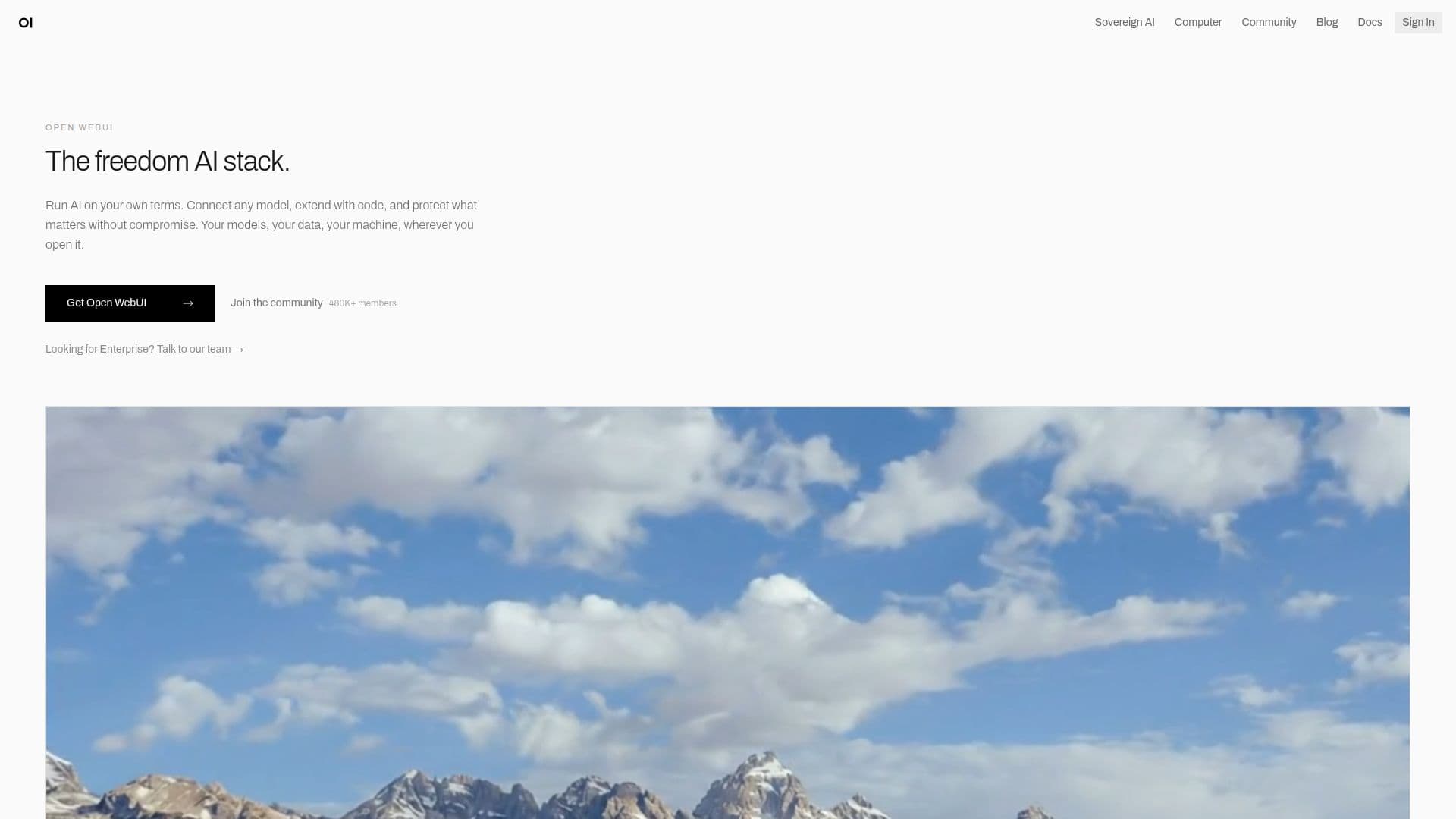
Open WebUI is a self-hosted AI platform for running AI on your own terms. It connects to any model, local or cloud, including Ollama and OpenAI-compatible APIs as well as Anthropic and vLLM, and gives you a provider-agnostic interface where your models, conversations, and tools live in one place. It is extensible, feature-rich, user-friendly, and built to run entirely offline, so your data stays exactly where it belongs.
Read More
The platform supports voice, vision, retrieval, generation, and search out of the box, and can be extended with Python through plugins, pipelines, and custom workflows. A community of nearly half a million members shares prompts, models, tools, functions, and discussions that anyone can browse, install, and contribute to. It installs in about a minute via Docker, pip, uv, or a desktop app with no account required, and pairs with Open WebUI Computer, an agent harness and runtime that works on the real files, terminal, git, and services on your own machine.
Built for scale from a laptop to institutional deployments, Open WebUI supports SSO, RBAC, audit logs, data residency, and on-premises or air-gapped deployment for regulated industries, providing the technical foundation for frameworks like SOC 2, HIPAA, GDPR, FedRAMP, and ISO 27001. It is free to use as-is, sustained by sponsors and optional enterprise licenses that add white-labeling and dedicated support, and is used by organizations including Samsung Semiconductor, Astellas Pharma, and a 35,000-user university deployment.
- CategoryAI Chatbots
- Pricing ModelFree
- DeploymentSelf-hosted
- PlatformsWeb
Open WebUI's Core Features
Self-hosted platform that runs entirely offline
Provider-agnostic connection to local and cloud models (Ollama, OpenAI, Anthropic, vLLM)
Voice, vision, retrieval, generation, and search built in
Python extensibility via plugins, pipelines, and custom workflows
Community library of prompts, models, tools, and functions to install and share
One-command install via Docker, pip, uv, or desktop app, no account needed
Open WebUI Computer agent harness that acts on your real machine
Enterprise controls: SSO, RBAC, audit logs, data residency, and air-gapped deployment
How to use Open WebUI?
Install it: Run Open WebUI via Docker, pip, uv, or the desktop app in about a minute, no account required.
Connect a provider: Point it at Ollama, OpenAI, Anthropic, vLLM, or any compatible model, local or cloud.
Extend and customize: Add plugins, tools, and Python workflows, or install community-built components.
Scale up: Turn on SSO, RBAC, audit logs, and on-premises or air-gapped deployment as your needs grow.
Open WebUI's Use Cases
- Private self-hosted AI
- Unified multi-model interface
- Extending AI with code
- Regulated enterprise deployment
- Real-machine agents