An OpenAI analysis estimates that more than 40 million weekly ChatGPT messages about healthcare in the U.S. ask about healthcare for someone else (OpenAI). We can't check that figure (it's the company's own count, over a short window), but the behavior is easy to believe: people are typing a parent's or partner's problems into a chat box. OpenAI's response, built with the Caregiver Action Network, the Alzheimer's Association and the American Diabetes Association, was a free one-day workshop in five U.S. cities. We like the idea, though a workshop run by the vendor will teach the vendor's tool. Our version of the lesson is shorter: use AI on the paperwork around care, keep it away from the care decisions, and change one setting before you paste anything.
Start with the paperwork around care
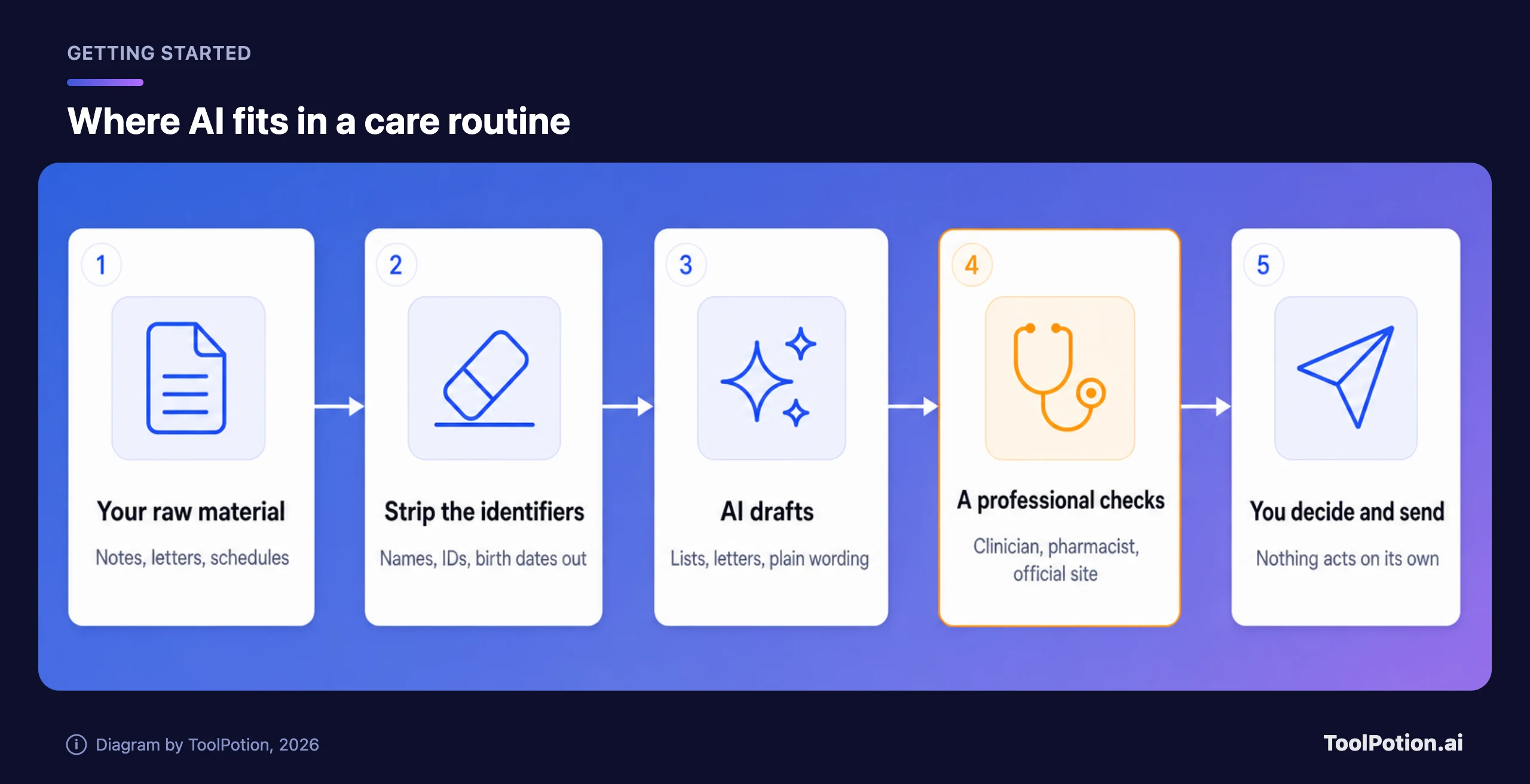
OpenAI's own list for the workshops is modest: caregiver schedules and checklists, plain-language versions of trusted educational material, community resources, and discussion guides for support groups. We think that's the right scope, and the first item pays off fastest. Paste a messy medication list (drug names and times, nothing else) into ChatGPT, Claude or Gemini Live (our three-way comparison covers the differences) and ask for a one-page daily grid in large type, one row per dose. Ask for a second copy for the sibling who covers weekends. The assistant is doing layout. You still own every number on the grid, so check it against the pharmacy label or ask the pharmacist before it goes on the fridge.
Appointments work the same way. The National Institute on Aging tells caregivers to plan what they want to discuss and to make a list of concerns and medications, and it publishes printable worksheets for that (NIA). A chatbot can turn three pages of scattered notes into five ranked questions with the urgent one first. Start with whichever assistant you already have; we wouldn't buy a plan for this.
After the visit, type what you remember and ask for a summary under three headings: what changed, what to do, what to ask next time. If you'd rather record the visit, ask the clinic first. A transcript tool such as Otter.ai stores the whole conversation, not your summary of it, and our notetaker comparison covers what each one stores.
Appeals, services and the language barrier
If we had to pick one job, it would be the insurance letter. A denial is dense, and a good first draft saves an evening. For U.S. readers (the rest of this paragraph is Medicare-specific; other insurers and countries have their own rules), Medicare says a Medicare Advantage or drug plan must tell you in writing how to appeal, you can ask your provider or supplier for information that makes the appeal stronger, and you can appoint a trusted family member or friend as your representative (Medicare.gov). So have the chatbot turn the denial's stated reasons into a checklist, then draft a letter with placeholders. You add the dates, claim numbers and the clinician's supporting note. Medicare also points people to State Health Insurance Assistance Programs for free local counseling, which a chatbot can't replace. Take every deadline from the denial letter, never from the chatbot.
Local services are weaker ground. Assistants will name agencies with total confidence, and some will be closed, out of area or wrong. Official directories are better: for readers in England the NHS lists carer's assessments, breaks and respite care, and benefits for carers (NHS), and the NIA caregiving hub links to its guide on services for older adults living at home (NIA). Use the AI to draft the phone script instead: cost, waiting list, hours, who's allowed to book. Then make the call yourself. The same trick plans respite. Give it the dates you need and the names of the relatives, and ask for a rota everybody can read.
Translation is the other easy win. A schedule or visit summary for a relative who reads another language takes seconds in Google Translate or DeepL, and our comparison of DeepL, Google Translate and ChatGPT says which suits which text. Consent forms and dosing instructions are different. The NIA's appointment advice includes requesting an interpreter if you need one, and for those documents we'd use one.
Turn off the training setting first
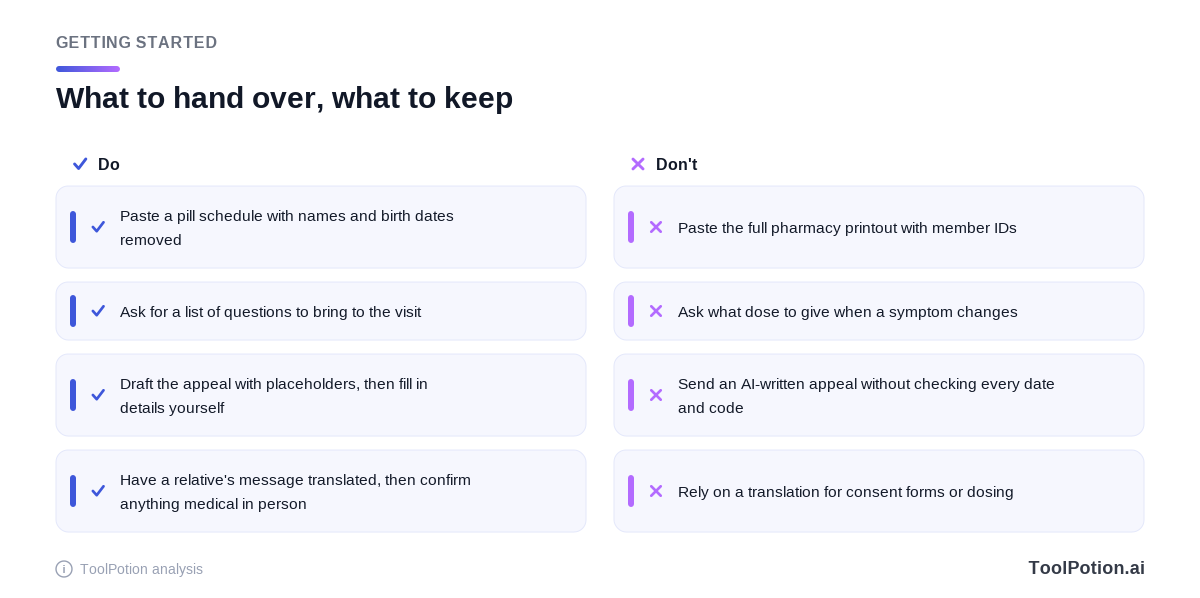
Defaults are policy. OpenAI's help page says that on personal Free, Plus and Pro accounts, data sharing is on by default, and the switch is Settings, Data controls, "Improve the model for everyone". Turning it off keeps your chat history. Voice mode has its own training control, so check that too, and know that a thumbs up or down on a reply can send the whole conversation for training even after you've opted out. While they stay temporary, those chats stay out of your history, don't create or update memories, aren't used to improve OpenAI's models, and may be kept up to 30 days for safety (OpenAI help). For anything about a relative's health we'd use a temporary chat and strip names, birth dates, addresses and member IDs first. Other assistants have their own settings and we haven't compared them all, so read the data page before you paste. Our memory explainer covers what assistants carry from one chat to the next.
Then there's the person you're caring for, who hasn't agreed to any of this. Tell them what you're doing. If they can't follow, ask yourself what they'd have wanted. A parent who has always kept medical matters private might not want a diagnosis typed into a chatbot, even by you.
When we'd skip the chatbot entirely
OpenAI says its workshop also covered when to consult healthcare professionals, and that AI tools should complement, not replace, medical, legal or financial advice. We'd go further, and name the moments.
- Anything sudden or severe, or a possible overdose or wrong dose. Call emergency services, a poison control line or the clinician.
- Any question that starts "how much should I give" or "is it safe to combine". That's a pharmacist's job.
- Choices about treatment, end-of-life care or who decides when someone can't. Those belong to the person, the family and their clinicians, and the legal paperwork belongs to a lawyer.
- The 3 a.m. conversation where the chatbot is the only listener you have. Our guide to chatbot health questions explains how these tools go wrong. Call someone, a friend or a carers' line; the CDC has a page on caring for yourself while caring for someone else (CDC).
The CDC says a care plan can keep a caregiver's important information in one place, and an assistant can draft the layout from your notes (you fill in the facts). If you want purpose-built tools, browse our healthcare board and hub. We'd read the data policy of any of them before entering a relative's details, Healthee for benefits and the Australian healthdirect Symptom Checker included. None of this replaces a clinician, a pharmacist or the official pages above: NIA and CDC in the U.S., the NHS in England.
Frequently asked questions
Is it safe to paste my mother's medication list into ChatGPT?
Safer than pasting her whole record, never risk-free. Send drug names and times only, use a temporary chat, and turn off model training in Data controls first. Check the output against the pharmacy label. Rating a reply with a thumb can still share the conversation for training.
Can AI tell me whether a symptom is serious?
No, and we wouldn't ask it to. Describe what you see to the clinician's line, or call emergency services if it's sudden. The assistant can help you write down what you've noticed and when, which makes that call faster.
Will an AI-drafted appeal get a denial overturned?
Nobody can promise that. For Medicare (U.S. only), the agency says there are generally 5 levels of appeal, so a first draft is the start of a process. The facts, dates and supporting note from the clinician do the persuading.
Are the OpenAI workshops still available?
Not as announced: OpenAI ran one event day in Oakland, Tampa, Pittsburgh, Atlanta and Detroit, free and with no technical background required. It says what attendees raised will help shape future learning resources, but it hasn't announced more dates, so check OpenAI Academy.