"In 35 years, I haven't seen a chip CEO with this much direct influence on export policy," Patrick Moorhead, CEO of Moor Insights & Strategy, told CNBC. He was talking about Jensen Huang, and he said it while Nvidia's board was investigating its own co-founder.
We aren't going to relitigate anyone's private life. The reason this story belongs on a site about AI tools is simpler: Nvidia chips train and run most of the models you use, and a company in this position makes decisions about export licences, chip supply and financing that eventually reach your subscription bill. So this piece does two jobs. It lays out what named outlets and official statements say, attributed, with allegations kept as allegations. Then it follows each thread toward the tools.
What was reported, and by whom
On Sunday, Huang emailed Nvidia staff admitting to an extramarital affair. In the same release the board said it was starting an independent investigation "in light of recent reporting that founder and CEO Jensen Huang has been the target of a foreign intelligence effort," and that it had "no reason to believe that either national security or NVIDIA secrets were compromised" (CNBC, which published both texts). Huang wrote that he supported the investigation and would "cooperate fully." Nvidia told CNBC he was "committed to continuing to lead NVIDIA as CEO without interruption."
The woman at the center was not named in either text. The New York Times and the Financial Times reported that US intelligence agencies concluded an executive tied to Megaspeed, a Singapore-based Nvidia customer, was passing information to Beijing; China has called the allegation a smear, and Megaspeed denies wrongdoing and says inspections found no violations (CNBC). Other outlets have named her. We won't: the intelligence assessment hasn't been published, the claims come from people briefed on it, and the story reads fine without her name.
On Tuesday the board's independent directors retained Joon H. Kim, a former acting US attorney for the Southern District of New York, and his firm Wachtell, Lipton, Rosen & Katz to run a "thorough and independent investigation" (CNBC). Then Wednesday turned the story. The Wall Street Journal reported that the board was preparing to replace Huang and could meet as soon as that day to decide (CNBC). Bloomberg reported that Nvidia is working with an outside firm to identify CEO candidates, per TechCrunch. And the New York Times separately reported that Huang had a relationship with an executive who reports to him (The Verge). We're leaving that executive unnamed too. The reporting line is the governance point. Nvidia hadn't responded to CNBC's request for comment when it published.
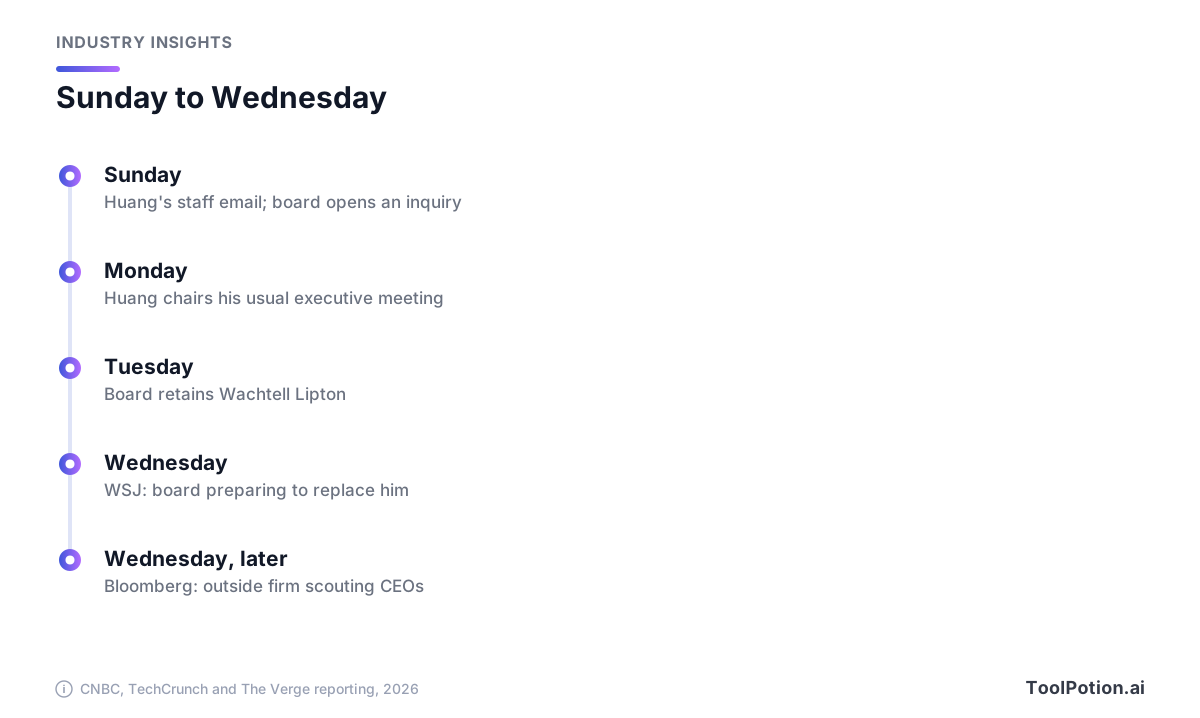
What nobody has shown is a decision. As far as we read, the board's Sunday statement of confidence in Huang hasn't been withdrawn, and the WSJ and Bloomberg items are sourced reports, not announcements. We'd treat them that way. Nvidia's shares fell after hours on the WSJ report (more than 9% at one point, per CNBC; more than 7%, per The Verge). We won't tell you what that means for the stock, and nobody should take that from a tools directory.
A board with a thin bench
TechCrunch spoke to two corporate governance professors, who said there is no real precedent for a CEO caught up in a suspected honeypot. Ann Lipton of the University of Colorado said an internal investigation will be "exactly as thorough" as the directors running it want it to be, which she called standard (TechCrunch). Todd Henderson of the University of Chicago framed the key question as what Huang knew and when: a CEO who hired a crisis-PR firm over an affair he thought was only embarrassing is one story; a CEO who knew the woman was a suspected spy is another.
Two structural facts frame what the board can do. Huang has about 60 direct reports, delegates very little and, per TechCrunch, the company has no obvious successor or succession plan. On the other side, Nvidia has no dual-class shares and Huang reportedly owns about 3.6%, so he doesn't control the vote, which Lipton said makes him "easier to dislodge."
Our view: the second fact is why the WSJ story is plausible, and the first is why a hurried exit would be messy. A company that routes this many decisions through one person has to find out, in public, which of them nobody else can make.
What Washington is asking Nvidia
Three House chairs (Brian Mast of Foreign Affairs, John Moolenaar of the China committee and Rick Crawford of intelligence) asked Huang to appear before their committees. Asked whether a subpoena was possible if he declined, Mast said "yes" (CNBC). Mast's list of questions is mostly about the business: where Nvidia has sold chips, what Megaspeed may have used them for, who has been remotely accessing Nvidia chips, and what information passed between Huang and the woman (CNBC). Moolenaar, on CNBC, added a question that bears directly on supply: whether China was given preference in buying Nvidia's limited supply of advanced chips.
The politics cut across parties. Republican Sen. Kevin Cramer and Rep. Don Bacon, and Democratic Rep. Suhas Subramanyam, have said Huang should resign. Sen. Chuck Schumer, citing press reports, said Trump was briefed more than a year ago and did nothing (CNBC). Trump suggested he only recently learned of it, said he was "amazed," said Huang told him he "had no idea that she was a spy," and said the FBI is looking into it (CNBC). We can't adjudicate between those accounts, and neither can the reporting we read.
Legislation is where this could turn into rules. Sens. Elizabeth Warren and Jim Banks urged colleagues to attach the AI Overwatch Act to this year's defense bill, saying it would "cut off pathways through which China accesses advanced chips" (CNBC). Moorhead expects more export-control legislation, possibly giving Congress oversight of chip licences or requiring location-tracking security features. Not everyone wants the scandal in that debate: Rep. Jay Obernolte, who co-chairs the House AI task force, told CNBC "It's important not to have a personal scandal interfere with the substantive policy discussion about to what degree we should be allowing the export of cutting edge chips to our geopolitical competitors like China." (CNBC).
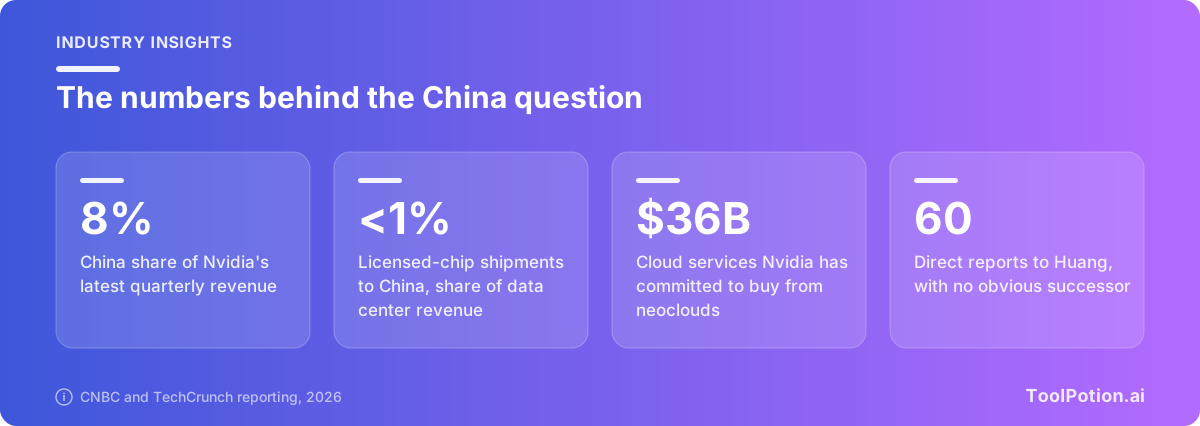
Our read is that the near-term change is in process, not in headline bans. Moorhead's line is the best summary of it: "Every China license now gets read through this story." Licensed sales were already small. China was 8% of Nvidia's revenue in the latest quarter, Nvidia's own forecasts assume 0% for China, and Beijing hasn't approved large-scale imports of the licensed chip, Moorhead said (CNBC). The live fight is about leakage, and we'd expect Congress to focus there.
How restricted chips reach Chinese buyers is a separate and older story: Moorhead pointed to a Bloomberg report that Megaspeed imported 50,000 more Nvidia chips than Nvidia tallied in its data centers (Megaspeed denies wrongdoing). CNBC also points to the rental gap: a Chinese company that can't buy the chips can still rent them in a data center outside China.
Supply and prices: nobody has reported a change
We looked for a delayed shipment, a price change or a shift in who gets allocation. None of the coverage we read reports one, and Nvidia's position is that nothing will be interrupted. Anyone predicting GPU prices from this story is making a forecast, and we'd read it like one.
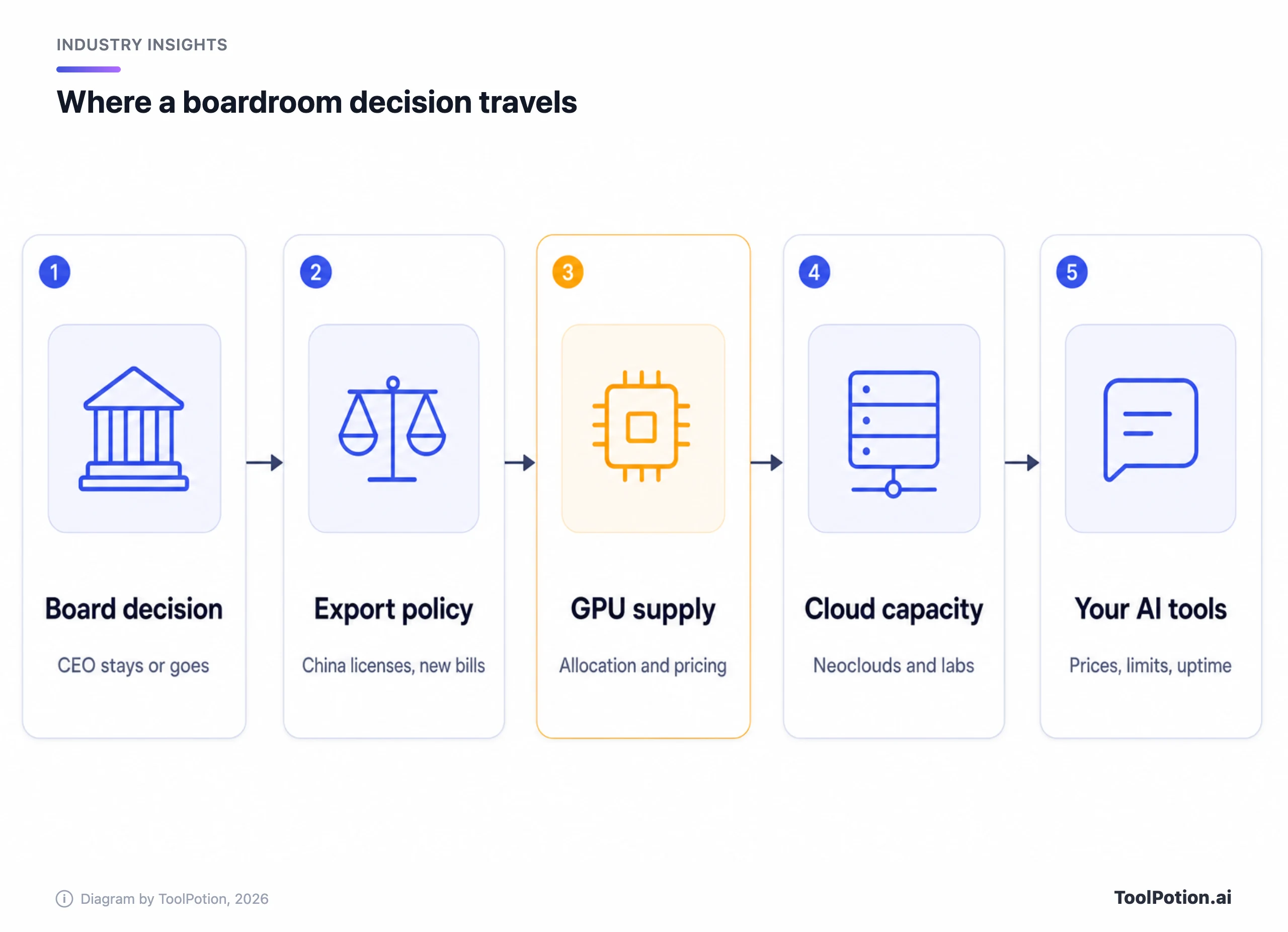
There are four places a change could come from. Allocation is the first: if Congress forces answers on who got scarce chips, buyers will want to see those answers too. License friction on China-bound products is the second, and its direct effect on worldwide supply looks small given those numbers. Leadership bandwidth is third: Huang is unusually hands-on, and a board fight takes attention. The fourth is compliance cost, if tracking requirements become law, because somebody pays for that hardware and software. We doubt any of the four moves prices in the short run. Demand and financing push prices harder, and CNBC's analysis of Nvidia's financing web is the better place to look for stress.
Neoclouds and labs lean on Nvidia for more than chips
CoreWeave and its peers rent out Nvidia GPUs, and CNBC's analysis reports that Nvidia has committed to buy up to $36 billion in cloud services from those companies. That helps Nvidia guarantee customers for its chips and helps the neoclouds borrow. Jason Wu, an IMF assistant director, calls arrangements like this circular financing, and warned that "both the economy and financial markets are standing on the same leg." Columbia's Stijn Van Nieuwerburgh puts Nvidia's commitments of every kind (the $36 billion is one piece; project guarantees are others) at about $400 billion, a small fraction of its roughly $4 trillion market value, and unlikely to come due all at once (CNBC).
The market has so far treated the scandal as Nvidia's own problem. Most neocloud share prices recovered while Nvidia's fell, per CNBC's financing analysis (CNBC). CoreWeave's own results release puts its latest quarterly revenue at $3.66 billion, up about 168% from $1.37 billion a year earlier (CoreWeave). A CEO change doesn't void a purchase contract. What would hurt neoclouds is a credit scare, in which falling GPU values make lenders question whether borrowers can repay, and nothing reported so far is that. Sheila Bair, who ran the FDIC, told CNBC Nvidia isn't too big to fail "in a bank sense at all."
For labs the exposure is different. They need chips more than they need any one executive, and Van Nieuwerburgh told CNBC that Google, Microsoft and OpenAI, among others, are building their own AI chips that could replace Nvidia's over time. We'd call that the long-run hedge. It does nothing for anyone's capacity this year.
| Who | Depends on Nvidia for | Reported so far | Our read |
|---|---|---|---|
| Frontier labs | Training and serving chips | Nothing on supply changes | Watch allocation news, not headlines |
| Neoclouds such as CoreWeave | Chips, purchase commitments, financing | $36B in commitments; CoreWeave revenue up 168% year over year | Insulated now, exposed to a credit scare |
| AI tool makers | Model APIs that run on rented GPUs | Nothing | Any price change would arrive late |
| People using the tools | Nothing directly | Nothing | No action beyond good habits |
What changes for the tools you use
Today, nothing. We found no coverage of a change to ChatGPT, Claude, Gemini or any other assistant tied to this story. If one comes, it will arrive as a price move, a tighter rate limit or a capacity wobble, and it will arrive late, because vendors absorb cost changes for a while before they pass them on. Price is part of the product, so it's the first thing we'd check. Here is what we'd do in the meantime.
- Find out where your model calls run. If you build on an API, ask the vendor which clouds serve you. If you only use apps, skip this one.
- Wire in a second provider and test it. For assistants we'd keep both ChatGPT and Claude available (our three-way comparison covers which jobs suit which). For coding agents, Claude Code and Gemini CLI are the pair we'd keep installed.
- If you run open models, spread them. Together AI and Runpod rent capacity differently, and vLLM or Ollama lets you move a model between them or onto your own machine.
- Don't prepay a year of anything on a rumour in either direction. Month to month costs a little more and keeps the option open until the investigation and the earnings report settle.
- Set a spending alert that fires within a day, so a price change doesn't wait for the invoice.
If you build on Nvidia's own open software, the picture is narrower. Code and weights you've already downloaded don't change. The risk is on the roadmap and license side for NVIDIA NeMo and models like Nemotron 3.5 Bolt 74B, where nobody has said anything. We'd keep a copy of what you depend on. Our earlier piece on Nvidia and Hugging Face makes the same case for open models generally, and Hugging Face remains the easiest place to check what else exists. Our Top 50 LLMs board shows what's ranked today if you need to swap one out, and the AI coding assistants board does the same for developers.
Three endings, and what each costs you
Huang could stay if the investigation clears the board and Washington moves on, which looks hard after Wednesday's reports. He could hand over in an orderly way, with a successor named and Huang advising. Or he could be pushed out while an outside search is still running in public.
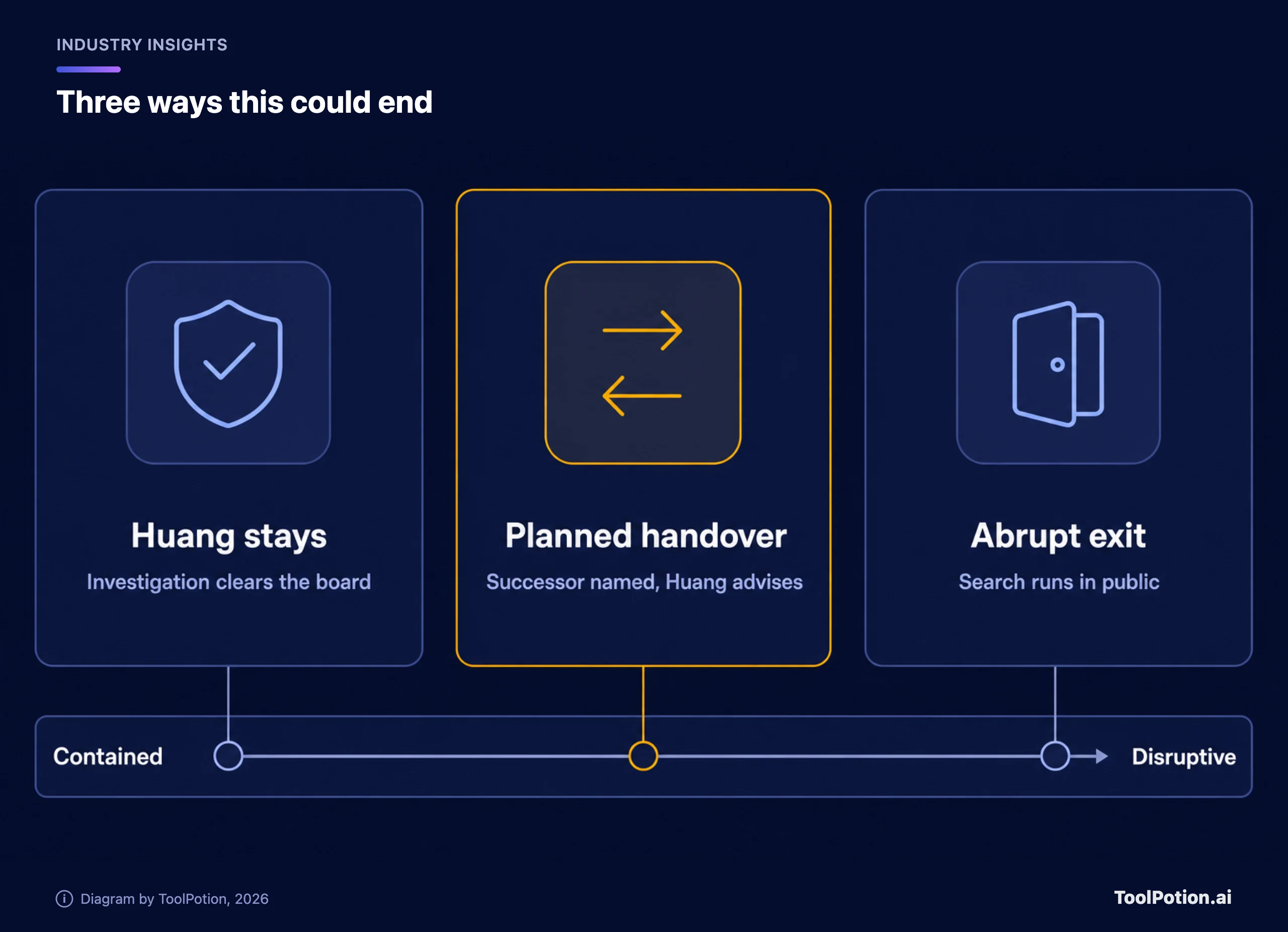
We think the planned handover is the best case for customers: it's the one outcome that tells buyers somebody has the whole job. We'd expect an abrupt exit to produce weeks of mixed messages on China and no change at all in what ships, because roadmaps and fabs don't turn on a boardroom vote. And if he stays, the policy fight carries on regardless. The CEO is the variable investors and reporters are staring at. The export rules, the neocloud financing and the chip supply are the ones that touch your tools.
Dates and decisions to watch
- The board's decision, and whether it names an interim CEO or a timeline for a search.
- Nvidia's earnings report, which CNBC says is due on the 17th: the first set of numbers after all this, and whether it repeats the assumption of 0% for China.
- Whether the three House committees follow through on a subpoena if Huang doesn't appear.
- Whether the AI Overwatch Act or similar chip-tracking language makes it into the defense bill Congress is still negotiating.
- Whether Huang takes his place on the delegation for the next US and China leaders' meeting, which CNBC says is in doubt (CNBC).
- Any neocloud or lab saying it was told to expect a delay. That would be the first real change for tools, and we haven't seen it.