

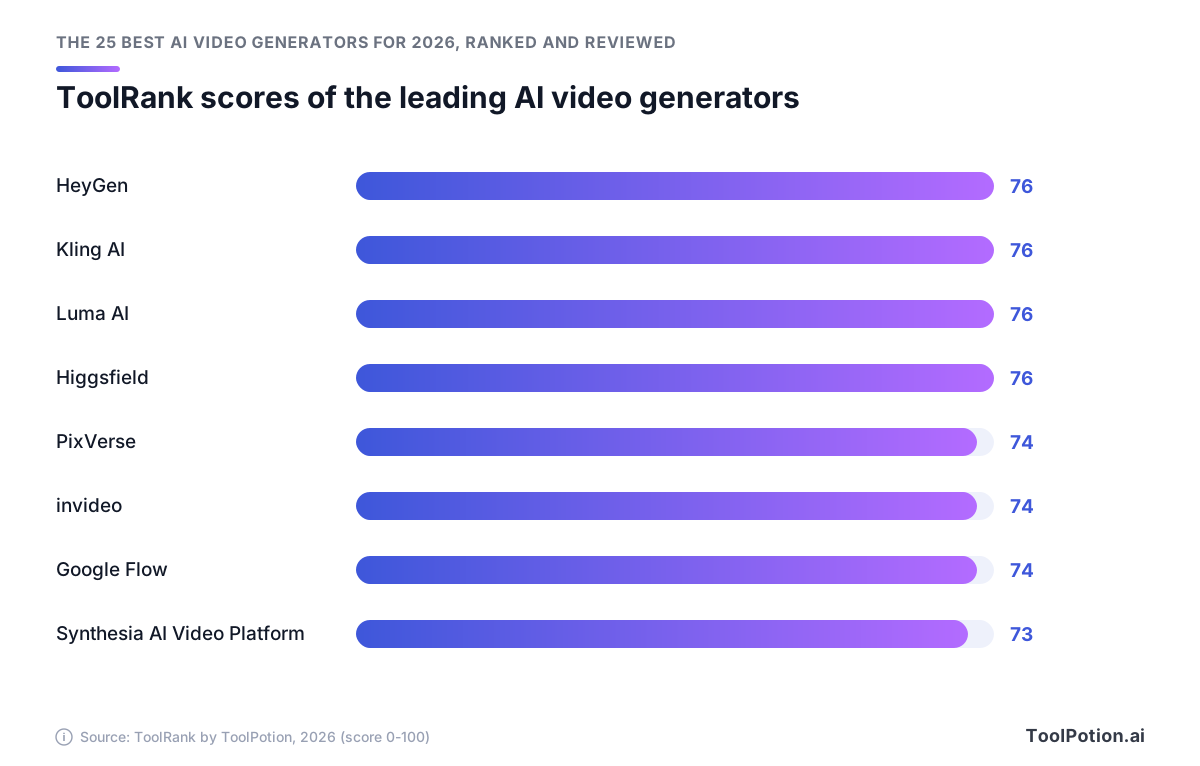
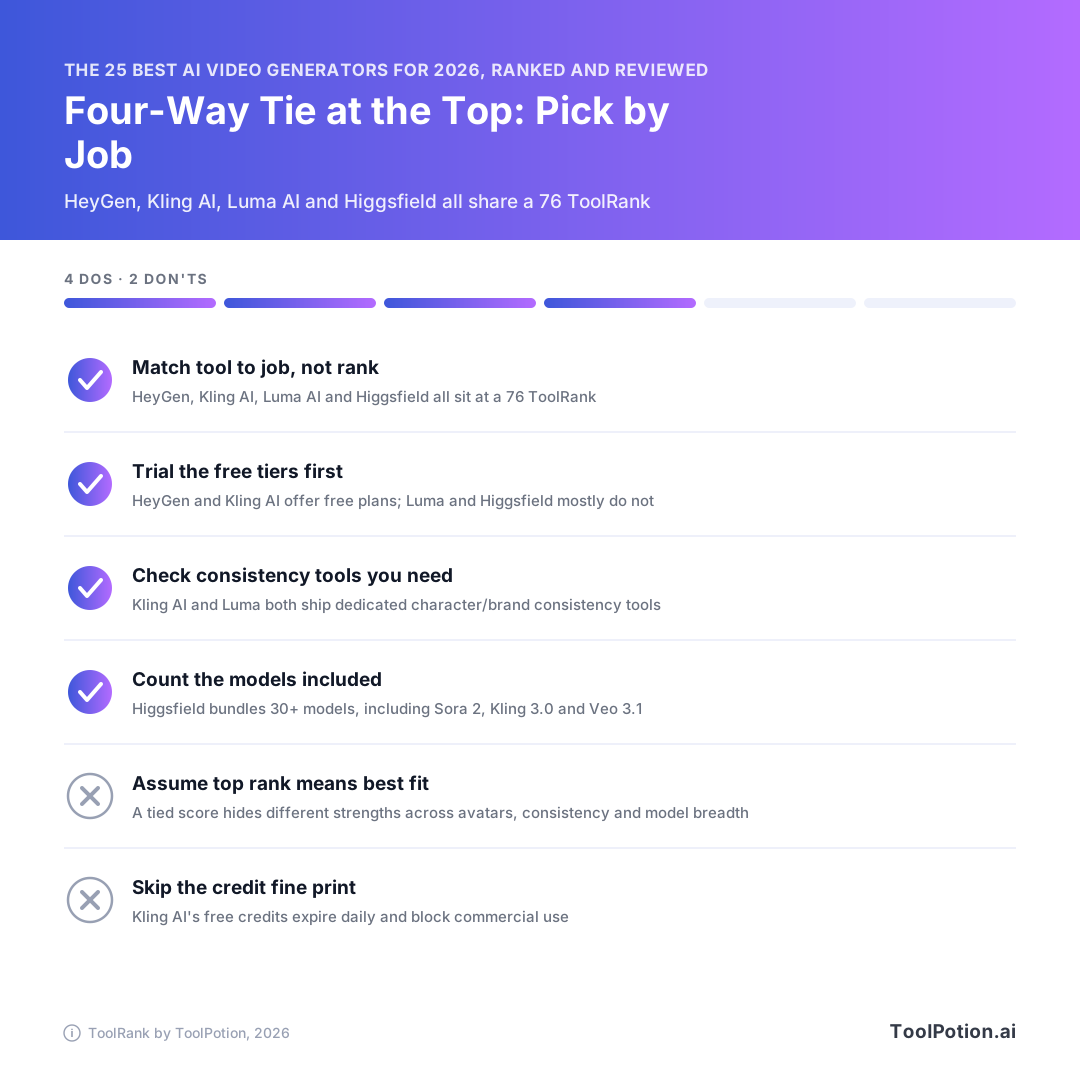
If you're comparing the best AI video generators 2026 has to offer, start with a four-way tie. HeyGen, Kling AI, Luma AI and Higgsfield share the top ToolRank score of 76 on the 2026 board, so the right pick depends on the job you need done.
Our AI video generators leaderboard ranks 335 tools. This guide covers the top 25 with quick picks, short reviews that name each tool's catch, sourced pricing and a decision guide. Prices have moved a lot this year, and several free plans have shrunk or disappeared.
If you already know what you're making, start with the leaderboard below.
The top 25 AI video generators in 2026
- # 1首选HeyGenAI 应用HeyGen 允许用户通过输入文本、图像或音频在几分钟内创建逼真的 AI 视频。它提供了多种视频生成特性,包括旁白、字幕和动画,非常适合创作者和企业使用。77ToolRank强劲
- # 2亚军Kling AIAI 应用Kling AI 是一个先进的 AI 视频和图像生成器,可以将文本和图像转化为高质量的多媒体内容。它提供了本地音频、电影级分辨率和角色一致性等功能,非常适合创意专业人士和市场营销人员。76ToolRank强劲
- # 3季军LumaAI 应用Luma AI 是一个创意平台,专为视频生成和图像创作而设计,利用先进的人工智能模型。它简化了创意工作流程,使用户能够高效地生成、编辑和完善多媒体内容。非常适合希望提升创意流程的机构和品牌。76ToolRank强劲



- 4HiggsfieldAI 应用Higgsfield 是一个原生于 AI 的创意套件,可以根据文本提示或参考生成图像、视频和语音内容。它为各个技能水平的创作者、营销机构和电影制作人而构建。76ToolRank强劲
- 6Google FlowAI 应用Google Flow 是一个 AI 创意工作室,帮助用户利用先进的生成模型将他们的想法转化为电影般的视频和图像。它提供无缝创建、完善和分享创意项目的工具。74ToolRank强劲
- 7Adobe FireflyAI 应用Adobe Firefly 是一个全方位的 AI 创意工作室,使用户能够使用超过 30 个 AI 模型生成高质量的内容,包括图像、视频和音频。它为各种创意项目提供速度、控制和创作自由。73ToolRank强劲
- 8Synthesia AI 视频平台AI 应用Synthesia 是领先的商业 AI 视频平台,用户可通过文本创建专业视频,使用超过 160 种语言的先进 AI 虚拟形象和配音。它简化了培训、营销和内部沟通的视频制作流程,无需技术专长即可轻松上手。73ToolRank强劲
- 9PikaAI 应用Pika 是一个用于视频、图像和音频生成的 AI 创意平台。它将自己的模型(如 Pika 2.5 和 Pika Soundtrack)与第三方模型(如 Seedance、Nano Banana 和 ElevenLabs)结合在一套应用程序中,旨在为广告创意人员、编辑、营销人员和电影制作人提供视频创作、图像编辑、角色设计和音效的工具。73ToolRank强劲
- 10invideoAI 应用invideo 是一个基于 Agent Two 的 AI 视频创作和编辑平台,允许用户使用多个 AI 模型和 5000 多个模板生成和编辑视频。它服务于创作者、营销人员和企业。72ToolRank强劲
- 11Viggle AIAI 应用Viggle AI 是一个用于 3D 角色动画和动作捕捉的空间 AI 平台。其 Meme Maker 可以将角色替换到任何视频或照片中,PINOC 可以将手机视频片段转化为游戏准备好的动作捕捉,无需动作捕捉工作室,而其 API 和游戏则允许开发者和工作室将角色和动作功能构建到自己的产品中。71ToolRank强劲
- 12Luma AI (luma.ai)AI 应用Luma Layers 是一个由 AI 驱动的平台,可以从文本或图像创建视频。它提供多种模型和模板进行编辑,确保在创作前对信用成本的隐私和透明度。69ToolRank强劲
- 13Hailuo AIAI 应用Hailuo AI 是一个 AI 视频生成器和提示工具,可以将一小段文本转化为精美的 AI 视频。它旨在帮助希望快速制作引人入胜视觉内容的创作者。67ToolRank强劲
- 14Runway移动应用RunwayML 的 iOS 应用为 iPhone 用户提供由 AI 驱动的图像和视频生成功能。以任何风格创建具有一致角色和场景的视觉内容。提供聊天模式,简化提示输入,并与桌面账户无缝传输素材。定期更新,包含新的 AI 模型和功能。63ToolRank强劲
- 15Fliki - AI视频生成器AI 应用Fliki是一个AI视频生成器,可以将文本、脚本和博客文章转换为视频,支持80种语言中的2000多种AI语音。它不需要相机或编辑技能,使视频创作对每个人都变得可及。60ToolRank强劲
- 16Pictory.aiAI 应用Pictory.ai 是一款视频创作工具,可将文本转换为专业的视频。它利用 AI 自动选择相关的素材库视频、添加配音,并从文章、脚本或现有内容创建引人入胜的视频内容。非常适合营销人员、内容创作者和寻求高效视频制作的企业。57ToolRank稳健
- 17D-IDAI 应用D-ID 提供一个自助平台,用于生成 AI 视频,用户可以创建带有动画头像的视频。其创意现实工作室将深度学习技术与文本生成相结合,适用于寻求创新视频解决方案的企业和内容创作者。57ToolRank稳健
- 18Hedra — 视觉智能的推理与基础设施AI 应用Hedra是一家人工智能研究和基础设施公司,专注于构建视觉智能模型及其在生产环境中的运行平台。通过其先进的工具和协作功能,Hedra促进了创造性生产力。57ToolRank稳健
- 19Lumen5AI 应用Lumen5 是一个由人工智能驱动的视频创作平台,可在几分钟内将博客和文章等文本内容转化为引人入胜的视频。它通过提供拖放式界面和自动化功能,简化了视频制作流程,即使是没有经验的用户也能轻松上手,适用于营销、沟通和教育领域。55ToolRank稳健
- 20Steve AI 视频创作AI 应用Steve AI 是一个获得专利的 AI 视频创作平台,可在几分钟内将文本、音频或提示转换为专业视频。拥有超过 700 万用户信赖,它提供生成式 AI、实景和动画视频选项,让视频制作对创作者和企业都触手可及。免费开始创作。54ToolRank稳健
- 21Biteable - AI视频制作工具AI 应用Biteable是一个基于AI的在线视频制作工具,使用户能够快速创建专业视频。通过AI头像、文本转语音和可自定义模板等功能,它简化了营销、培训等视频制作过程。54ToolRank稳健
- 22freebeat.aiAI 应用freebeat.ai 是一个 AI 音乐视频生成器,可以将歌曲、上传文件或流媒体链接转换为成品视频。它分析曲目的节奏和结构,然后在一个工作流程中生成与节拍同步的视觉效果、舞蹈或表演场景,以及卡拉 OK 风格的歌词视频。它专为希望获得成品视频而无需编辑技能的音乐家、舞者、内容创作者和制作人而设计。54ToolRank稳健
- 23MagicLightAI 应用MagicLight 是一个 AI 长视频生成器,可以将创意、剧本或故事转化为最长可达 50 分钟的完整视频,具有一致的人物、场景切换、配音和字幕。54ToolRank稳健
- 24AI STUDIOSAI 应用DeepBrain AI 的 AI STUDIOS 是一个集成的 AI 视频平台,提供头像视频、文本转视频、配音和生成视频。它提供 2000 多个逼真的头像和声音,支持 150 多种语言的配音,以及用于营销、培训和创作者的 4K 导出。53ToolRank稳健
- 25KaiberAI 应用Kaiber 是一个由 AI 驱动的视频生成平台,专为音乐人和创作者设计。它提供画布(Canvas)等工具,可从提示或参考素材开始创作;节拍同步(Beat Sync)功能可自动创建与音乐同步的视频;编辑器(Editor)则用于完善最终输出。该平台支持多种领先的 AI 模型,简化了社交媒体和其他平台的视频内容创作。53ToolRank稳健



















ToolRank 如何运作
ToolRank is ToolPotion’s proprietary ranking engine.
It continuously evaluates hundreds of signals across the open web — real traffic and popularity, audience and community strength, authority and longevity, adoption and engagement — processing millions of data points to place every tool where it has earned to be.
Every AI type is measured by its own tailored model: what proves traction for a SaaS app is not what proves it for an open-source framework or a creator channel. Missing a platform never counts against a tool — ToolRank judges the evidence that exists.
No paid placement. No self-reported numbers. Rankings refresh monthly as ToolRank re-measures the market.
Best AI video generators 2026: quick picks by job
Short on time? Match the tool to what you're making, then check the plan terms in the reviews further down.
- For avatar-led marketing and presenter videos, go with HeyGen, #1 on the 2026 board.
- Cinematic clips with native audio point to Kling AI, which is built around native audio output and cinematic 4K resolution.
- Agencies that need brand consistency across a campaign should start with Luma AI, because its Master Reference Assets are designed to keep outputs on-brand.
- If you want one hub for trying many models, Higgsfield lets you run a prompt through several of them from one login.
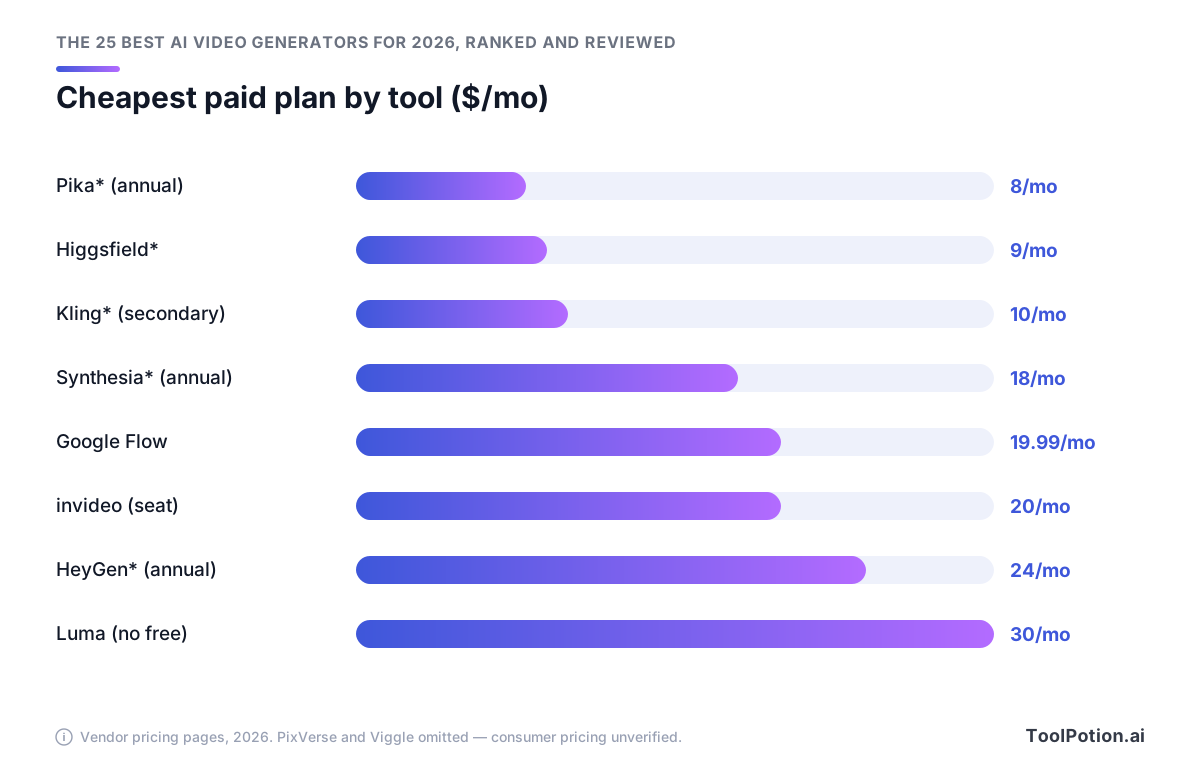
- The best budget entry is Pika, whose Standard plan costs $8/mo billed annually for 700 credits with no watermark (Pika pricing).
- For enterprise training in many languages, Synthesia is the pick, and its free Basic plan gives you up to 10 minutes of video a month with no card required (Synthesia pricing).
Stuck between the top four? Let the output decide. If your video is a scripted talking head, pick HeyGen. For prompt-driven footage, choose Kling AI if you want one model or Higgsfield if you'd rather compare several.
What changed for AI video generators in 2026
A roundup from 2025 gets two things wrong for 2026: who has the money to last, and what you'll pay to start.
The money got serious
Synthesia raised a $200M Series E at a $4B valuation on Jan 26, 2026, led by Google Ventures (Synthesia). Seven months later, Higgsfield closed a $400M Series B at $5.4B and reported $700M in annualized revenue and 30M+ users (TechCrunch).
Our read is that products this well funded will keep changing. The tool you standardize on this year may look different by the time your annual plan renews, so keep your source files and exports somewhere you control, and don't build a team workflow around one vendor's quirks.
Sharper output: vertical, 4K and editable layers
Google's Veo 3.1 "Ingredients to Video" update on Jan 13, 2026 added native 9:16 generation plus 1080p and 4K upscaling, and every output carries a SynthID watermark (Google). If you publish Shorts or Reels, you can stop cropping 16:9 renders. The upscaling only works in Google Flow, the Gemini API and Vertex AI, so check where you're generating before you promise a client 4K.
Luma launched Layers on July 29, 2026. It splits an image into independently editable layers, so you can pull a product or character out as a transparent asset (Luma).
The bigger structural shift is the multi-model hub. Higgsfield bundles Kling 3.0 and Veo 3.1 among its 30+ models, and invideo puts Seedance 2.5, Veo 3.1 and Kling 3.0 behind one subscription. That's handy when you want to test one prompt across models without juggling logins. For a model-by-model breakdown, see how Sora, Veo, Runway and Kling compare.
Free tiers got thinner
invideo's pricing page lists no free plan at all now, though reports from earlier in 2026 described one with 10 AI minutes a week (invideo). Luma's Agents pricing has no free tier either (Luma pricing).
The free plans that are left come with strings attached. Kling AI gives you 66 daily login credits and bans commercial use (Kling AI). Pika caps free users at 80 credits a month of watermarked 480p video, also with no commercial use (Pika).
The four leaders tied at the top
HeyGen, Kling AI, Luma AI and Higgsfield all score 76 and sit in the strong tier on the 2026 board. Don't treat the #1-to-#4 order in the leaderboard above as a quality ladder. With identical scores, the right pick comes down to what you're making.
HeyGen: best for avatar-led marketing and training videos
HeyGen turns a script, an image or an audio file into a video with a presenter. It fits marketing explainers and onboarding modules, where a talking head is the format. Its March 2026 release added Avatar V, which generates studio-quality video from a 15-second recording (HeyGen).
Free users get 3 videos a month, each capped at 1 minute and watermarked. That's enough to judge avatar quality and too little to ship anything. Creator costs $29/mo, or $24/mo billed annually. It removes the watermark and allows videos up to 30 minutes. Pro starts at $49/mo, and its credit ladder climbs to $4,300/mo for 100,000 credits (HeyGen pricing). Most solo marketers will be fine on annual Creator, and if avatars are all you need, check the top AI avatar generators before you commit.
Kling AI: best for cinematic clips with native audio
Kling AI is the pick when you want prompt-driven footage with sound already attached. Native audio, 4K output, multi-shot control and character consistency are all built in, which suits short ads and storyboards. Kling also has three more listings lower on the board, which we sort out in the ranks 11 to 25 section.
Credits expire monthly, so size your plan to what you'll render in a month. Paid plans run Standard at $10/mo, Pro at $37/mo, Premier at $92/mo for 8,000 credits and Ultra at $180/mo for 26,000 credits (Kling AI). Treat those figures as approximate and confirm them on Kling's membership page before you pay.
Luma AI: best for agencies that need brand consistency
Luma AI makes you pay from day one, since its Agents plans have no free tier. Plus is $30/mo for 10,000 credits, Pro is $90/mo for 40,000 and Ultra is $300/mo for 150,000. An older set of Dream Machine plans ($9.99, $29.99 and $94.99) still exists separately, so it's easy to budget against the wrong prices (Luma Labs).
What you get for that money is a platform built for teams running campaigns. Its agents can handle several creative tasks at once, and Master Reference Assets keep products and characters on brand from one asset to the next. Layers, covered earlier, works inside the same workspace.
For an agency with steady client work, Pro makes sense. Solo creators who are still testing ideas should try a tool with a free plan first.
Higgsfield: best hub for many models in one place
Higgsfield puts 30+ models behind one login, so it suits you if you want to run one prompt through several models and keep the best result. Cinema Studio adds 1,296 camera lenses and color grading. Soul ID keeps a character's look the same from shot to shot.
Budget more credits than you think. The free tier covers only a small set of models, and Basic is $9/mo for 120 credits, which runs out fast when every comparison means another render. Plus is $49/mo for 1,000 credits and Ultra is $129/mo for 3,000 (Higgsfield). These prices come from Higgsfield's own 2026 comparison with Runway. If comparing models is why you're signing up, skip Basic and start on Plus.
Ranks 5 to 10: specialists and all-rounders
Scores barely drop after the top four. Ranks 5 through 9 score 74 or 73, and Viggle AI rounds out the top 10 at 70. All six are in the strong tier, so choose by the job you need done.
PixVerse: best for batch video ads
PixVerse runs its own video foundation models for text-to-video and image-to-video. Growth Studio turns one brief into a batch of ads ready for each channel. Canvas is a node graph where you plan a production and rerun single steps when a client changes the brief. The models have a track record: V5 debuted at #2 on Artificial Analysis's image-to-video leaderboard in 2025, and the line has since moved through V5.5 and V5.6 to V6 in 2026 (PR Newswire).
Canvas takes some learning. If you've never wired up a node graph, expect a while before batch runs beat prompting by hand.
Developers pay separately. The PixVerse API has no free tier, and its Essential plan costs $100/mo for 15,000 credits (PixVerse docs). That's the developer API only, and this guide doesn't cover PixVerse's consumer plan prices, so check those on its site.
invideo: best template-led editor with multi-model access
invideo is an editor first. Its Agent Two builds and edits the video using 200+ image, video, audio and music models, and you can start from any of 5,000+ templates. If your marketing team wants to generate and cut in one tab, this is the tool we'd pick.
Everything is priced per seat. Starter is $20 per seat per month for 400 credits, and you need Plus at $60 per seat to unlock Seedance 2.5 (invideo). A five-person team on Plus pays $300 a month. For lighter options, see our list of the best AI short video makers.
Google Flow: best for vertical and 4K Veo output
You'll need a Google AI Plus ($19.99/mo) or Ultra subscription before Google Flow will generate any video. Once you're in, it's Google's studio for Veo 3.1, and since a 2025 update its main video modes generate native audio, including dialogue and lip-synced music (Google). In 2026, Google folded Whisk and ImageFX into Flow, so you make images and video in the same workspace (Google).
Add the vertical and 4K output covered earlier, and it's our pick here for high-resolution Shorts and Reels.
Synthesia: best for enterprise training at scale
Synthesia's AI video platform is built for corporate video. Its avatars speak 160+ languages, and more than 90% of the Fortune 100 use it (Synthesia). It also has one-click video translation, which is worth a look if your L&D team ships the same compliance course to a dozen countries.
Your plan decides how many avatars you get. The free Basic plan is watermarked and has 9, while Enterprise gets 240+. Starter costs $29/mo ($18/mo billed annually), and Creator costs $89/mo ($64/mo annually) and adds API access (Synthesia pricing).
Pika: best low-cost entry point
Pika's Standard plan has the lowest annual-billed price we could verify among these tools, with 700 watermark-free credits. Pro is $28/mo annually for 2,300 credits. Monthly billing costs about 20% more on either plan, so the listed prices assume you commit for a year (Pika). Pikascenes, its editing tool, is aimed at trend clips and photo animation.
The free plan, covered earlier, is a sample and nothing more.
Viggle AI: best for memes and photo-to-motion clips
Viggle AI is a niche tool for memes and remixes. Give it a photo and a reference video, and it makes the person in the photo dance or lip-sync using motion taken from that video. It can also export the animation as an FBX or GLB file, so a 3D artist can reuse the motion in other software.
For a polished product ad, PixVerse or HeyGen will serve you better. Get consent before you animate a real person's photo, and check your local law on using someone's likeness. For more motion-first tools, browse our board of AI tools for creating animations.
How to choose the right AI video generator
Decide what you're making first. Then read the plan terms before you pay, because that's where the surprises are.
If you make talking-head, training or localized videos
For marketing explainers and personalized sales outreach, pick HeyGen. If your audience is employees in a dozen countries, pick Synthesia instead, since it's built for localized training. If you plan to plug video into an LMS or internal tooling, Synthesia's Creator plan (priced in its review above) is the tier that includes API access.
If you make cinematic or social clips
If you want one model with native audio and consistent characters, start with Kling AI. If you already have the Google AI subscription Flow requires, you get its vertical and 4K output without paying for another tool. If you'd rather run one prompt through several models before you commit, Higgsfield is the better fit.
If you're on a tight budget or need commercial rights
For the cheapest watermark-free output we could verify, pick Pika Standard. Be careful with free plans, though: Kling's and Pika's both bar commercial use (see above), so neither works for client projects.
If you run a team, agency or ad pipeline
Agencies that juggle several brands should look at Luma AI for the brand controls covered in its review. If you ship ads in volume, PixVerse's Growth Studio is built for batch runs. Template-led teams will get along with invideo, though its prices are per seat.
Run this check before you enter a card number:
- Confirm the plan allows commercial use.
- Export a test clip and look for a watermark.
- Find out when credits expire, and don't buy more than you'll use before they do.
- Multiply any per-seat price by your real headcount before you compare it with a flat plan.
If you mostly edit footage you already have, the top AI tools for video editors board and our guide to the best AI video editing tools are a better place to start.
Beyond the top 10
Ranks 11 to 25 worth a look
From #11 to #25, scores fall from 69 to 56, and the tier changes from strong to solid at #18. We'd shortlist these six, each for a specific job.
- Hailuo AI (#12, 69) has first- and last-frame control, so you decide where a clip starts and where it lands.
- Vidu (#13, 69) keeps subjects consistent across multiple references and handles anime.
- Adobe Firefly (#14, 67) puts 30+ models inside one Adobe studio.
- Runway's iOS app (#18, 59, solid) is the one to pick if you want consistent characters and locations from your phone.
- Dreamina (#23, 57) runs the Seedance and Seedream models and can make short dramas for ads and social posts.
- D-ID (#22, 57) gives you a self-service studio for animated avatar videos, useful for quick talking-head clips.
Some brands appear more than once. Kling has four listings: Kling AI at #2, the Kling 3.0 AI Video Generator at #15 (67), the Kling AI mobile app at #17 (63) and the Kling 3.0 model page at #19 (58). Luma has #3 plus Luma Layers at #11 (69). The board lists distinct products, models and apps separately, so a web platform and its mobile app each get their own spot. For Kling, the #2 entry is the one to bookmark.
CapCut AI Video Editor (#16) and Wondershare AI (#20) are ranked but don't have a score yet.
Just outside the top 25
A few tools below #25 cover narrow jobs. MagicLight turns scripts or stories into long-form videos up to 50 minutes. Tavus builds real-time AI humans that talk with people face to face. Seedance is a standalone generator for the Seedance 2.0 and 2.5 models. For everything else, see ranks 26 to 250 on the full board.
About ToolRank
ToolRank is ToolPotion's independent ranking of AI tools, and no one can pay for a spot. We keep every board current as tools launch and fade, and you can find all ToolRank leaderboards in one place. To look past the rankings, browse every AI video generator in our directory.
Frequently asked questions
What is the best AI video generator in 2026?
HeyGen is #1 on the 2026 board. Pick it if your videos need a presenter or an avatar. For cinematic text-to-video, go with Kling AI (#2), and see the four-leaders section above for how Luma AI (#3) and Higgsfield (#4) compare.
Is there a free AI video generator without a watermark?
None of the free plans we could verify. HeyGen (HeyGen pricing), Synthesia (Synthesia pricing) and Pika (Pika pricing) all watermark free exports. Pika's Standard plan is the cheapest watermark-free option we could verify, and HeyGen's Creator plan also removes the watermark.
Can I use videos from a free AI video generator commercially?
Not on the free plans we could check. Kling AI's free tier doesn't allow commercial use (Kling AI), and Pika's free plan rules it out as well (Pika). Plan to pay for a tier, and read its license terms before you put a clip in a paid campaign.
Is HeyGen or Synthesia better for training and avatar videos?
For internal training, pick Synthesia. Its free Basic plan gives you up to 10 minutes of video a month, and Starter costs $18/mo billed annually (Synthesia pricing). HeyGen's free plan stops at 3 one-minute videos, and Creator costs $24/mo billed annually (HeyGen pricing). HeyGen ranks higher on the 2026 board (#1 with a ToolRank score of 76, against Synthesia's #8 and 73), and its Avatar V model generates studio-quality video from a 15-second recording (HeyGen), so it's the better choice for marketing and personalized outreach.
Do AI video generator credits expire?
Kling AI's do. Its credits expire monthly, so anything you don't use is gone when the month ends (Kling AI). For the other tools here, we couldn't confirm the expiry rules. Luma Plus gives you 10,000 credits for $30/mo (Luma), and HeyGen Creator includes 600 credits (HeyGen pricing), but neither pricing source says whether unused credits roll over. Check the terms before you buy a bigger tier.
Which AI video generator lets me use Veo 3.1 and Kling 3.0 in one place?
Higgsfield and invideo both give you Veo 3.1 and Kling 3.0 in one workspace. Higgsfield is #4 on the 2026 board with a ToolRank score of 76. It has a limited free tier, and Basic starts at $9/mo for 120 credits (Higgsfield). invideo is #6 with a ToolRank score of 74, has no free plan and starts at $20/seat/mo for 400 credits (invideo). We'd start with Higgsfield: it ranks higher and costs less to try.