Streaming services disagree about almost everything involving AI music except one point: listeners should be told. YouTube Music has started putting AI-generated music labels on the player page, and Deezer says a switch that hides AI tracks from search is coming before the end of the year (TechCrunch, TechCrunch).
Spotify, Tidal, Bandcamp and Apple Music have each picked their own mix of badges, bans and demonetization. If you make music with a generator like Suno or Udio, the platform you release on now changes what happens to the track. Some will label it, some will cut its royalties, and one won't host it at all.
Here's what each service does, why it's happening, and what to do before you upload.
What YouTube Music started labeling
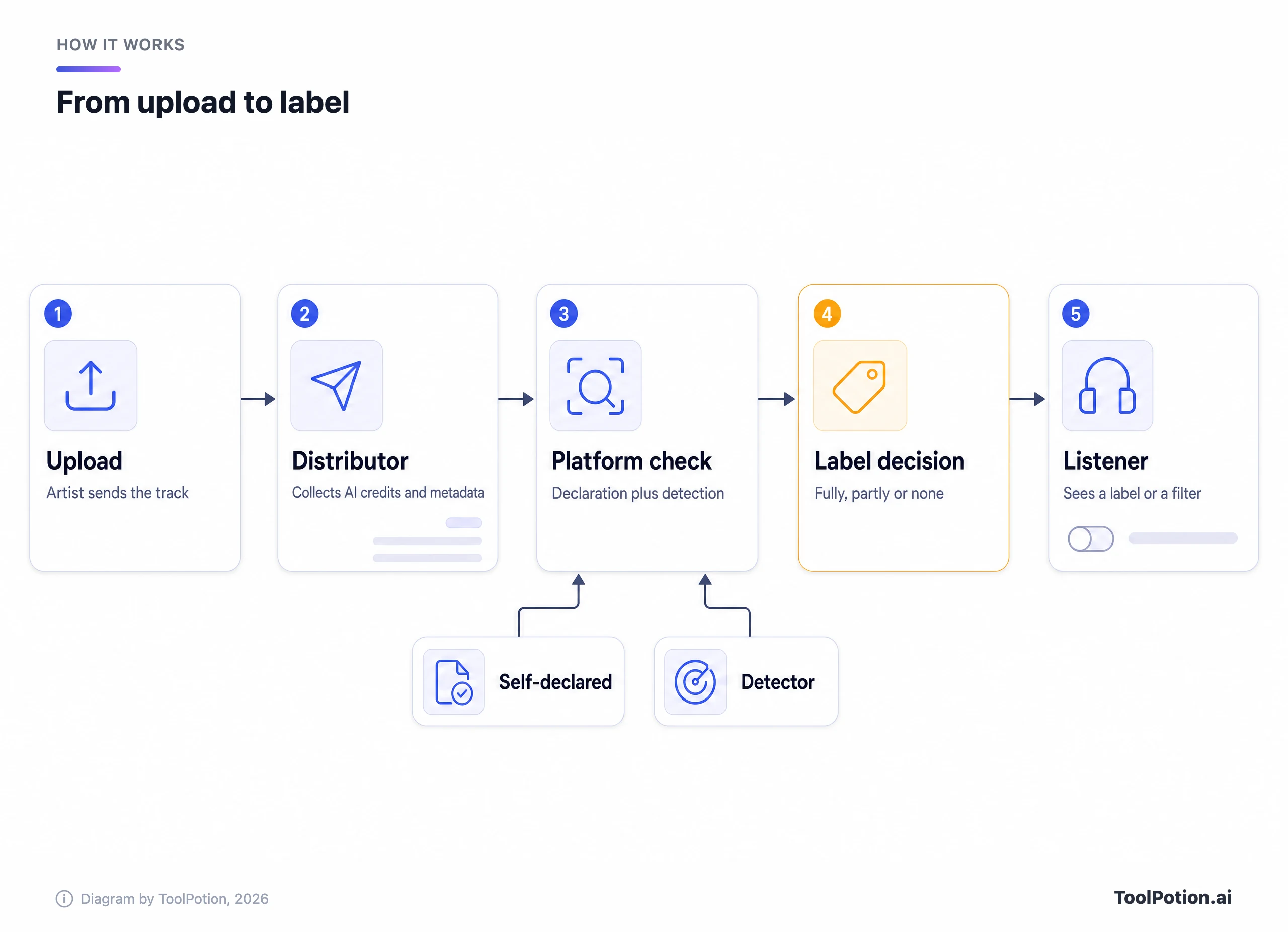
YouTube says it's rolling out labels for songs created primarily with generative AI, for example when a model produced the composition and the vocals. The label sits on the player page in YouTube Music, and tapping it opens a short explanation. YouTube says the same labels will reach the main YouTube app (YouTube blog).
The labels come from two places. Music partners declare AI use when they deliver a release, and YouTube runs its own detection on top. Partners pick one of three designations: Fully Gen AI, Partly Gen AI or No Gen AI. It's up to the partner to interpret those definitions. If a partner provides nothing, the status is treated as unknown unless YouTube can determine it some other way, in which case it may mark the content as fully or partly Gen AI (YouTube Help). Partners who don't deliver through DDEX or CSV can mark the disclosure in the attribute section of YouTube Studio.
The part creators care about is the money. According to TechCrunch, AI involvement alone doesn't make a track ineligible for monetization on YouTube, so this is disclosure and not a ban. Standard pitch correction like Auto-Tune counts as No Gen AI.
Deezer detects, tags and is about to hide
Deezer has taken the hardest line among the big services that still carry AI music. It tags tracks its detector flags as fully AI-generated, keeps them out of algorithmic and editorial recommendations, and pulls fraudulent streams out of the royalty pool. The new toggle, due before the end of the year, will remove AI tracks, albums and related artists from search results (TechCrunch).
The reason is demand. TechCrunch reports that a survey from last year found around 45% of Deezer's customers wanted a way to remove AI music from their feeds. CEO Alexis Lanternier said Deezer has "seen clear user demand for the ability to filter out AI-generated music."
The volume is the other reason. Deezer says fully AI-generated tracks reached more than 50% of daily deliveries on peak days, averaging about 90,000 a day at its 2026 peak (Deezer). TechCrunch notes the figure was about 10,000 a day, or 10% of uploads, at the start of 2025 (TechCrunch).
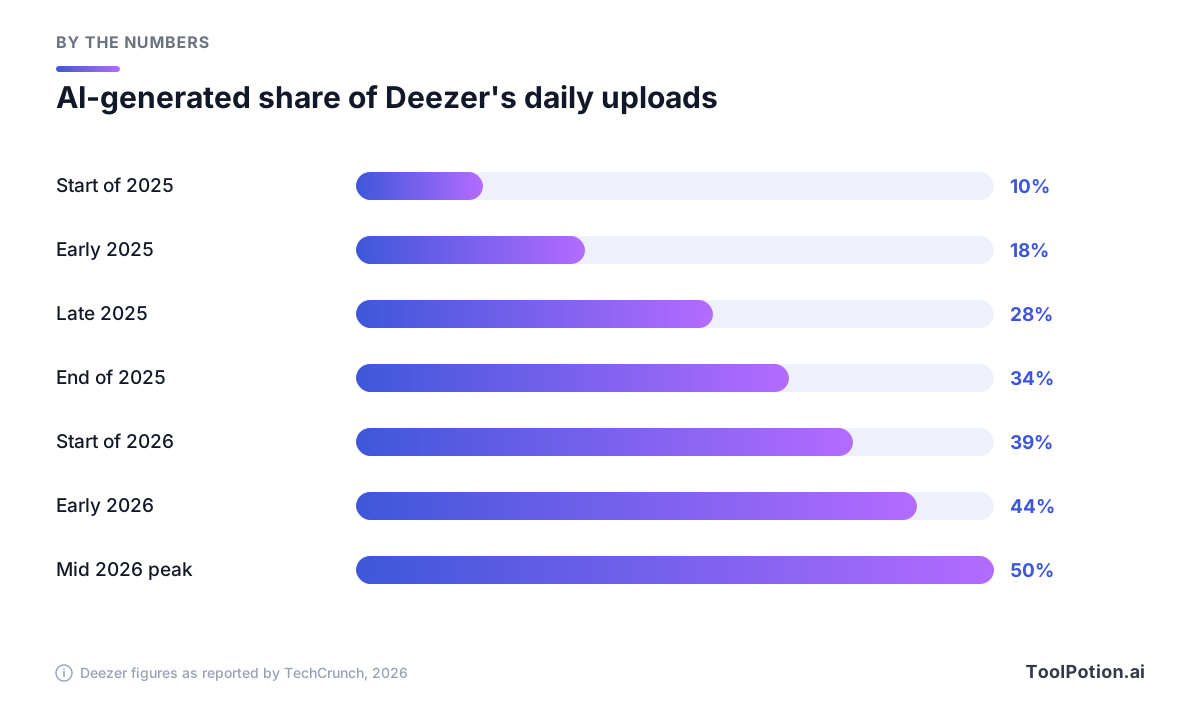
Listening hasn't kept up with uploading. Deezer says AI tracks make up only 1 to 3% of total streams, and that up to 85% of streams on fully AI tracks were fraudulent in 2025. It plans to remove AI tracks used for streaming fraud and those that haven't been streamed in six months. Deezer says its detector is 99.8% accurate and flags fewer than 1 in 10,000 human tracks by mistake, and TechCrunch adds that it can identify output from Suno and Udio models. Those accuracy numbers are Deezer's own claims, and no outside audit of them turned up.
Spotify, Tidal, Bandcamp and Apple Music
Spotify's approach is to build a spectrum rather than a switch. Its 2025 policy backed DDEX, an industry standard that lets labels, distributors and partners put AI disclosures in a track's credits, covering AI vocals, instrumentation or post-production. Spotify says disclosing AI use won't bring penalties or down-ranking. It also announced a spam filter and a rule that vocal impersonation is only allowed when the impersonated artist has authorized it (Spotify). Its reasoning is that AI use is "increasingly a spectrum, not a binary."
This year Spotify added "AI Persona" badges. They go on artist profiles that appear to be AI-generated people, and the music stays out of editorial and algorithmic recommendations unless a listener follows the artist. Spotify says it will review profiles itself instead of relying on self-disclosure, that artists can appeal, and that the badge is "about the artist's public identity, not about how the music was made" (TechCrunch).
Tidal went after the money. Under a policy that took effect in 2026, fully AI-generated tracks get an AI badge, can't collect royalties and aren't eligible for direct-to-fan sales, and impersonation tracks are removed (TechCrunch). Bandcamp went furthest, banning music generated wholly or in substantial part by AI (TechCrunch). Apple Music plans "Made With AI" labels later this year, and will require labels and distributors to tag songs where a material portion was made with AI (Variety).
Apple Music shows how fast this moved. Vice president Oliver Schusser told Billboard earlier this year that "more than a third" of uploaded tracks were "100% AI," Variety reports. He said Apple has in-house detection but that uploaders must "take responsibility" for disclosing AI use. YouTube and Spotify are making the same bet: self-declaration first, detection as the backstop.
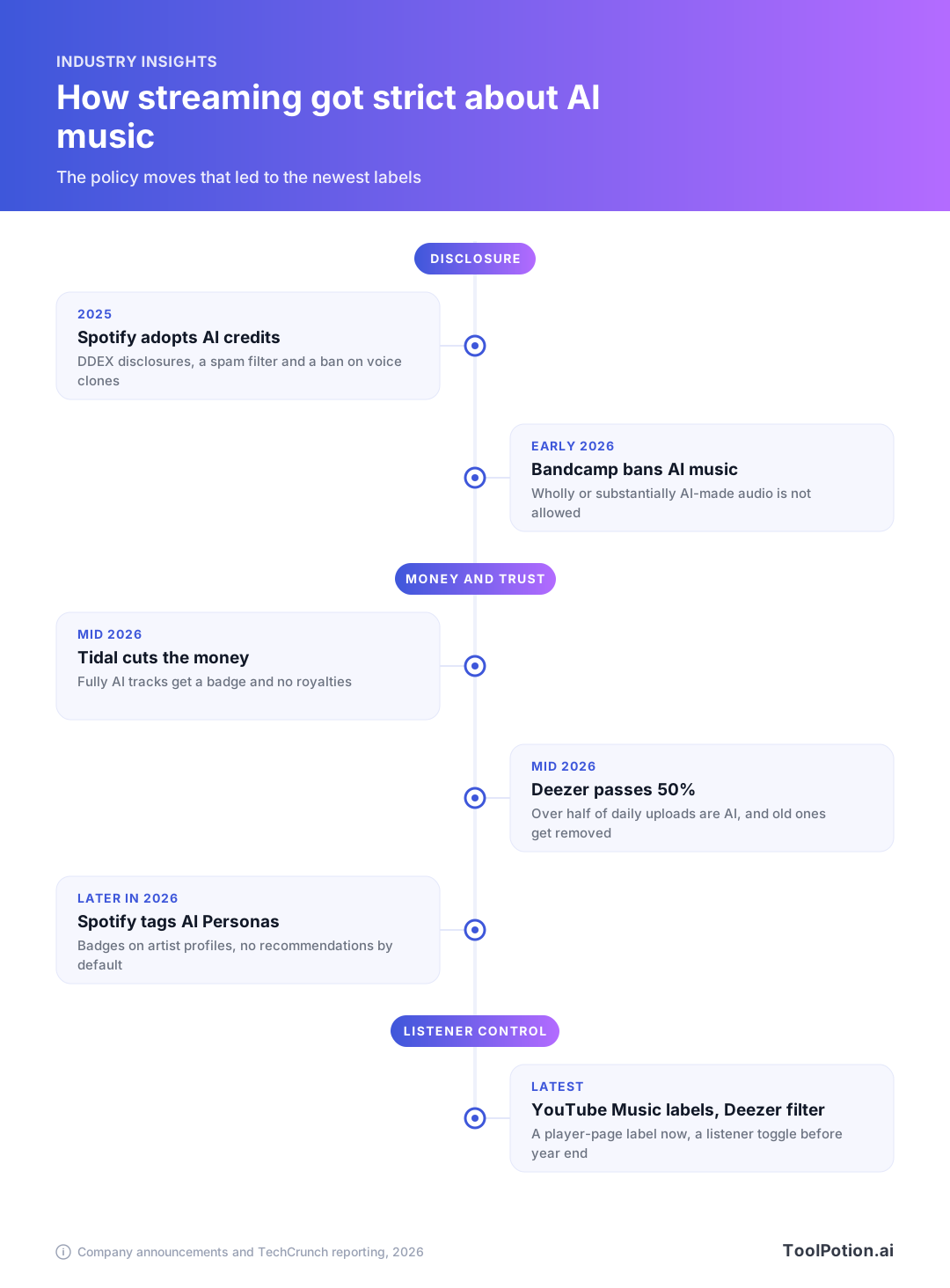
Put side by side, the differences are plain. Only Tidal cuts off royalties for fully AI tracks outright, and only Bandcamp keeps them out entirely.
| Platform | What listeners see | What happens to fully AI tracks |
|---|---|---|
| YouTube Music | Label on the player page | Labelled, monetization not blocked by AI alone |
| Deezer | AI tag, filter toggle coming | No recommendations, fraudulent streams demonetized, unstreamed ones removed |
| Spotify | AI credits, AI Persona badges | Unauthorised voice clones barred, personas kept out of recommendations |
| Tidal | AI badge | No royalties and no direct-to-fan sales |
| Bandcamp | Not applicable | Not allowed |
| Apple Music | Made With AI label planned | Labelled once distributors tag them |
Why platforms are suddenly strict
Three pressures arrived together. Fans said they don't want to hear it. Fraudsters found that a generator plus a distributor makes a cheap way to farm royalties. And rights holders started suing. Universal Music Group filed suit against DistroKid in federal court in Delaware in 2026, alleging the distributor lets large volumes of AI-generated tracks and unauthorized remixes reach streaming services, some of them passed off as genuine artist releases (RouteNote, Hypebot). DistroKid disputes the claims and says it will defend itself.
Since the suit, some indie artists have complained that songs disappeared from services, and some say their tracks were human-made. DistroKid told Hypebot that "a very small number of recordings" were removed in response to UMG's claims. None of this has been tested in court. A distributor under legal pressure will usually err toward removal anyway.
Where your track falls on the spectrum
The labels only make sense if you know which bucket a track lands in. YouTube's own examples draw the line at what the model made. A song generated end to end from a prompt is the clear Fully Gen AI case. AI layers under your own live playing sit in the middle. Standard pitch correction sits at the other end, and YouTube puts Auto-Tune in the No Gen AI bucket.
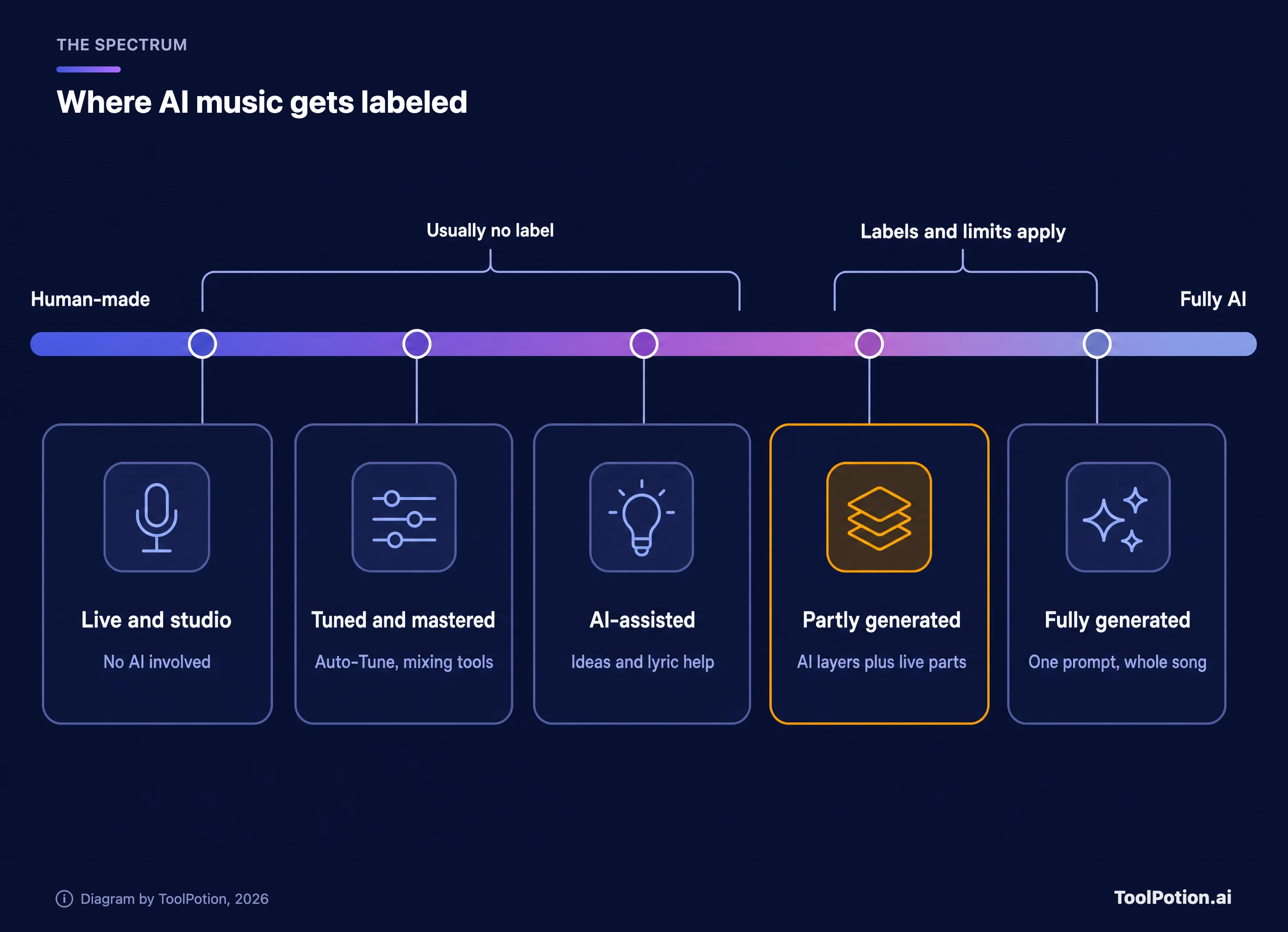
The hard cases are in the middle. YouTube's help page gives one example: generate a bassline or string section with a tool, record your own vocals and instruments over it, and the track is Partly Gen AI. Lyric ideas or mixing aids are less clear, and YouTube says it's up to partners to interpret the definitions. Spotify's DDEX credits face the same gray area. Disclose more rather than less. A label you chose costs you little. A label a detector slapped on after you stayed silent comes with no explanation.
What the labels can't tell you
A label is a claim about process, and the process is invisible. YouTube's wording is "primarily" generative AI, which leaves a wide gray zone. A track built from a Suno draft, re-sung by a human and mixed by hand might be called Partly Gen AI by one distributor and No Gen AI by another. Nothing in the rules settles that, because the definitions are left to the partners.
Detection has the opposite problem. Deezer and YouTube both say they use their own tools, and Deezer says its detector can pick out Suno and Udio output. Detectors work on what a model leaves in the audio. That means a heavily edited generation, or a human track that happens to share traits with a model, can land on the wrong side. The platforms say these errors are rare, but the appeal paths are thin.
So the labels are best read as a rough guide to how a track was made, not a verdict on its quality. Plenty of listeners will use them as a filter anyway, which is the point of Deezer's toggle. For creators, that turns disclosure into a marketing choice as well as a compliance one.
What to do if you release AI-assisted music
Start with the generator's terms. Suno's help center says paid Pro and Premier plan users own their songs and get a commercial license to monetize them, while on the free plan Suno owns the songs and use is non-commercial. It also warns that songs may not be eligible for copyright protection either way (Suno Help). Check Udio's current terms before building a release on it. Other tools worth a look sit on our AI music generators board, including Stable Audio, SOUNDRAW and DiffRhythm. For a broader comparison, see our guide to AI music generators.
Distributors are the other gatekeeper, and they're the one most creators forget about. The platforms read AI credits from whatever the distributor delivers, so a vague answer in your upload form travels all the way to the listener's screen. After Universal's suit, some artists say tracks were pulled from DistroKid, which says only a very small number of recordings were affected. If a release matters to you, check your distributor's current AI rules before you pay for the upload, not after a takedown.
Then work through the practical steps:
- Fill in your distributor's AI disclosure field every time, and match it to what you actually did.
- Skip anything that imitates a real artist's voice or name. Spotify and Tidal both say they'll remove it.
- Upload finished releases at a sensible pace. Batches of near-identical tracks look like spam to filters and fraud teams.
- Keep your project files, stems and prompts. If a detector gets it wrong, you'll want proof of how the track was made.
- Pick the platform to match the track. A fully generated song won't survive Bandcamp, and it earns nothing on Tidal.
Detection errors are real, even if Deezer says they're rare. A human producer with heavily processed vocals could get flagged, and appeals differ by platform. Spotify has an appeal route for AI Persona labels. Elsewhere you'll mostly be going through your distributor.
A cleaner workflow also helps. If you use AI audio editors for noise removal or mastering, note it in your records, since YouTube's help page doesn't say where mastering tools land and your distributor may ask. Our roundup of AI audio editors covers what's available.
What listeners can do now
On YouTube Music, look for the label on the player page and tap it for detail. On Deezer, watch for the toggle before the year ends. On Spotify, check the artist profile for an AI Persona badge, since the label is about the profile, not each song. Deezer has also released a tool that scans Apple Music and Spotify playlists for AI-generated tracks, TechCrunch reports. If you'd rather curate by hand, our AI music generators hub shows what's out there, so you know which names to expect.
Frequently asked questions
Does YouTube demonetize AI-generated music?
Not on the basis of AI use alone, according to TechCrunch. YouTube is focusing on disclosure with its new labels. Other YouTube rules, such as copyright and impersonation, still apply.
Can I stop AI music from showing up on Deezer?
Soon. Deezer says its filter toggle will arrive before the end of the year and will hide AI tracks, albums and related artists in search results.
Will Spotify label my Suno song?
Spotify uses DDEX credits that distributors supply, plus AI Persona badges for AI-generated artist identities. It doesn't force a simple yes or no on tracks. What shows depends on what your distributor reports.
Is it safe to distribute Suno or Udio tracks right now?
It depends on disclosure, rights and the distributor. Declare AI use, check your plan's commercial terms and avoid sound-alikes. Distributors are tightening checks while lawsuits are pending, so expect more friction.
Which streaming services ban AI music?
Bandcamp bans music made wholly or substantially with AI. Tidal and Deezer allow it but restrict royalties or recommendations. YouTube Music and Spotify mainly label and filter.