AI copyright lawsuits are still mostly unresolved in 2026, but the map is clearer than it was a year ago. Anthropic paid $1.5 billion to settle with authors, music labels are signing licensing deals with Suno and Udio, and the biggest news-industry case, The New York Times against OpenAI and Microsoft, is in the summary judgment phase. No US court has ruled that training an AI model on copyrighted work is always legal, and none has ruled that it is always illegal.
One independent tracker counts 148 US copyright suits against AI companies (ChatGPT Is Eating the World). You don't need all of them. This guide covers the cases that move the law, where each one stands right now, and what that means if you use ChatGPT, Claude or Midjourney for real work. Anything described as a claim below is an allegation. Courts haven't decided most of them.
This is a status report, not legal advice. It's built from court coverage, trackers and the vendors' own terms, and some of it will date quickly. If real money rides on a decision, ask a lawyer.
The short version: who is winning AI copyright cases
Nobody is winning cleanly. Here is how the pieces fit.
Settlements and licenses are piling up faster than verdicts, which suggests both sides would rather buy certainty than risk a ruling. The one appeals court to speak so far, in the Ross case, went against the AI company, but on a non-generative tool. Courts in Germany are reading the same question more strictly than US courts would. And on the question most users care about, owning what the AI makes, the US answer is stable: a human has to contribute the expression.
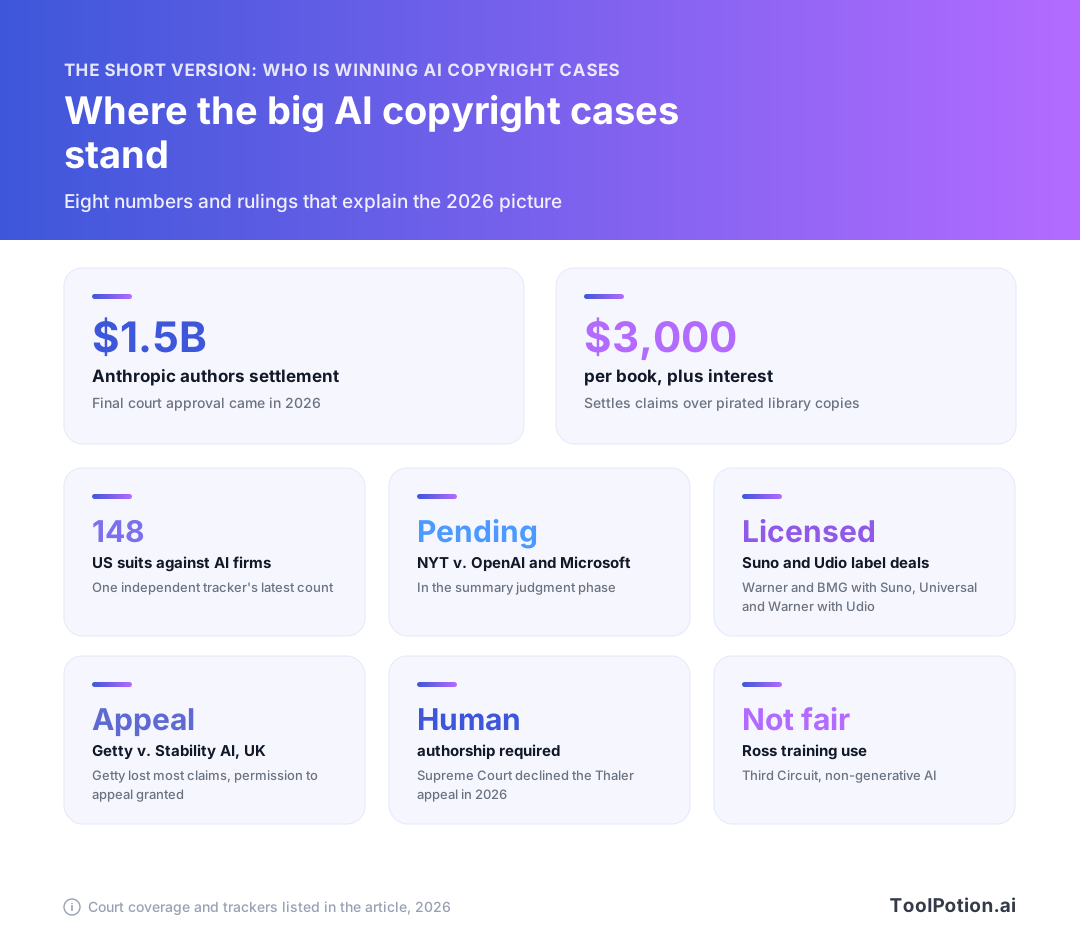
The graphic above is the whole article in eight tiles. The rest explains what sits behind each one.
How we got here, in four years
The first wave came in 2023. Artists sued Stability AI, Midjourney and DeviantArt, Getty sued Stability AI in the UK, and The New York Times sued OpenAI and Microsoft at the end of the year. Record labels followed in 2024 with suits against Suno and Udio. In 2025 the first real rulings arrived, and the studios joined in: Disney and Universal sued Midjourney, then Warner Bros. Discovery did too.
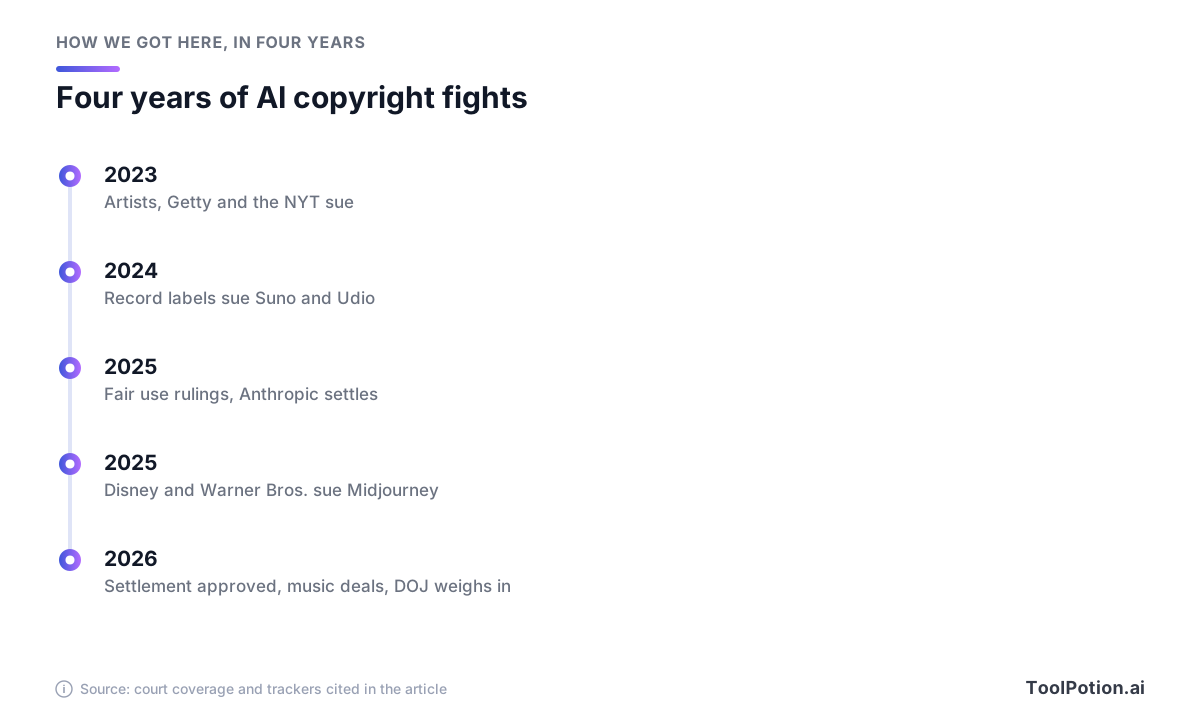
What changed in 2026 is that the pending cases started to mature. A big settlement got final approval, appeals courts started to speak, and the US government weighed in on one side. The next sections take them in order of how much they matter.
The New York Times v. OpenAI and Microsoft
This is the case most people mean when they say "the AI copyright lawsuit." The Times sued in late 2023, alleging that OpenAI trained on its articles without permission and that ChatGPT and Microsoft's Copilot can reproduce them. OpenAI says training is fair use. The cases from other news outlets and authors were folded into one proceeding in New York, and the tracker describes it as "already in the summary judgment phase" (ChatGPT Is Eating the World).
The big recent move came from Washington. The Trump administration filed a brief in the Manhattan federal court backing OpenAI and saying AI training generally makes fair use of copyrighted material. Reuters reported it appears to be the first time the US government has weighed in on the wave of AI training cases, and noted that such a brief carries advisory rather than legal weight. The Times' response was that the administration was siding with AI companies at the expense of the creators whose work they used (Reuters).
Don't read a verdict into it. A government brief is an argument, not a ruling, and summary judgment decisions can be appealed. USA Today has since filed its own suit against OpenAI that tracks the Times claims, per the tracker, so the pile keeps growing even as the lead case moves toward a decision.
Authors v. Anthropic: the $1.5 billion settlement
The Anthropic case is the biggest payout so far. Authors accused Anthropic of downloading pirated books from the Library Genesis and Pirate Library Mirror sites while building its Claude models. Anthropic settled for $1.5 billion, roughly $3,000 per work plus interest, and Judge Araceli Martinez-Olguin granted final approval in 2026, according to the Authors Guild (Authors Guild). Anthropic did not admit liability.
The release is narrow. Authors give up claims over Anthropic's past acquisition and copying of their books. Claims over AI outputs and over future conduct are not released, and neither are claims over works that aren't on the settlement's works list (same source). Music publishers have also sued Anthropic over lyrics. Those remain allegations.
The lesson for everyone else in the industry: where the training data came from matters. The money here was paid over pirated library copies, not over the act of training itself.
Thomson Reuters v. Ross and the fair use rulings
The first two US judges to rule on AI training and fair use, in 2025, issued diverging rulings, Reuters noted. The newest marker comes from an appeals court. Ross Intelligence, a now-defunct startup, trained a legal research tool on Westlaw headnotes. In 2026 the Third Circuit affirmed that the headnotes are copyrightable and that Ross's use was not fair use (Courthouse News).
The panel called Ross's use "minimally transformative at best" and stressed that Ross wanted to compete directly with Westlaw. That is a big caveat for everyone else. Ross wasn't a generative model, so defendants like OpenAI will argue the ruling doesn't reach them. Still, it is the first appeals-level word on training and fair use, and it went against the AI company.
Music, images and video: licenses before verdicts
Suno and Udio
Music is where deals have moved fastest. Udio says it has licensing agreements with Universal Music Group and Warner Music Group to train new models on their catalogs, and that the Warner arrangement also resolves their copyright litigation (Udio). Suno has announced partnerships with Warner Music Group and BMG, and says its v6 models were developed with industry partners including Warner, BMG and Believe. Suno's announcements describe partnerships rather than settlements, so we don't call them settlements here. We could not confirm from primary sources which labels, if any, are still suing Suno, so check before you rely on a given catalog being licensed.
Udio and Suno now look less like pure defendants and more like licensees of some labels. For you, that means the answer to "is this track safe for my ad" depends on which catalog a given output draws on, which you can't see. We come back to that in the practical section.
GEMA in Germany
Outside the US, a Munich court has been less friendly to AI companies. German collecting society GEMA prevailed against OpenAI over song lyrics in 2025. In 2026 the Munich Regional Court ruled for GEMA against Suno. Teosto, the Finnish collecting society, summarizes the judgment this way: the court found that the model memorizes the protected works and retains copies, so both training on them and reproducing them in output are infringement. Suno can appeal (Teosto).
Fair use is a US doctrine, so German courts reason differently, but anyone selling into Europe should note the direction.
Midjourney, Getty and Stability AI
Disney and Universal sued Midjourney in 2025, and Warner Bros. Discovery followed. Midjourney has agreed by stipulation to hand its video training datasets to the plaintiffs (ChatGPT Is Eating the World). That's discovery, not a finding, but it means the studios will get to look inside the training data.
Getty's UK case against Stability AI went the other way. The judge dismissed Getty's copyright infringement claims, then gave Getty permission to appeal, which Chambers notes is rare for a first-instance judge (Chambers). Getty also has a separate US case against Stability AI, which this guide doesn't cover. If you use the open-weight Stable Diffusion Web UI, the UK appeal is the one to watch.
Here is the status of the main cases at a glance.
| Case | What is alleged | Where it stands now |
|---|---|---|
| NYT, authors v. OpenAI and Microsoft | Training on articles and books without permission | Summary judgment phase in New York. US government brief backs OpenAI |
| Authors v. Anthropic | Training on pirated books | Settled for $1.5B, final approval in 2026 |
| Thomson Reuters v. Ross | Training on Westlaw headnotes | Third Circuit affirmed: not fair use |
| Labels v. Suno | Training on sound recordings | Partnerships announced with Warner and BMG; status of other labels unconfirmed |
| Labels v. Udio | Training on sound recordings | Licensing deals with Universal and Warner (Udio's account) |
| Disney, Universal, Warner Bros. v. Midjourney | Training on and reproducing characters | In discovery, with training video data to be shared |
| Getty v. Stability AI (UK) | Training on photos, watermark use | Copyright claims dismissed, permission to appeal granted |
Where the legal risk sits when you use AI tools
Most of the cases above are fights between rights holders and AI companies. They're about how models were built. As a user you sit at the other end of the pipeline, and your exposure comes mainly from what you publish.
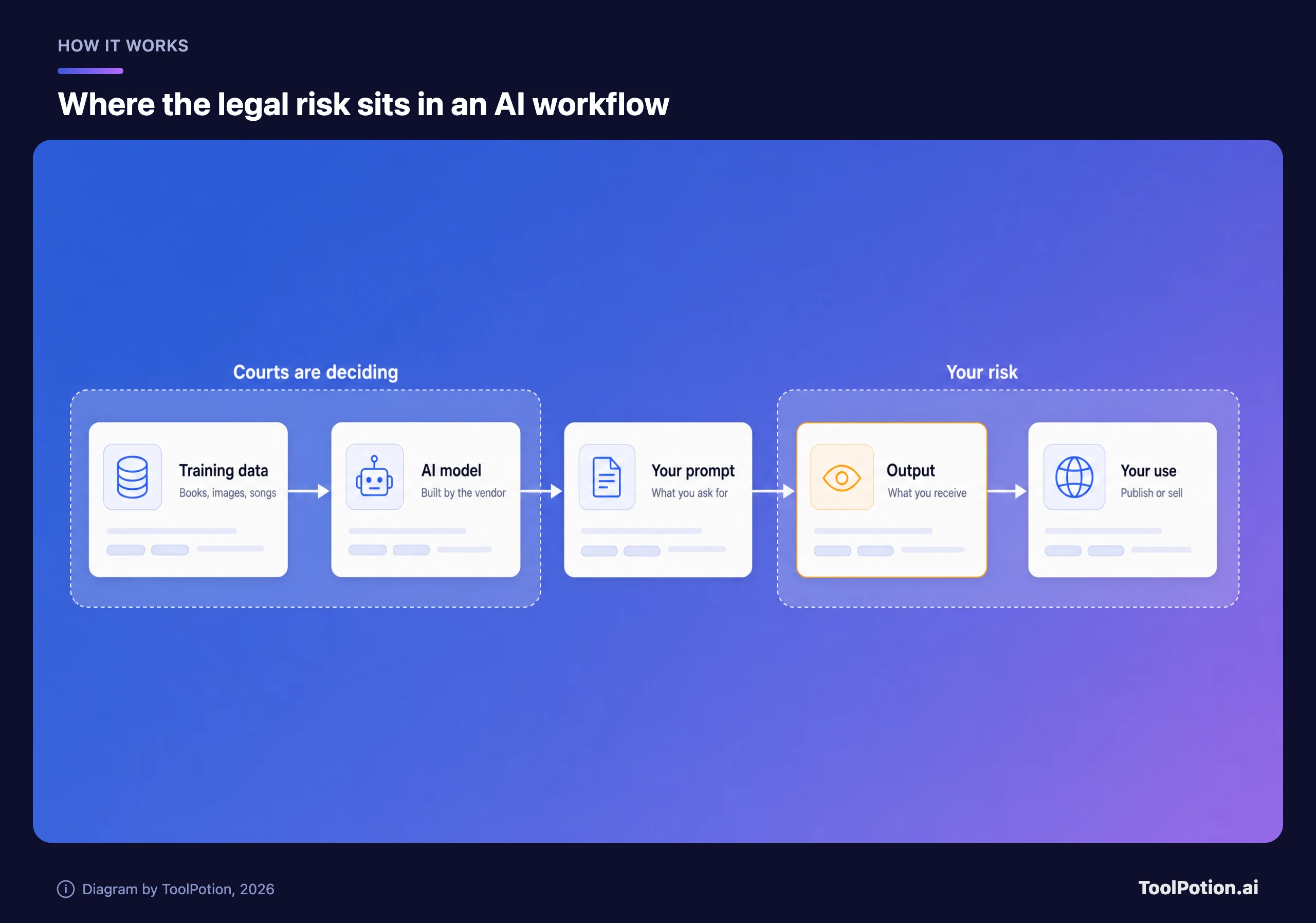
The left zone is the vendors' problem, at least until a court says otherwise. The right zone is yours. The lawsuits that name end users are rare, and the ones against AI companies mostly rest on outputs that reproduce a specific character, song or text, which is the part you control with your prompts and your review. A generic landscape image or a first draft of a blog post is a very different risk from a track that sounds like a signed artist.
What vendor indemnities cover, and what they don't
Several vendors promise to defend business customers if someone sues over output. These promises are real contract terms, and they all come with conditions. Here is what each one's own documents say.
| Vendor | What it says | The catch |
|---|---|---|
| Anthropic | Defends customers against third-party IP claims over paid use of its services or their outputs (terms) | Excludes modified outputs, combinations with other content, your inputs, knowing misuse, and trademark use of an output in commerce |
| Microsoft | Customer Copyright Commitment: defends customers against certain IP claims over output (Microsoft) | Azure OpenAI customers must keep required mitigations in place, such as a metaprompt, testing and protected-material filters |
| Google Cloud | Announced in 2023 as separate indemnities for training data and generated output. Google now publishes a list of covered services (Google) | Covers only the listed generative AI services (Google's page was last modified in 2026), and the terms have conditions. Check the current terms |
| OpenAI | Business terms: defends customers against claims that the services infringe (terms) | Excludes combinations, modifications and customer content; it also references a separate service-specific indemnity |
The pattern is that coverage tends to belong to paid, business-tier use of Claude, Microsoft Copilot, Google Gemini, ChatGPT's business plans and GitHub Copilot. Microsoft's page says GitHub offerings have no additional required mitigations as of earlier this year, while its Copilot Studio doesn't cover outputs from outside models unless they run in Azure OpenAI with the required settings. A free consumer account usually isn't covered by any of this.
Image tools market safety differently. Adobe Firefly pitches its own models as "commercially safe,", and Generative AI by Getty Images is a rights-holder's own product. Marketing claims like these are about training data. Whether a contract also protects you is a separate question, so ask for the indemnity language, not the marketing.
Who owns what the AI makes
The US Copyright Office settled the policy question in 2025. Its report on copyrightability says AI outputs can be protected only where a human determines the expressive elements. Using AI as a tool doesn't disqualify a work, but prompts alone aren't enough (US Copyright Office).
Courts agree. The D.C. Circuit held that the Copyright Office was right to refuse registration for a picture that Stephen Thaler's AI system made on its own, and the Supreme Court declined to hear his appeal in 2026 (Supreme Court docket, Chambers). A denial isn't a ruling on the merits, but it leaves the lower court's decision in place.
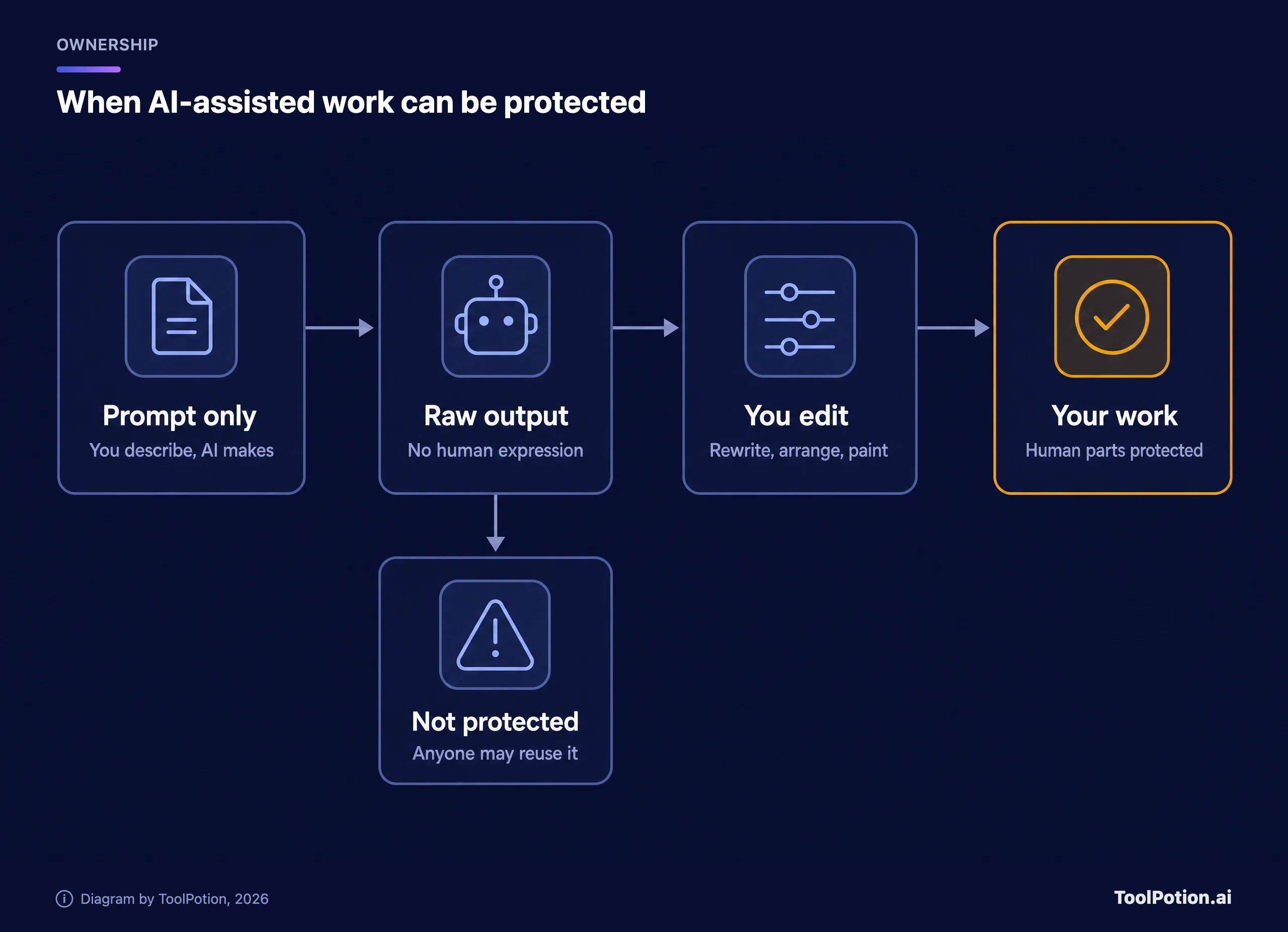
In practice, raw output from one prompt gives you something anyone can copy. If you rewrite the text, paint over the image, or select and arrange many outputs into something new, you can claim your human contribution, not the machine's. Keep the drafts and the edit history, because that's your evidence if anyone asks.
What to do today if you use AI tools for work
None of this requires a legal team. Most of the risk reduction is habit.
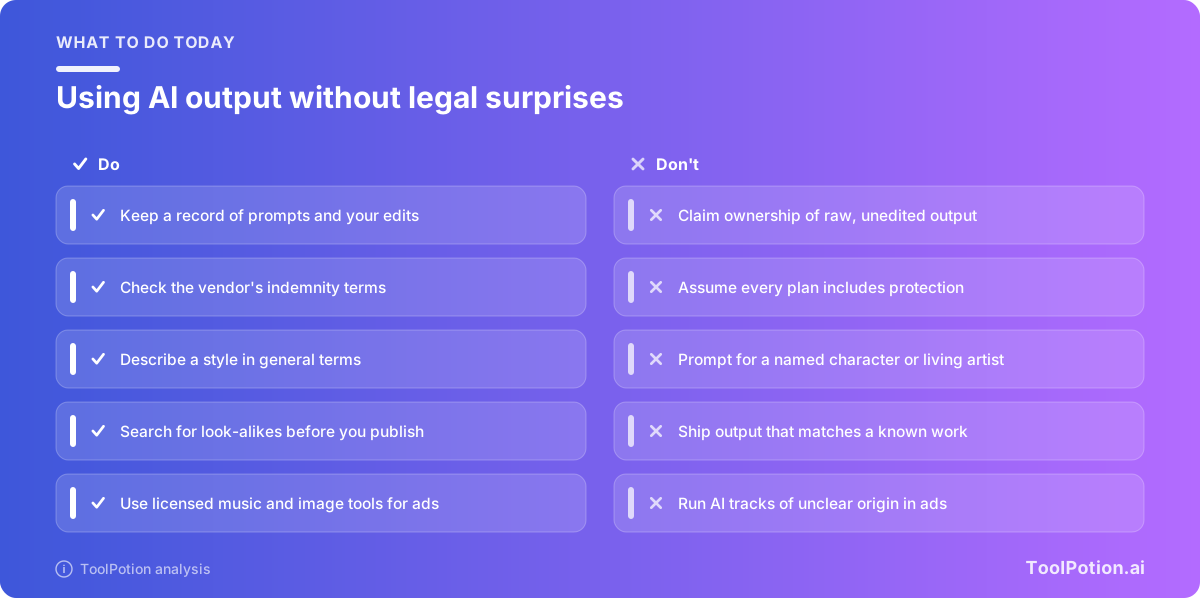
- Read your vendor's indemnity terms and note the exclusions, especially for edited output and for tools you've connected yourself.
- Never prompt with a named character, brand or living artist for anything public. That's where the studio suits focus.
- Edit what matters. Human changes strengthen your claim to own the result and lower the odds of publishing something that copies.
- Before a wide release, run a look-alike check: reverse image search for pictures, a quick search of distinctive lines for text, and a listen for music.
- For paid campaigns, prefer tools with licensed training data or clear commercial terms, and keep the terms page you relied on.
- Keep prompts and drafts for important work.
Use the tree below to place a specific piece of output on the risk scale.
Then score your team's habits. The checklist won't give legal assurance, but it shows which gap to fix first.
What is still unsettled
A lot. No appeals court has decided whether training a generative model on copyrighted books or news is fair use. The Times case could produce the first major ruling, then an appeal that takes years. The Copyright Office's report on training is out in a pre-publication version, with a final version still to come. UK, German and US courts are reasoning differently, so a tool can be fine in one market and exposed in another.
Settlements also hide information. The Anthropic deal gave authors money but produced no ruling on whether the training itself was lawful. And the music deals mean some catalogs are licensed while others aren't, with no label on the output that tells you which is which.
If you build products on top of AI models, or sell content made with them, the sensible position is to assume the rules will keep moving. For comparing tools on quality rather than legal posture, ToolPotion's boards for audio, voice and music and AI audio editors are a good start, and the ChatGPT alternatives guide covers the assistant side.
Frequently asked questions
Is it legal for AI companies to train on copyrighted work?
Not yet. The Third Circuit held that Ross's training on Westlaw headnotes was not fair use, but Ross was not a generative model. Anthropic paid $1.5 billion over pirated books without a ruling on training itself. Courts outside the US, like Munich's in the Suno case, apply different rules.
Can I be sued for using AI-generated images or text?
It's possible, but suits against ordinary users are rare. The risk rises if the output copies a recognizable work, character or voice, or if you use it in advertising. Business customers of some vendors get an indemnity, so check which plan you're on.
Who owns AI-generated content in the US?
You can own the parts a human created, such as your edits, selection and arrangement. Purely machine-generated material isn't protected, and the Supreme Court declined to revisit that in 2026. Vendors' terms usually assign you whatever rights exist, but they can't create rights the law doesn't grant.
Is Suno safe to use for commercial music?
Read Suno's current terms and plan details before using output in paid work. Suno says it has partnerships with Warner Music Group and BMG, and a Munich court ruled against Suno in the GEMA case in 2026 (Suno can appeal). Output from a licensed catalog isn't labeled as such.
When will the New York Times case be decided?
Nobody can say yet. The case is in summary judgment, and whichever side loses can appeal, which usually takes a long time. Treat any ruling as one stage rather than the end.