
Description
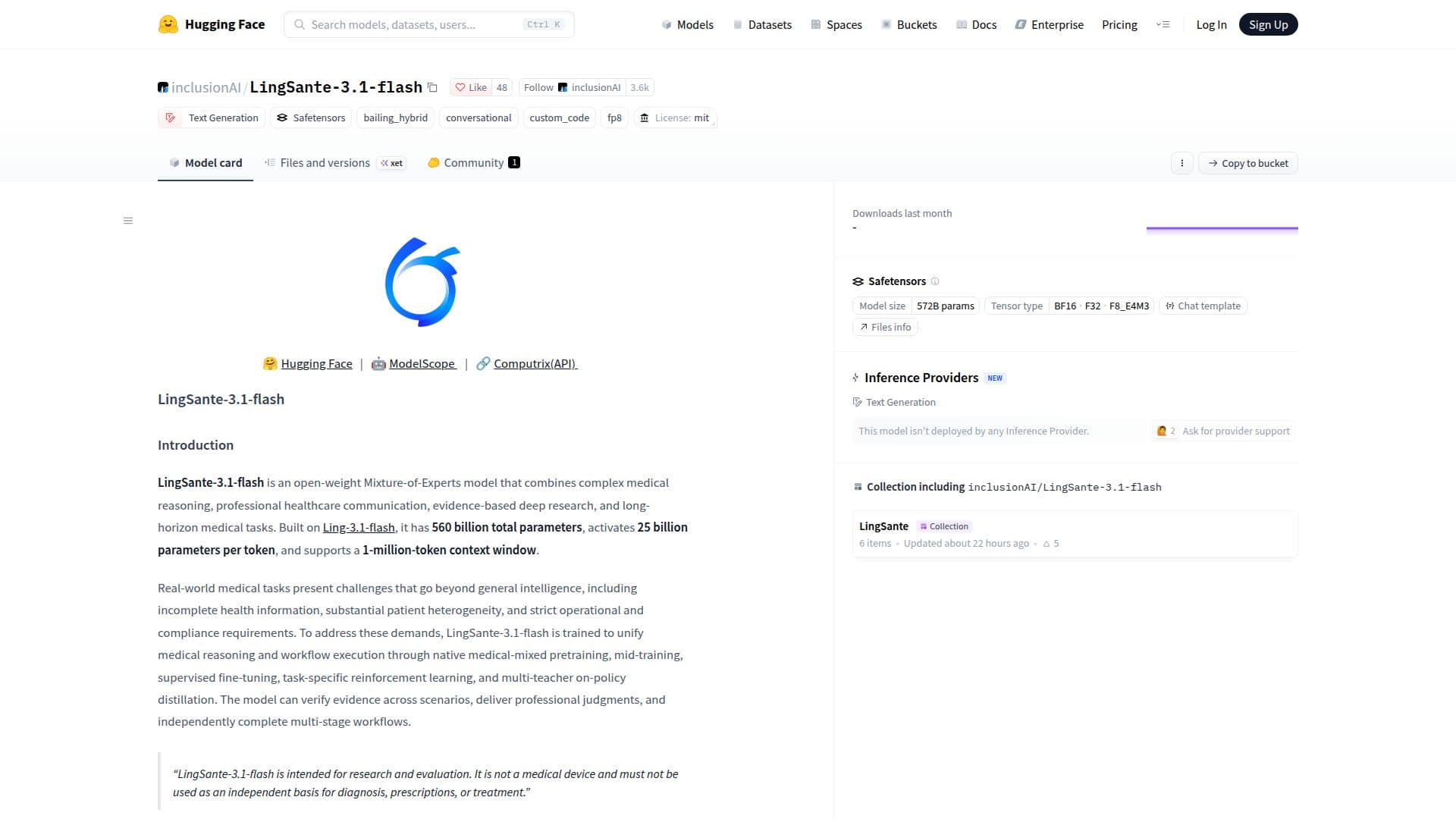
LingSante-3.1-flash is an advanced open-weight Mixture-of-Experts (MoE) model specifically engineered to address the intricate demands of real-world medical tasks. Built upon the Ling-3.1-flash architecture, it features 560 billion total parameters, activating 25 billion parameters per token, and boasts an impressive 1-million-token context window. This model is designed to handle challenges such as incomplete health information, patient heterogeneity, and strict operational and compliance requirements inherent in healthcare.
Read More
The model's training methodology is comprehensive, incorporating native medical-mixed pretraining, mid-training, supervised fine-tuning, task-specific reinforcement learning, and multi-teacher on-policy distillation. This rigorous approach enables LingSante-3.1-flash to unify medical reasoning with workflow execution, allowing it to verify evidence across various scenarios, provide professional judgments, and independently complete multi-stage medical workflows.
Key capabilities include complex medical reasoning, which goes beyond accurate knowledge understanding to identify clinical decision factors, validate supporting evidence, and resolve conflicts across sources. It utilizes a medical evidence–reasoning alignment framework to strengthen its reasoning foundation. For long-horizon medical tasks, the model operates across interconnected sub-scenarios, coordinates tools and information within workflows, and adapts plans as new information emerges, supported by a framework combining realistic interactive environments and diverse tool-use settings.
Furthermore, LingSante-3.1-flash excels in medical professional behavior alignment. It is trained to deliver context-aware, professional, and actionable responses, aligning with real clinical scenarios and medical professional standards. The model demonstrates strong performance on benchmarks for medical professional behavior, ranking highly among its peers.
Intended for research and evaluation, LingSante-3.1-flash supports medical and healthcare research, literature analysis, evidence synthesis, medical question answering, clinical document analysis (with human review), structured information extraction, and retrieval-augmented healthcare applications. It is also valuable for developing and evaluating medical, research, and general-purpose tool-using agents, as well as research on professional behavior and multi-agent search. It is crucial to note that LingSante-3.1-flash is not a medical device and must not be used as an independent basis for diagnosis, prescriptions, or treatment.
- CategoryAI Models & LLMs
- Pricing ModelOpen source
- DeploymentCloud
- PlatformsWeb
LingSante-3.1-flash Highlights
Open-weight Mixture-of-Experts (MoE) architecture
560 billion total parameters
25 billion activated parameters per token
1-million-token context window
Complex medical reasoning capabilities
Long-horizon medical task execution
Medical professional behavior alignment
Medical evidence–reasoning alignment framework
Native medical-mixed pretraining and fine-tuning
Reinforcement learning for medical reasoning and tool use
Multi-teacher on-policy distillation
Support for SGLang and vLLM inference
Evaluation across medical and general benchmarks
Tool-use and search capabilities in medical settings
Getting Started with LingSante-3.1-flash
Access Model: Visit the LingSante-3.1-flash page on Hugging Face to explore files and documentation.
Prepare Environment: Set up your environment with SGLang or vLLM for inference.
Configure Server: Deploy the model on a server, specifying parameters like TP and EP for optimal performance.
Run Inference: Execute inference commands using SGLang or vLLM client, adjusting sampling parameters as needed.
Utilize Cookbook: Refer to the SGLang Ling-3.1-flash cookbook for verified recipes and optimizations.
Integrate into Applications: Incorporate the model into research or healthcare applications for analysis and information extraction.
LingSante-3.1-flash's Use Cases
- Medical Literature Analysis
- Clinical Document Analysis
- Medical Question Answering
- Healthcare Information Extraction
- Tool-Using Agent Development
- Professional Behavior Research
- Evidence Synthesis
- Multi-Stage Workflow Execution