
Description
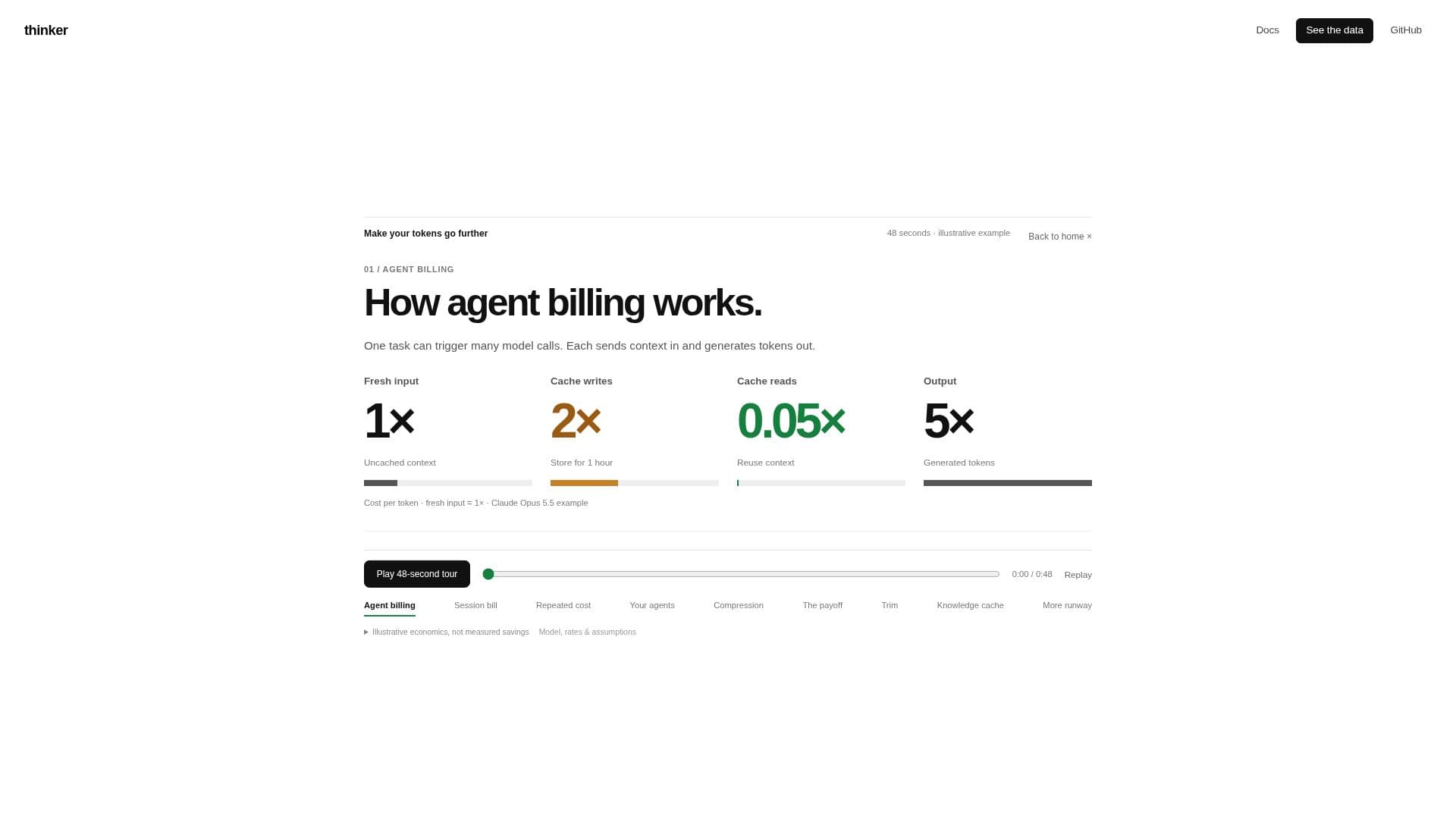
Thinker is a specialized tool designed to optimize the performance and cost-efficiency of AI agents by intelligently managing their token usage. It addresses the common challenge of agents repeatedly processing the same context, which can lead to increased costs and slower operations. Thinker achieves this through three core mechanisms: context compression, instruction trimming, and a knowledge cache.
Read More
Context compression automatically identifies and removes redundant or less relevant information from an agent's context, ensuring that only essential data is carried forward into subsequent calls. This significantly reduces the number of tokens processed per call, making agent interactions more efficient. For instance, it can trim large tool outputs, retaining only the most pertinent sections for future reference.
Instruction trimming analyzes instruction files and tool settings to identify and eliminate unnecessary or low-utility instructions that agents might repeatedly process. By focusing on the instructions that truly earn their place, Thinker helps agents operate with a leaner, more effective set of directives, further conserving tokens and improving processing speed. Users can review and apply suggested cuts, which are then integrated into their agent's configuration.
The knowledge cache allows agents to learn and reuse information, preventing the need to re-process the same knowledge repeatedly. When an agent learns a new piece of information, it can be stored as a 'note' (e.g., rules, maps, how-tos, behaviors) and retrieved when relevant. This cache is dynamic, learning from every session and knowing when a note becomes stale, ensuring that agents always have access to current and pertinent knowledge without incurring repeated token costs for exploration.
Thinker supports a range of popular AI agents, including Claude Code, Codex CLI, Gemini CLI, Cursor, Devin CLI, Pi, Windsurf Cascade, GitHub Copilot CLI, and OpenCode. It integrates by installing locally and connecting to agents' settings, allowing for seamless operation. The platform provides views like 'Find Savings' to monitor context cost and usage, 'View Report' to track token costs over time, and 'Recent activity' to manage applied changes. Thinker's illustrative economics suggest significant savings by reducing fresh input, new writes, and output tokens, ultimately extending the effective runway for agent tasks within existing token limits.
- CategoryPrompt Engineering Tools
- Pricing ModelPaid
- DeploymentLocal
- PlatformsWeb
Thinker's Core Features
Automatic Context Compression: Reduces repeated context in agent sessions.
Instruction Trimming: Analyzes and removes unnecessary instruction tokens.
Knowledge Cache: Stores and reuses learned information to avoid re-processing.
Token Cost Optimization: Helps agents operate within token limits more efficiently.
Agent Integration: Connects with various AI agents like Claude Code, Codex, Gemini, Cursor, Devin, Pi, Copilot CLI, OpenCode.
Output Trimming: Optional feature to trim tool results before they enter context.
Usage Reporting: Provides insights into context cost and token usage over time.
Change Management: Tracks and allows management of applied context cuts and changes.
Local Data Storage: Stores notes and configuration locally under ~/.thinker.
GitHub Integration: Manages instruction changes via pull requests for review.
Multi-Language Support: Uses tree-sitter parser for Python, JavaScript, TypeScript, Go, Rust.
Configurable Learning: Allows control over session distillation and verification.
Telemetry Control: Option to disable sending metrics for privacy.
Multiple Cache Types: Supports different cache types for tools, instructions, RAG context, and conversation history.
Cache Invalidation Management: Details what changes invalidate different cache segments.
How to use Thinker?
Install Thinker: Install Thinker locally, which sets up under ~/.thinker and connects to your agents' settings.
Analyze Usage: Thinker generates an initial report by reading recent sessions from your active repositories.
Identify Savings: Use the 'Find Savings' view to see context cost and usage, and identify areas for cuts.
Apply Context Compression: Enable automatic context compression where supported by your agent.
Trim Instructions: Review suggested instruction cuts and apply them to reduce wasted tokens.
Utilize Knowledge Cache: Allow Thinker to learn from sessions and reuse knowledge through notes.
Monitor Performance: Use the 'View Report' to track token costs and cache savings over time.
Manage Changes: Review and manage all applied changes and their status under 'Recent activity'.
Thinker's Use Cases
- Optimizing Agent Token Usage
- Cost Reduction for AI Agents
- Improving Agent Efficiency
- Managing Developer Workflows
- Knowledge Management for Agents
- Debugging Agent Context
- Customizing Agent Instructions
- Extending Agent Usage Limits