Description
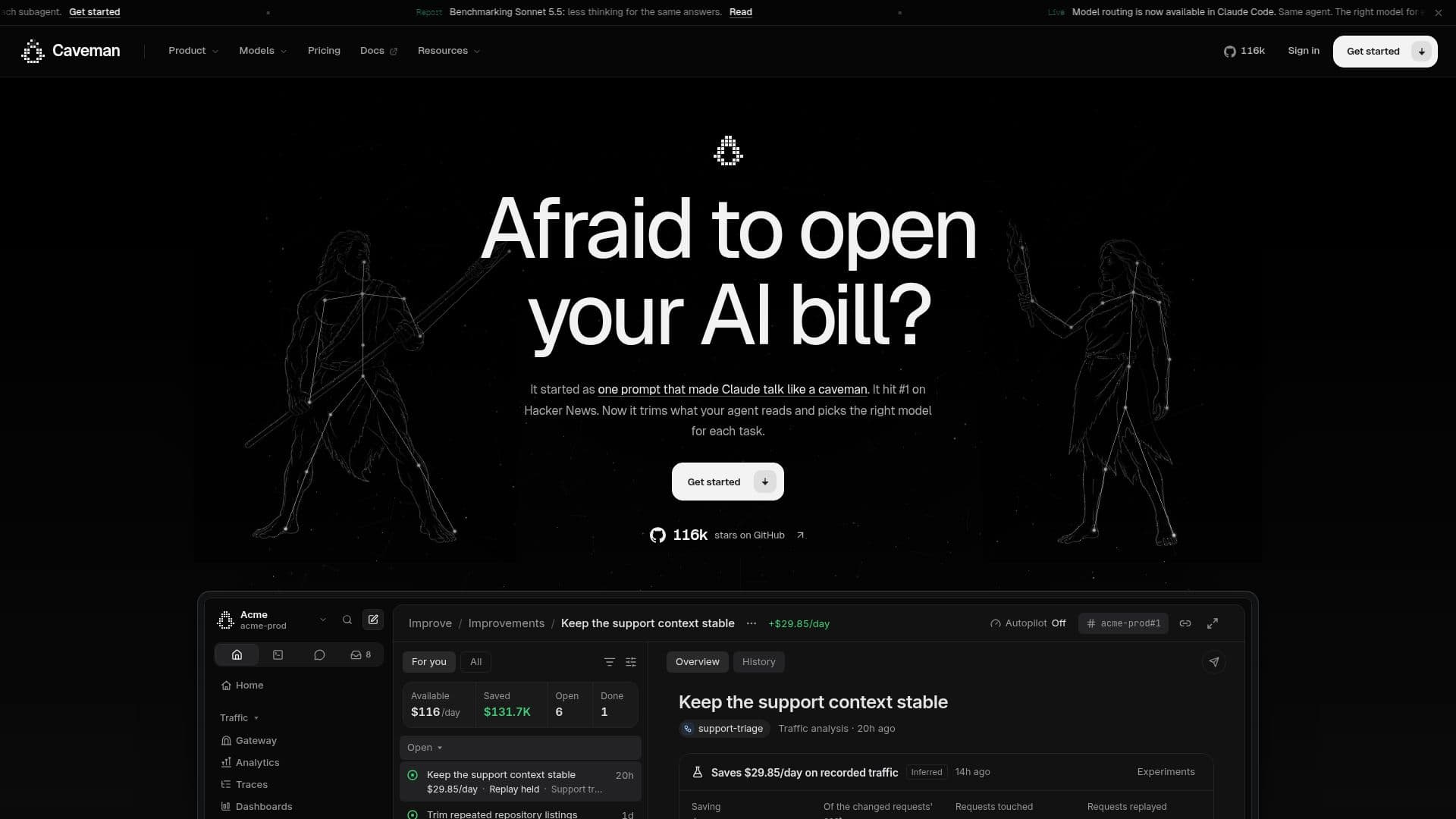
Caveman provides a comprehensive solution for developers and teams looking to optimize their AI agent interactions and significantly reduce operational costs. The platform offers local context compression, which shrinks eligible input like logs, test output, JSON, and diffs before they reach the model, while keeping the original data available for recovery. This process can lead to substantial reductions in input tokens, with reported savings of up to 33.2% in whole sessions.
Read More
Beyond input optimization, Caveman also focuses on output efficiency by asking for shorter agent replies. This "Says less" feature helps eliminate filler words from agent responses, delivering code, commands, and errors byte for byte. This can result in up to 65% less readable output, translating to approximately 10% of total token savings on long-horizon coding tasks.
A key capability of Caveman is its adaptive model selection, which intelligently routes each agent turn to the cheapest model capable of completing the task correctly. This ensures that hard work still gets assigned to frontier models, while simpler tasks leverage more cost-effective options, potentially reducing cost per task by 0.46x. The platform integrates with popular coding agents like Claude Code, Codex, and Gemini CLI, and offers SDKs for agents built with TypeScript and Python, including middleware for Vercel AI SDK, OpenAI, Anthropic, and LangChain.
Caveman Cloud extends these capabilities with advanced analytics, providing visibility into agent costs, traces of every request, and team-wide spend. It identifies waste, suggests fixes, and can even implement improvements on Autopilot, testing them on historical data before deployment. The platform also includes governance features such as soft and hard spending caps, rate limits, and guardrails to mask or block sensitive data, all recorded in an audit log. The core tools (agent and SDK) are free and open-source, with a free tier for Cloud services for individual developers, and paid plans for teams and enterprises offering additional features like semantic caching, project access control, and VPC deployment.
- CategoryAI DevOps & Cloud Tools
- Pricing ModelFreemium
- DeploymentLocal, Cloud, VPC
- PlatformsTypeScript, Python
Caveman's Core Features
Recoverable Local Context Compression
Shorter AI Agent Replies
Adaptive Model Selection
Token Usage Measurement
AI Agent Cost Analytics
Waste Identification and Optimization
Autopilot for Performance Improvements
Real-time Request Tracing
Team Spend Visibility
Budget Management and Spend Caps
Guardrails for Data Masking/Blocking
Audit Logging for Changes
Open-Source Local Tools
TypeScript and Python Middleware
Semantic Cache
How to use Caveman?
Install Local Tools: Use the CLI or SDK to integrate Caveman with your existing coding agent or application.
Configure Compression: Implement context compression for logs, JSON, diffs, and other inputs to reduce token usage.
Enable Shorter Replies: Set up agents to generate more concise responses, cutting down on output tokens.
Activate Model Routing: Configure adaptive model selection to automatically choose the most cost-effective model for each task.
Monitor Costs: Utilize Caveman Cloud to track agent spending, identify inefficiencies, and analyze performance.
Implement Improvements: Apply suggested fixes for waste and leverage Autopilot for automated optimization.
Set Governance: Establish spending limits, rate limits, and data guardrails for your AI agent operations.
Evaluate Performance: Use built-in evaluation tools to test changes and measure cost per successful task.
Caveman's Use Cases
- Reduce AI API Costs
- Optimize Coding Agent Performance
- Monitor AI Agent Spend
- Automate Cost Savings
- Enhance Data Governance
- Develop Efficient AI Agents
- Evaluate Agent Optimizations
- Manage Team AI Usage