
Description
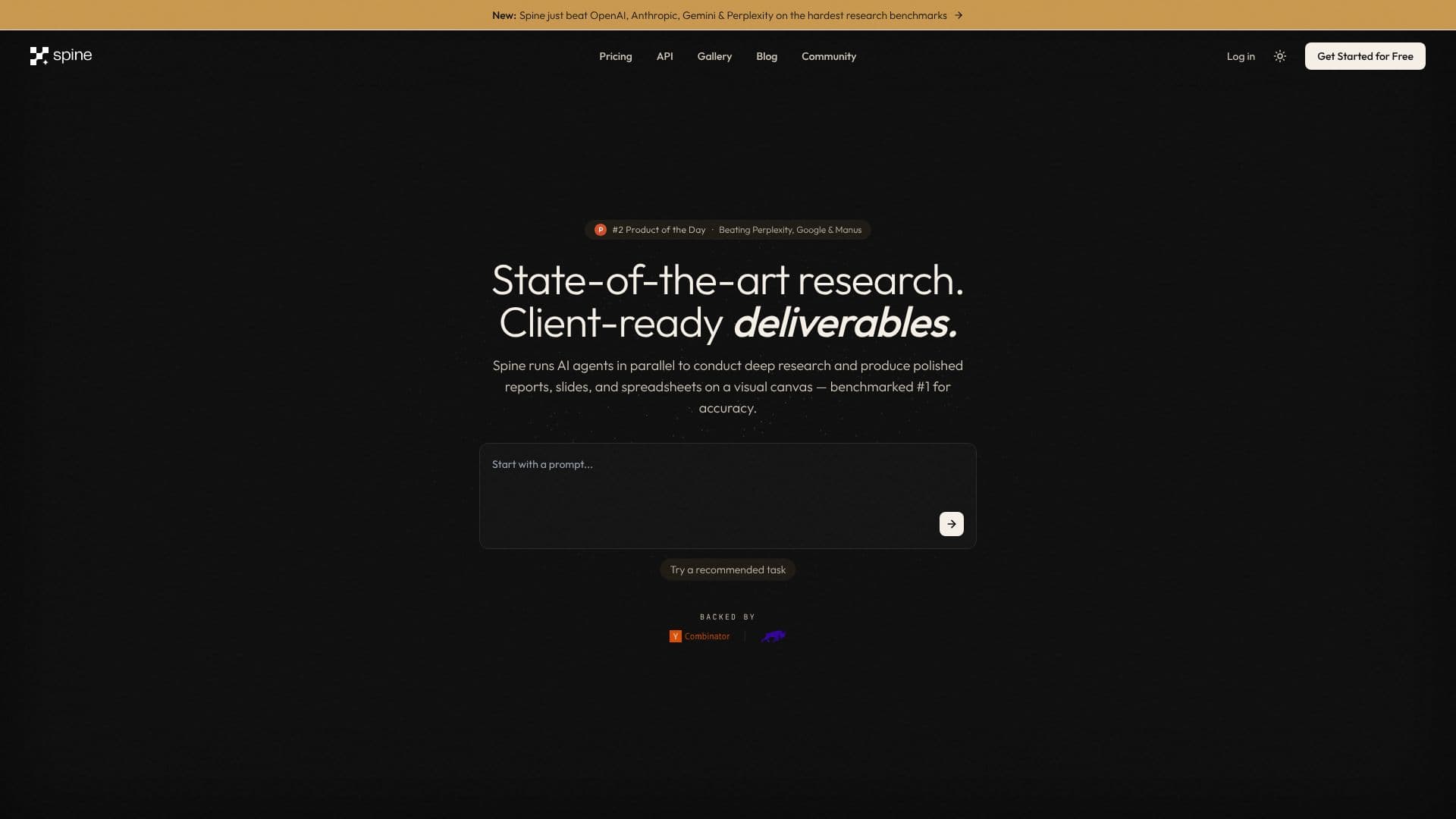
Spine builds AI products for research and deliverable work that a single chat model struggles to finish end to end. Instead of one model answering a prompt, Spine dispatches a brief across multiple specialized agents that plan the work, research it, review each other's output, and repair gaps before the result reaches the user.
Read More
Canvas is the cloud product: a workspace that assembles agents across more than 300 AI models to research, analyze and produce sourced deliverables such as reports, slide decks, documents, spreadsheets with scenario tabs, websites and small apps. Work happens as a graph of blocks that grows as agents discover new dependencies, and a review step can create repair branches that go back for verification before a task is marked complete. Canvas is SOC 2 Type I compliant.
Medley is a local-first counterpart: a daemon plus plugins for Claude Code and Codex that coordinate multiple models and worker harnesses on a machine, within permission boundaries the user sets. It keeps a full history of evolving plans, adaptive graphs and execution receipts, and is aimed at research, analysis and software tasks run from a developer's own tools rather than a browser tab.
Spine publishes detailed prompt templates by role: investors get market sizing and earnings-analysis workflows, consultants get competitive intelligence and due-diligence briefs, legal teams get case-law and regulatory tracking, medical users get literature reviews and clinical-trial pipeline maps, founders get competitive landscapes and investor targeting, and sales teams get account research and outreach personalization, each producing a sourced document rather than a chat answer.
Canvas uses a credit system. A free plan gives 2,000 credits a month; Starter plans run from about $16 to $50 a month (annual pricing) for 30,000 to 100,000 credits; Max plans run from about $80 to $299 a month for 200,000 to 750,000 credits; and Enterprise pricing is custom, with SSO, dedicated support and SOC 2 documentation on request. Typical tasks cost a few hundred to a few thousand credits, for example around 5,000 credits for a competitive analysis or 500 credits for a blog post from an outline.
- CategoryAI Research Assistants
- Pricing ModelFreemium (implied by 'free to get started')
- DeploymentCloud, Runs locally
- PlatformsWeb
Spine's Core Features
Canvas dispatches parallel agent swarms across 300+ models to research and build deliverables
Sourced outputs: reports, slide decks, documents, spreadsheets with scenario tabs, websites and small apps
Adaptive work graphs that expand as agents discover new dependencies, with review and repair branches
Medley runs agent orchestration locally through Claude Code or Codex plugins, within set permission boundaries
Full history of plans, adaptive graphs and execution receipts for every Medley task
Role-based prompt libraries for investors, consultants, legal, medical, founders and sales teams
Plan mode to review an agent's proposed approach and cost before it runs
SOC 2 Type I compliant (Canvas)
How to use Spine?
Choose a product: use Canvas in the cloud, or install Medley locally through Claude Code or Codex.
Start a canvas: dispatch a brief and let Spine's agents plan, research and build blocks.
Review the plan: use plan mode to check the proposed approach and estimated credit cost before running it.
Let agents work: agents research, write and coordinate across blocks, creating repair branches when review finds gaps.
Review and export: check the sourced deliverable, then export or publish the report, deck, document or app.
Scale up: move from the free plan to Starter or Max credits, or contact sales for Enterprise.
Spine's Use Cases
- Investor research memos
- Consulting deliverables
- Legal and regulatory research
- Medical literature review
- Sales account research