Description
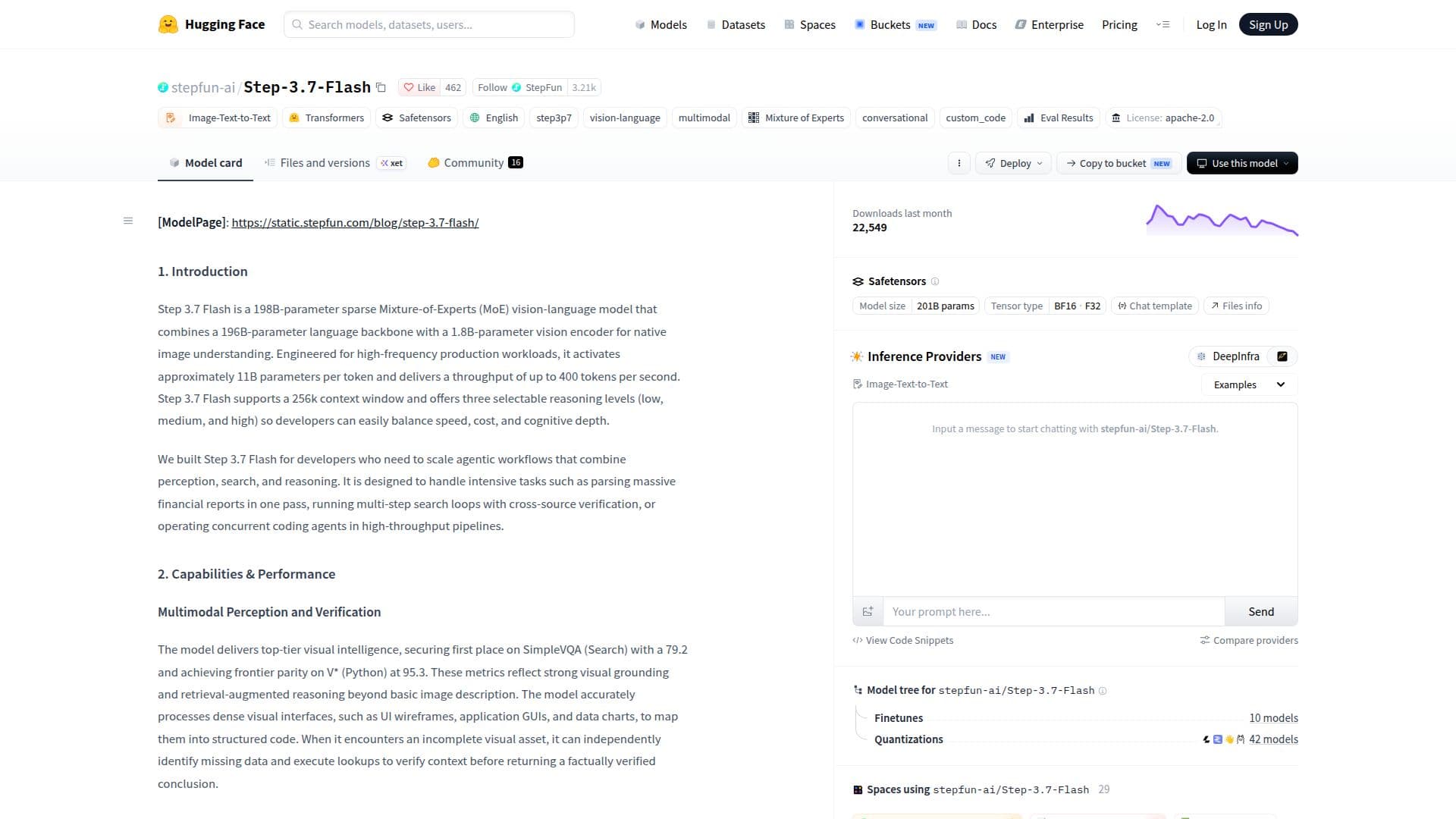
Step 3.7 Flash is a 198B-parameter sparse Mixture-of-Experts (MoE) vision-language model, engineered to handle high-frequency production workloads. It combines a 196B-parameter language backbone with a 1.8B-parameter vision encoder, enabling native image understanding and processing dense visual interfaces such as UI wireframes and data charts.
Read More
The model activates approximately 11B parameters per token and delivers a throughput of up to 400 tokens per second, supporting a 256k context window. It offers three selectable reasoning levels—low, medium, and high—allowing developers to balance speed, cost, and cognitive depth.
Step 3.7 Flash is designed for developers who need to scale agentic workflows that combine perception, search, and reasoning. It excels in tasks such as parsing massive financial reports in one pass, running multi-step search loops with cross-source verification, and operating concurrent coding agents in high-throughput pipelines.
The model delivers top-tier visual intelligence, securing first place on SimpleVQA (Search) with a score of 79.2 and achieving frontier parity on V* (Python) at 95.3. It accurately processes dense visual interfaces and can independently identify missing data and execute lookups to verify context before returning factually verified conclusions.
Step 3.7 Flash leads the ClawEval-1.1 benchmark with a score of 67.1, demonstrating high resistance to adversarial traps and strict adherence to system policies during multi-turn orchestration. It reliably interacts with external APIs and executes long-horizon workflows without drifting from instructions or violating system constraints.
Pricing for Step 3.7 Flash includes $0.20 per million tokens for input cache misses, $0.04 per million tokens for input cache hits, and $1.15 per million tokens for output. The model is available on the StepFun Open Platform, OpenRouter, and NVIDIA NIM, with plans to expand availability through partnerships with DeepInfra, Fireworks AI, and Modal.
Step 3.7 Flash supports flexible deployment across cloud, data center, and local environments, and is optimized for local inference using industry-standard backends such as vLLM, SGLang, Hugging Face Transformers, and llama.cpp. It is supported across popular open-source infrastructure for both inference and model development, including the NVIDIA Nemo ecosystem.
- CategoryAI Models & LLMs
- Pricing ModelPaid
- DeploymentCloud, Runs locally
- PlatformsWeb
Step 3.7 Flash Highlights
198B-parameter sparse MoE model
196B language backbone
1.8B vision encoder
11B parameters activated per token
400 tokens per second throughput
256k context window
Three reasoning levels
Top-tier visual intelligence
Getting Started with Step 3.7 Flash
Access model page: Visit the Hugging Face model page
Authenticate: Use your API key to authenticate
Configure: Set up the model parameters
Send prompts: Input your queries for processing
Fine-tune: Adjust the model for specific tasks
Step 3.7 Flash's Use Cases
- Financial Report Parsing
- Multi-Step Search Loops
- Coding Agent Operations
- Dense Visual Interface Processing
- Autonomous API Interaction