
Description
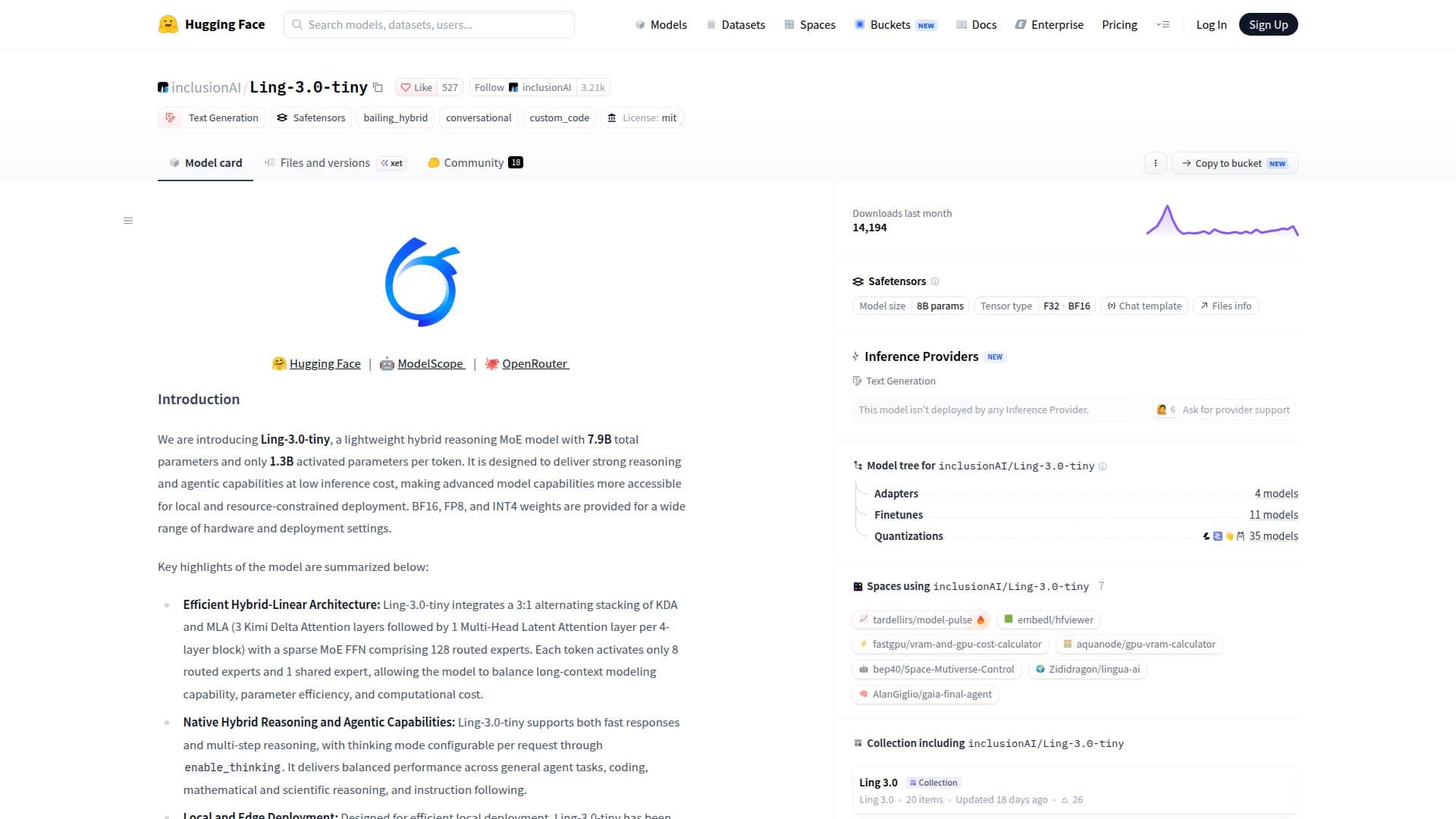
Ling-3.0-tiny is a lightweight hybrid reasoning model developed by inclusionAI, hosted on Hugging Face. It features a total of 7.9 billion parameters, with only 1.3 billion activated per token, making it efficient for local and resource-constrained deployments. The model integrates a 3:1 alternating stacking of Kimi Delta Attention (KDA) and Multi-Head Latent Attention (MLA) layers, along with a sparse Mixture of Experts (MoE) Feed-Forward Network (FFN) comprising 128 routed experts. This architecture allows the model to balance long-context modeling capability, parameter efficiency, and computational cost.
Read More
Ling-3.0-tiny is designed to deliver strong reasoning and agentic capabilities at a low inference cost. It supports both fast responses and multi-step reasoning, with a configurable thinking mode. The model is validated on various hardware, including NVIDIA DGX Spark and Apple Silicon MacBook, enabling capable reasoning and agentic workloads without the need for datacenter-class GPUs. With FP8, it achieves around 100-105 tokens per second on DGX Spark and 86-90 tokens per second on an M4 Pro MacBook, with approximately 8.34 GiB peak memory usage at an 8K context length.
The model's efficiency is highlighted by its performance on the Artificial Analysis Intelligence Index v4.1.1, scoring 25, and the Artificial Analysis Agentic Index, scoring 16. It reaches an output speed of over 160 tokens per second, with approximately 18 seconds of end-to-end latency for a 500-token response. Ling-3.0-tiny is suitable for a wide range of tasks, including agentic tasks, coding, long-context understanding, knowledge reliability, mathematical and scientific reasoning, and instruction following.
- CategoryAI Models & LLMs
- Pricing ModelFreemium
- DeploymentRuns locally
- PlatformsWeb
Ling-3.0-tiny Highlights
7.9B total parameters
1.3B activated parameters per token
Hybrid reasoning capabilities
Efficient local deployment
3:1 KDA-MLA architecture
Sparse MoE FFN with 128 experts
Supports fast responses and multi-step reasoning
Validated on NVIDIA DGX Spark and Apple Silicon
Getting Started with Ling-3.0-tiny
Access model page: Visit Hugging Face
Authenticate: Log in to your account
Configure: Set up model parameters
Send prompts: Use the model for inference
Fine-tune: Adjust settings for specific tasks
Ling-3.0-tiny's Use Cases
- Agentic Tasks
- Coding
- Scientific Reasoning
- Instruction Following
- Local Deployment