
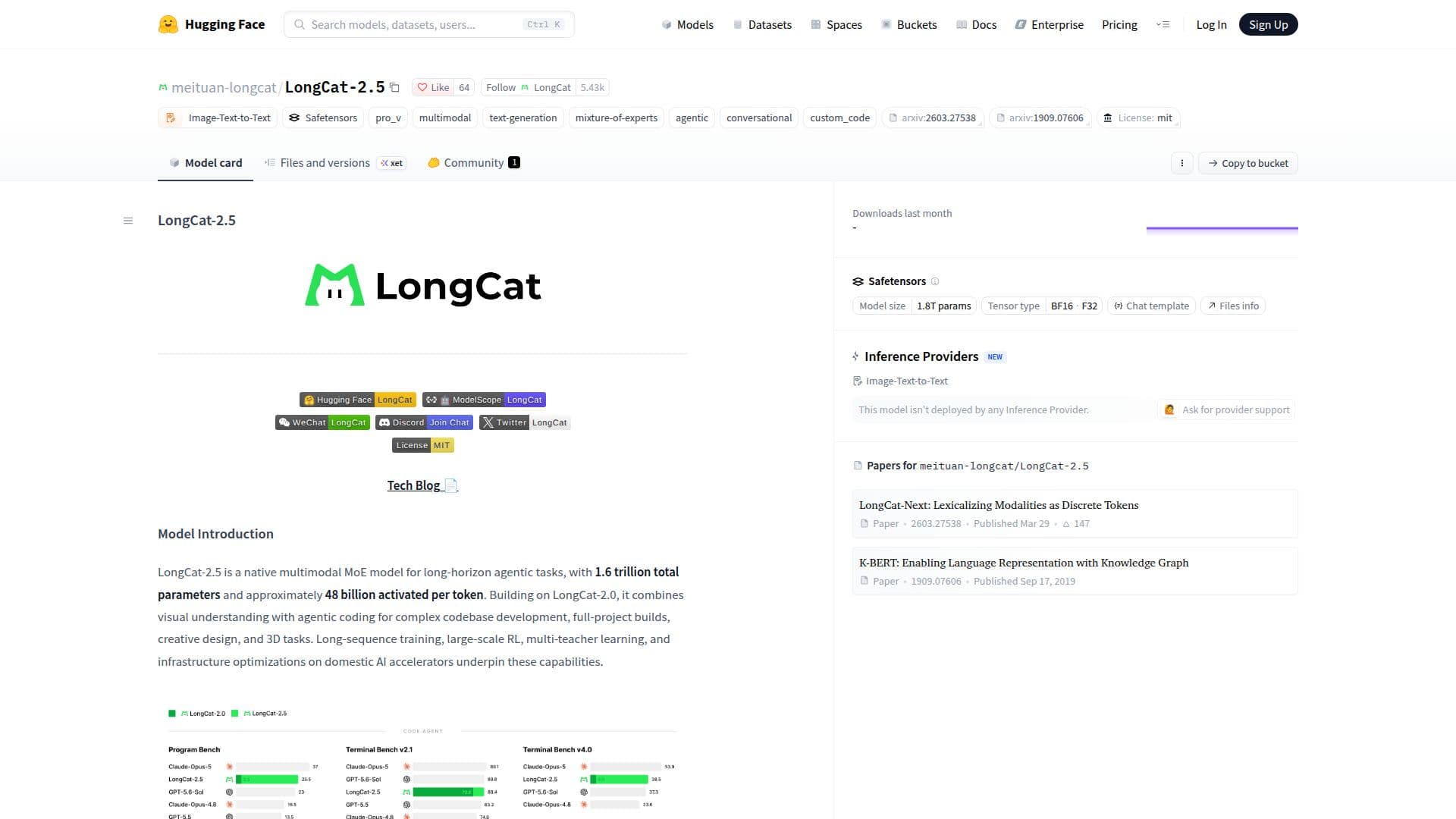
Description
LongCat-2.5 represents a significant advancement in multimodal AI, building upon its predecessor, LongCat-2.0. This model is engineered to handle intricate, multi-step agentic tasks by combining robust visual understanding with sophisticated agentic coding. It features a massive 1.6 trillion total parameters, with approximately 48 billion activated per token, making it a powerful tool for demanding applications.
Read More
The model's core capabilities are underpinned by several key innovations. Native Visual Modeling allows LongCat-2.5 to convert native-resolution visual features into discrete tokens, aligning them with text in a shared semantic space. This enables a deeper, more integrated understanding of multimodal inputs. For long-horizon tasks, the model employs Agentic Reinforcement Learning (RL), trained on real-world engineering scenarios and reproducible agent failures. This training methodology, combined with efficient rollout strategies and safeguards against reward hacking, enhances its reliability in executing end-to-end tasks.
Multi-Teacher Learning is another crucial aspect, where specialized agent, reasoning, and interaction teachers guide the model through full-vocabulary KL distillation and Tree Attention. This process strengthens its ability to perform multi-turn executions, complex reasoning, and precise instruction following, while also improving safety. Furthermore, LongCat-2.5 incorporates Efficient Long-Context Training, utilizing supernode-aware parallelism, efficient sharding, and communication–computation overlap. These optimizations result in significantly higher per-device throughput compared to traditional baselines in long-sequence SFT tasks.
Deployment of LongCat-2.5 is supported on NPU platforms, with specific guidance available for NPU deployment through SGLang-FluentLLM. The model also features W4A4 quantization for expert weights and activations, enabling native INT4 computation on domestic AI accelerators while maintaining accuracy. This quantization, along with optimized weight layouts and tuned prefill/decode pipelines, leads to substantial improvements in throughput and reduced latency. LongCat-2.5 offers both thinking mode and non-thinking mode, allowing users to balance performance with token efficiency. It is released under the MIT License, making it accessible for a wide range of developers and applications.
- CategoryAI Models & LLMs
- Pricing ModelOpen source
- DeploymentCloud
- PlatformsWeb
LongCat-2.5 Highlights
Native Multimodal MoE Model
1.6 Trillion Total Parameters
48 Billion Activated Parameters Per Token
Visual Understanding Integration
Agentic Coding Capabilities
Long-Horizon Agentic RL Training
Multi-Teacher Learning for Reasoning and Instruction Following
Efficient Long-Context Training
RL Infrastructure with KV Cache Optimization
W4A4 Quantization for Expert Weights and Activations
NPU Platform Deployment Support
Thinking Mode for Enhanced Performance
Non-Thinking Mode for Token Efficiency
MIT License for Model Weights
Evaluation Across Coding, General Agent, and Visual Tasks
Getting Started with LongCat-2.5
Access Model: Navigate to the LongCat-2.5 page on Hugging Face.
Explore Files: Review the model's files and documentation for technical details.
Deploy on NPU: Refer to SGLang-FluentLLM for instructions on NPU platform deployment.
Configure Mode: Choose between thinking mode (enable_thinking=True) for performance or non-thinking mode (enable_thinking=False) for token efficiency.
Send Prompts: Interact with the model via the official chat website (longcat.ai) or through programmatic access.
Evaluate Performance: Utilize evaluation settings like temperature and top_p for specific tasks.
LongCat-2.5's Use Cases
- Complex Codebase Development
- Full-Project Builds
- Creative Design Tasks
- 3D Task Execution
- Multimodal Agentic Tasks
- Code Agent Benchmarking
- General Agent Benchmarking
- Visual Task Benchmarking