
Description
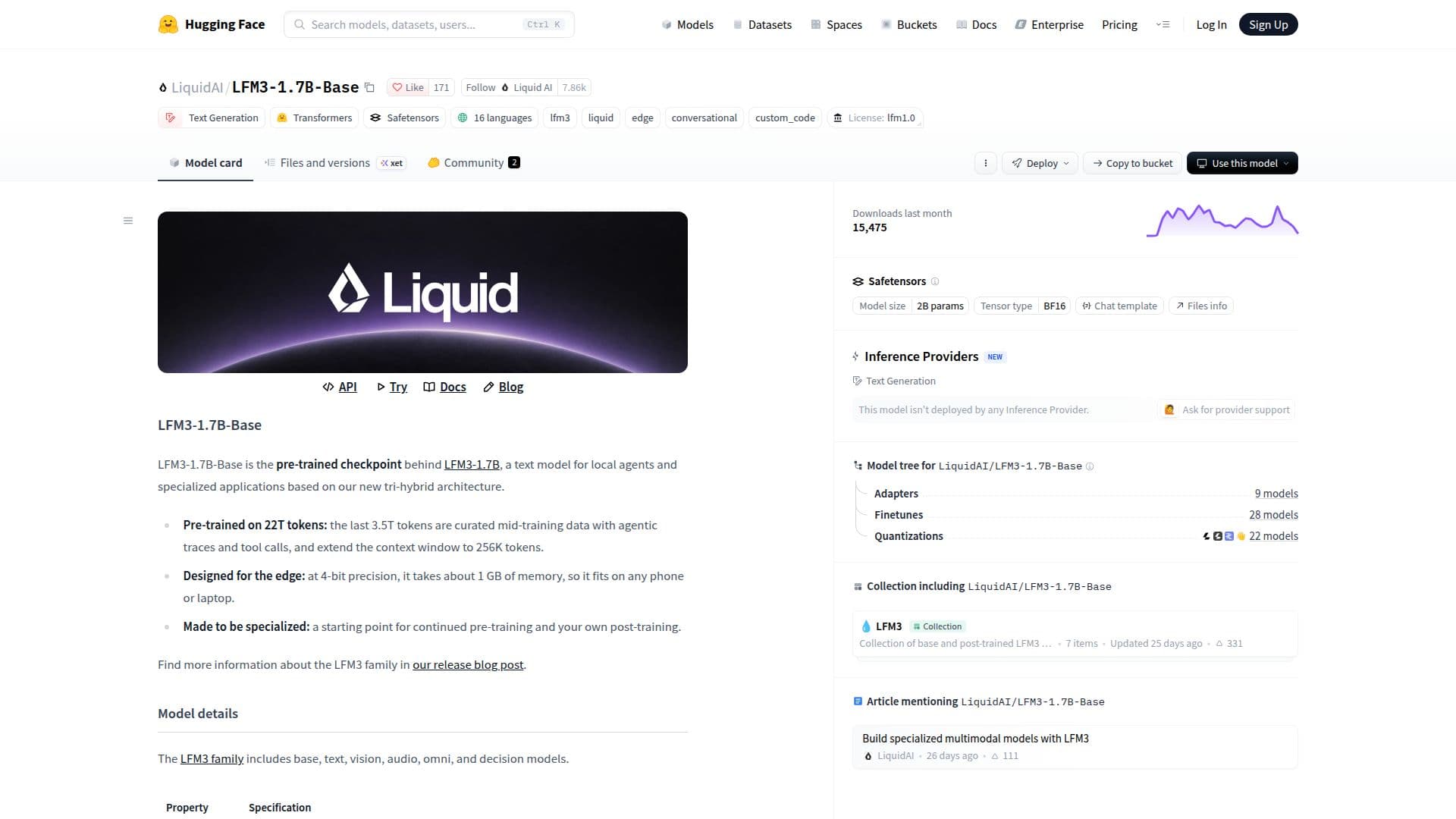
LFM3-1.7B-Base is a foundational text generation model developed by LiquidAI, serving as the pre-trained checkpoint for the LFM3-1.7B model. It is specifically engineered for deployment in local agents and specialized applications, leveraging a novel tri-hybrid architecture. The model boasts 1.73 billion parameters and has been extensively pre-trained on a massive dataset of 22 trillion tokens. The final 3.5 trillion tokens of this training data are curated mid-training data, incorporating agentic traces and tool calls, which significantly extends its context window to an impressive 256,000 tokens.
Read More
One of the key design philosophies behind LFM3-1.7B-Base is its optimization for edge computing environments. At 4-bit precision, the model requires approximately 1 GB of memory, making it highly suitable for deployment on resource-constrained devices such as smartphones and laptops. This accessibility allows developers to integrate advanced text generation capabilities directly into consumer-grade hardware without relying on cloud infrastructure.
The model is also designed for specialization, serving as an excellent starting point for continued pre-training and custom post-training. While LFM3-1.7B is recommended for general chat, tool calling, and agentic tasks, LFM3-1.7B-Base is particularly suited for scenarios demanding heavy fine-tuning. This includes developing language-specific or domain-specific assistants, training on proprietary datasets, or experimenting with novel post-training methodologies. It supports a wide array of languages, including English, Arabic, Chinese, French, German, Italian, Japanese, Korean, Portuguese, Spanish, Vietnamese, Thai, Indonesian, Hindi, Russian, and Polish.
For inference, LFM3-1.7B-Base utilizes the same architecture and modeling code as LFM3-1.7B, with BF16 weights. It includes chat data with and without thinking traces, formatted with a consistent chat template. Reasoning is enabled by default when using `apply_chat_template`, with responses beginning with a thinking trace, though this can be disabled. Fine-tuning capabilities are robust, allowing for substantial customization to adapt the model to new domains, languages, or behaviors that diverge from LFM3-1.7B, through continued pre-training or full post-training via TRL. The model is released under the LFM Open License v1.0.
- CategoryAI Models & LLMs
- Pricing ModelOpen source
- DeploymentRuns locally
- PlatformsWeb
LFM3-1.7B-Base Highlights
Text Generation Model
1.73 Billion Parameters
Tri-Hybrid Architecture
256K Token Context Window
Optimized for Edge Devices
Low Memory Footprint (1 GB at 4-bit precision)
Designed for Fine-tuning and Specialization
Supports Continued Pre-training
Supports Full Post-training via TRL
Multilingual Support (15+ languages)
BF16 Weights for Inference
Includes Agentic Traces and Tool Calls
LFM Open License v1.0
Pre-trained on 22 Trillion Tokens
Getting Started with LFM3-1.7B-Base
Access Model Page: Navigate to the LFM3-1.7B-Base model page on Hugging Face.
Explore Files: Review the model files and documentation available on the page.
Run Inference: Utilize the provided Transformers quick start guide to run the model for text generation.
Configure Inference: Adjust settings like `enable_thinking` to control reasoning traces in responses.
Prepare for Fine-tuning: Set `model_id = "LiquidAI/LFM3-1.7B-Base"` in your training notebooks.
Initiate Training: Conduct continued pre-training (CPT) or supervised fine-tuning (SFT) for specialization.
Deploy Custom Model: Integrate the fine-tuned model into your local agents or specialized applications.
LFM3-1.7B-Base's Use Cases
- Language-Specific Assistants
- Domain-Specific Assistants
- Training on Proprietary Data
- Novel Post-Training Approaches
- Local Agent Development
- Structured JSON Extraction
- New Language Learning
- Edge AI Applications