
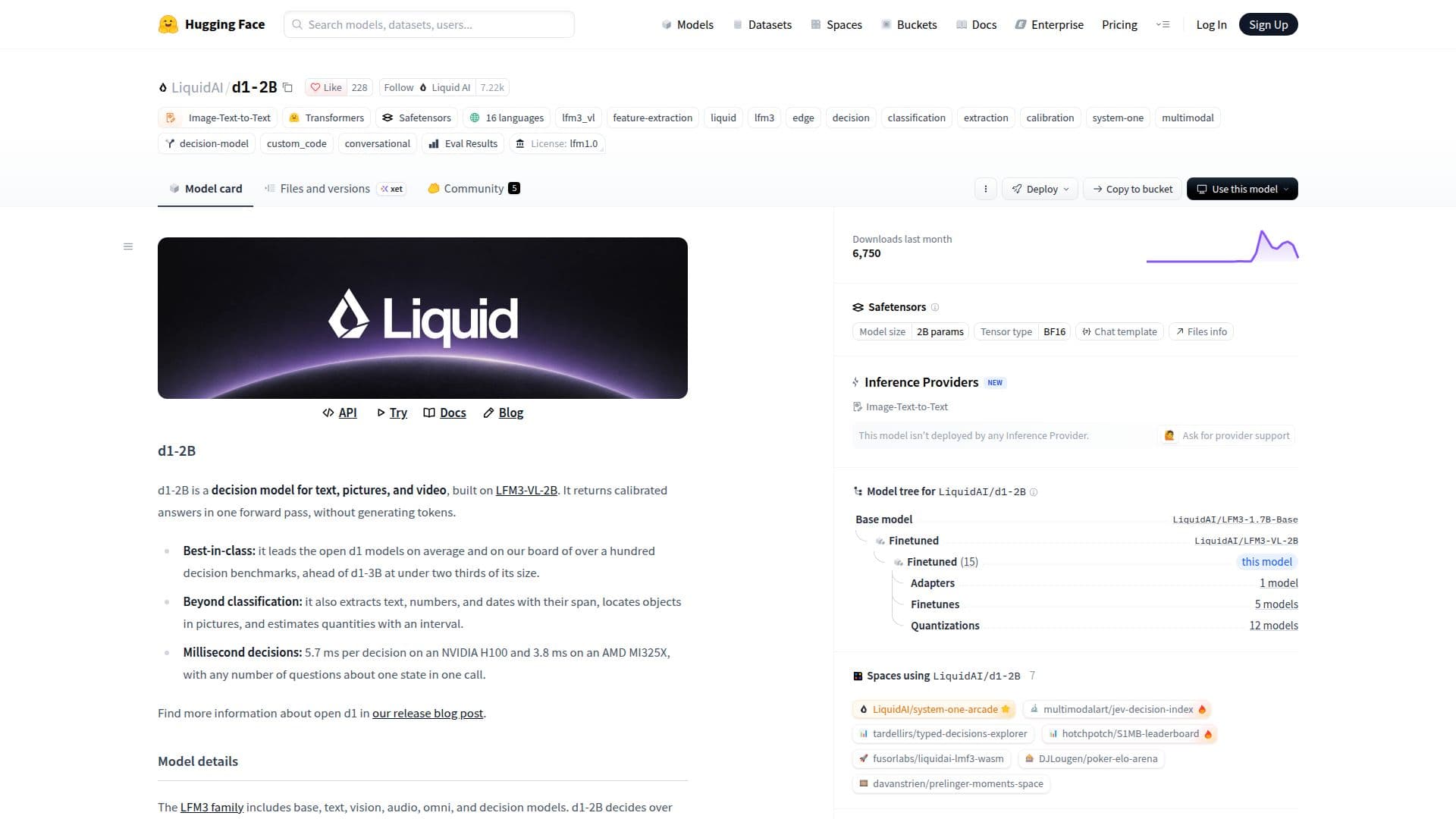
Description
d1-2B is a highly efficient decision model developed by LiquidAI, available on Hugging Face. Built upon the LFM3-VL-2B architecture, this model is engineered to process and make decisions based on multimodal inputs, including text, pictures, and video. A key characteristic of d1-2B is its ability to return calibrated answers in a single forward pass, eliminating the need for token generation, which contributes to its speed and efficiency.
Read More
The model demonstrates best-in-class performance among open d1 models, leading on average across over a hundred decision benchmarks. Despite being smaller than d1-3B, it often outperforms it, showcasing its optimized design. Beyond traditional classification tasks, d1-2B offers advanced capabilities such as extracting specific text, numbers, and dates with their spans, precisely locating objects within images, and estimating quantities with defined intervals.
Performance is a significant advantage, with d1-2B achieving decision times of 5.7 milliseconds on an NVIDIA H100 and 3.8 milliseconds on an AMD MI325X. This rapid processing is maintained even with multiple questions about a single state in one call. The LFM3 family, which includes d1-2B, features base, text, vision, audio, omni, and decision models. While d1-2B handles text, pictures, and video, its sibling d1-Omni-2B extends capabilities to include audio.
With 1.92 billion parameters and an LFM3 backbone architecture comprising 24 layers (13 gated short convolutions, 5 sliding-window attention, 6 global attention), d1-2B supports a context length of 128K tokens and a vocabulary of 128,000 tokens. It accepts inputs as a state (text or JSON), pictures, or video, along with any number of named questions, producing typed answers with probabilities without generating tokens. It supports a wide array of languages, including English, Arabic, Chinese, French, German, Italian, Japanese, Korean, Portuguese, Spanish, Vietnamese, Thai, Indonesian, Hindi, Russian, and Polish.
d1-2B is versatile, suitable for various pipeline steps requiring decisions, such as routing and triage, content moderation, intent and topic classification, data extraction from documents, judging and reranking, and visual inspection. It is explicitly noted as not being a chat model. While effective for knowledge-heavy questions, reliability may decrease past 64K tokens of state. Estimates are reliable for counts and scores but less so for free quantities. The model runs in Transformers with its own code, requiring no sampling parameters.
- CategoryAI Models & LLMs
- Pricing ModelOpen source
- DeploymentCloud
- PlatformsWeb
d1-2B Highlights
Multimodal Decision Model (Text, Pictures, Video)
2 Billion Parameters
Single Forward Pass for Calibrated Answers
No Token Generation
Best-in-Class Decision Benchmarks Performance
Text, Number, and Date Extraction
Object Location in Pictures
Quantity Estimation with Intervals
Millisecond Decision Speed (e.g., 3.8 ms on AMD MI325X)
LFM3 Backbone Architecture
128K Token Context Length
128,000 Token Vocabulary
Multilingual Support (15+ languages)
Designed for Routing, Triage, Moderation, Extraction
Runs in Transformers with Custom Model Code
Getting Started with d1-2B
Access Model Page: Navigate to the LiquidAI/d1-2B model page on Hugging Face.
Explore Files: Review the model details, architecture, and specifications provided.
Configure Inference: Utilize the Transformers library to set up the model for inference.
Prepare Inputs: Provide a state (text or JSON), pictures, or video, along with named questions.
Execute Calls: Use `system_one` for single requests or `system_one_batch` for batched requests.
Interpret Output: Receive typed answers with probabilities, without generated tokens.
d1-2B's Use Cases
- Routing and Triage
- Moderation and Guardrails
- Intent Classification
- Topic Classification
- Extraction from Documents
- Judging and Reranking
- Visual Inspection
- Multimodal Decision Making