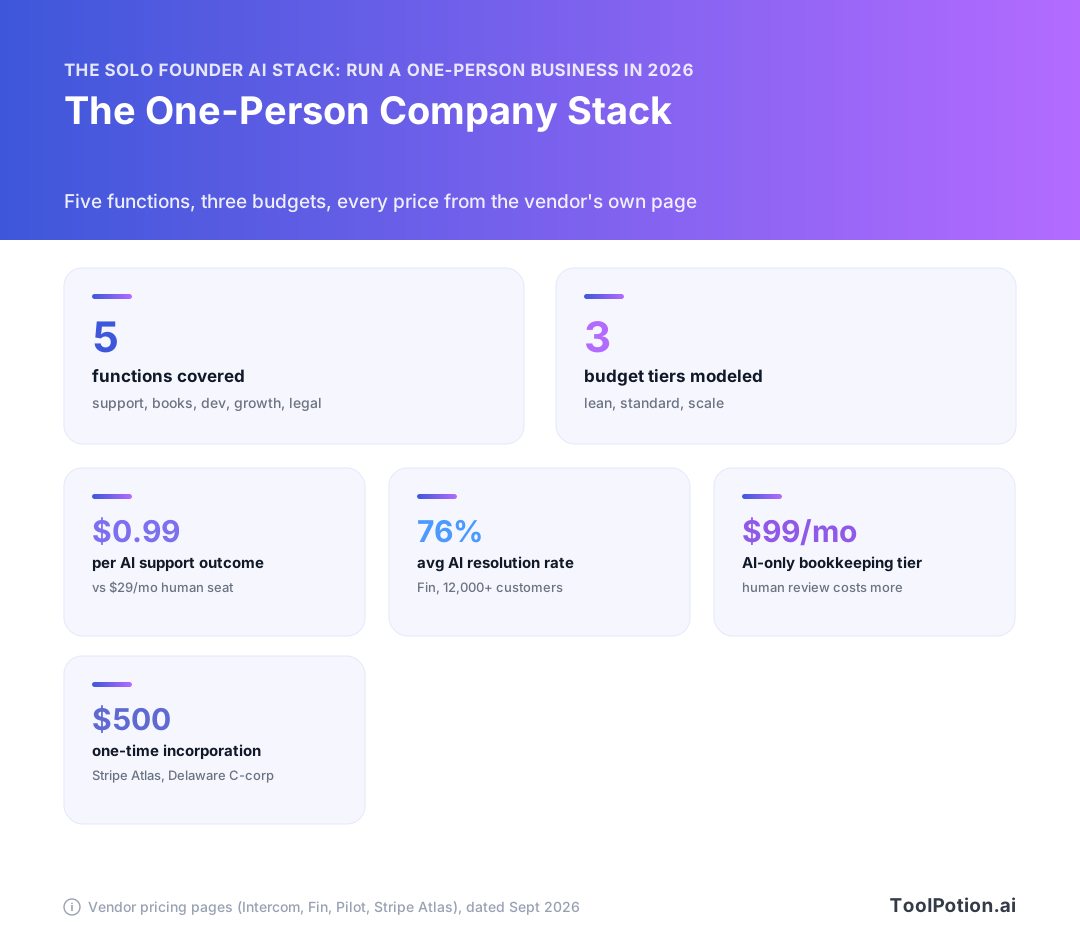
A working stack of solo founder AI tools in 2026 runs about $50-80/month at the lean end and $600-1,200/month at scale, and the reason published budgets disagree so wildly is that half the line items no longer bill per seat. Intercom charges $0.99 per resolution for its Fin agent, against $29/seat/month for a human on Essential. Zendesk includes AI agents in every Suite plan but bills separately per automated resolution and doesn't publish the rate. Your support bill now moves with ticket volume, not headcount.
This covers all five jobs a solo founder can't skip: support, marketing, bookkeeping, legal and formation, and dev. Every price here comes from the vendor's own pricing page, checked 5 September 2026. Fixed costs and variable costs are split apart, because mixing them is how a $20 plan becomes a $200 month. And there's a list of work you shouldn't hand to an agent at all.
The five functions a one-person company can't skip
Support, marketing, bookkeeping, legal and admin, and building the product. Those five jobs used to mean five hires, or at least five contractors and a lot of unpaid nights. In 2026 each has a working AI substitute you can buy on a credit card, and the interesting question stopped being whether the tools exist. It's what the whole set costs once it's running at your volume.
Why 'ChatGPT plus a few tools' isn't a stack
A general assistant writes your emails. It doesn't file your 83(b), reconcile last month's Stripe payouts, or answer a customer at 2am while you're asleep.
That gap is where the five functions live. Bookkeeping needs a system of record that a tax preparer will accept, which is why Pilot gates a US-based human bookkeeper behind a tier above its $99/month AI plan. Support needs something wired into your help center and your refund policy, with hard limits on what it's allowed to do. Formation is a one-time legal filing, not a chat. Picking a single chatbot and calling it a company is how founders end up rebuying the same stack twice, and browsing the broader AI app landscape makes the sprawl obvious fast.
Fixed subscriptions vs. usage-based AI spend
Half your bill no longer looks like a seat. Intercom charges $0.99 per resolution for its Fin agent, alongside human seats at $29, $85 and $132 per month. Zendesk includes AI agents in every Suite plan and then bills separately per automated resolution, without publishing the rate. Chatbase sells message credits, $40 per 1,000 on auto-recharge.
So a budget table with one flat number per tool is wrong before you read it. Model the fixed part and the variable part separately, then find the crossover: at $0.99 an outcome, about 29 resolutions a month costs what one Intercom Essential seat costs, and everything past that is where the math starts favoring the agent.
Customer support: the function AI takes over first
Support is the one job where the AI vendors will bill you for outcomes instead of hours, and that changes how you should shop. You're no longer buying a seat and hoping someone fills it. You're buying resolved tickets at a unit price, and you can do the arithmetic before you sign up.
Intercom Fin: $0.99 per resolution vs. $29 a seat
Intercom charges $0.99 per outcome for Fin, its support agent, meaning you pay when a ticket gets resolved without a human. Human seats run $29/mo (Essential), $85/mo (Advanced) and $132/mo (Expert) billed annually, with a one-full-seat minimum and a 14-day trial that doesn't ask for a card. So the floor for a solo founder is $29/mo plus whatever Fin resolves.
Fin reports a 76% average resolution rate across 12,000+ customers, with many above 85%, and about 2 million resolutions a week. Treat 76% as the number to plan against, not the 85%.
Zendesk's automated resolutions and the unpublished rate
Zendesk bills the same way in shape and worse in transparency. Suite runs $55/agent/month (Team) and $115/agent/month (Professional) paid yearly, AI agents are included in every Suite and Support plan, and you're charged separately per Automated Resolution: only requests handled without escalation count. The per-resolution price isn't on the pricing page. You have to ask sales for it, which is reason enough to skip Zendesk as a one-person shop.
Chatbase for founders who just need a docs bot
If your support load is a hundred questions a month that all live in your docs, buy the cheap thing. Chatbase starts at $0 for 50 message credits and one agent, then $40/mo (Hobby, 700 credits, 2 agents), $150/mo (Standard, 4,000 credits, 3 agents) and $500/mo (Pro, 15,000 credits, 5 agents). Extra agents are $25/agent/month and auto-recharge credits cost $40 per 1,000 messages. Note that Chatbase meters messages, not resolutions, so a chatty user who never gets an answer still burns your budget. It's the weakest billing model of the three and still the right pick under a few hundred tickets. Our directory tracks 550 AI agents built for support workflows if Chatbase's knowledge-base limits pinch.
The crossover math: when per-outcome beats a seat
At $0.99 an outcome, 29 Fin resolutions cost the same as one $29 Intercom seat. That's the line to hold in your head.
| Monthly tickets | Fin resolves ~76% | Fin cost at $0.99 | Plus 1 Essential seat |
|---|---|---|---|
| 100 | 76 | $75 | $104 |
| 300 | 228 | $226 | $255 |
| 1,000 | 760 | $752 | $781 |
Under roughly 200 tickets a month, Chatbase Hobby at $40 wins on raw cost. Past 300, Fin's resolution quality is worth the premium because the alternative is you answering the other 24% at midnight. Above 1,000 tickets a month you're paying about $780 for what a part-time support hire would cost several times over, and the per-outcome model still hasn't broken.
Bookkeeping and banking: cheap to automate, expensive to get wrong
Categorizing transactions is now a commodity feature that costs you $0 to $40 a month. Having someone qualified attest that the books are right costs multiples of that, and every vendor in this category prices it that way.
Xero, QuickBooks and FreshBooks: what you end up paying
For a solo founder in 2026 Xero is the better buy. US plans run $25/mo Early, $55/mo Growing and $90/mo Established, and JAX, Xero's AI finance partner, plus smart document capture and auto-reconcile come on all three tiers rather than being gated behind the top plan. Early caps you at 20 invoices and 5 bills a month, which is fine until it isn't. Payroll runs through Gusto as a $36/mo + $6 per employee or contractor add-on. If you buy before 30 September 2026, Xero is discounting new customers 90% for six months.
QuickBooks Online lists at $38 Simple Start, $85 Essentials, $140 Plus and $340 Advanced, with a standing 50% off for three months and a 30-day trial. Its AI story is thinner than the marketing implies: expert-guided setup and AI Chat are both still labeled Beta, and AI Chat is capacity-limited. You're paying the QuickBooks premium for accountant familiarity, not for the AI.
FreshBooks ($23 Lite, $43 Plus, $70 Premium, currently 90% off for three months) is an invoicing tool that keeps books, not the reverse. Pick it if you bill a handful of clients on retainer and hate everything else about accounting. Lite caps you at 5 billable clients.
Kick and the AI-native bookkeeping tier
Kick is free up to 250 transactions a year, which covers a pre-revenue side project completely. Unlimited transactions is $40/mo ($480 billed annually), and accrual accounting is $100/mo on Plus. Auto-categorization, receipt matching, P&L and balance sheet are on every tier including the free one. If you're under 250 transactions and don't have a CPA who insists on QuickBooks, start here and spend the $25 elsewhere.
Pilot at $99/mo, and why the human sits behind a paywall
Pilot Essentials is $99/month for up to $100,000 in monthly expenses and covers AI transaction categorization, reconciliation, the monthly close, a year-end tax package and AI chat. A US-based human bookkeeper who reviews your books is on Core, the tier above.
That split is the whole pricing logic of this category, stated plainly by a vendor. Machine classification is close to free. Someone who signs off on the result, and who you can point at when the numbers are wrong, is the expensive part. Price your stack accordingly: cheap software all year, and money set aside for a human before you file.
Mercury as the $0 banking layer
Mercury's base tier is $0/mo with no minimum balance, overdraft or account-opening fees, and it includes ACH, domestic wires and QuickBooks/Xero accounting automations. That last part matters more than the fee waiver: your bank feeding your books automatically is what makes the $25 Xero plan enough. Plus is $29.90/mo, or $23.95 on annual, adding recurring invoices and unlimited 1099 filings, and Pro is $299/mo. Stay on the free tier until you're filing enough 1099s that Plus pays for itself.
Legal and formation: a one-time cost most stack articles skip
Formation is the only line item here you pay once, which is exactly why every monthly-subscription roundup leaves it out. Budget $500 and be done.
Stripe Atlas, Clerky and LegalZoom compared
| Route | Price | What you get |
|---|---|---|
| Stripe Atlas | $500 one-time (Stripe Atlas) | Delaware C-corp, tax ID, 83(b) filing, first-year registered agent, done in two business days |
| Clerky Company Lifetime Package | $819 one-time (Clerky) | Formation plus the ongoing document machinery for equity and fundraising |
| LegalZoom LLC | $0 / $249 / $299 + state fees (LegalZoom) | LLC filing; Pro adds a 30-day attorney plan that renews at $49/month |
Pick Atlas if you'll ever raise money or issue equity. Pick the LegalZoom $0 tier if you're a US solo consultant who wants an LLC and nothing else, and skip the attorney plan unless you know what you'd ask it.
What the $500 and $819 packages actually include
The bundled items are the ones that hurt when you handle them yourself. An 83(b) election has a hard filing deadline and no forgiveness if you miss it, and Atlas files it for you inside that $500 (Stripe Atlas). Registered agent coverage for year one is in there too, so you're not shopping for a $99 renewal in month two. Clerky's $819 buys you the same starting point plus a document engine you'll use again at your first SAFE. If you never sell stock, that extra $319 sits idle.
Contracts and e-signature: DocuSign and the template trap
Use an AI model to draft your MSA, your privacy policy and your contractor agreement. Then send them through DocuSign eSignature and keep the executed copies somewhere you'll find them in three years. There are hundreds of legal and document AI tools in our directory that will produce a passable first draft in a minute.
Where the drafts stop being safe: anything with personal liability attached. Equity grants, 83(b) timing, your tax filing, and any contract where a mistake costs more than a lawyer's hourly rate. Pay a human for those four.
Marketing and content: where the credits quietly add up
Your marketing bill scales with two things: how many people are on your list, and how many seconds of audio or video you generate. Neither one tracks headcount, which is good news for a solo operation and bad news for anyone budgeting off a flat monthly number.
Email and audience: beehiiv vs. Kit
Both price by subscriber count (beehiiv, Kit), so the question isn't which is cheaper at zero subscribers. It's which one you want to be locked into at 10,000.
Pick beehiiv if the newsletter is the product and you want the ad network and referral mechanics that come with it. Pick Kit if email is a support channel for something else you sell, because its automation and tagging model handles the buyer-lifecycle stuff better. Sending twice a week for six months teaches you more about which one fits than any comparison table, and you can read what good ones look like in our directory's AI newsletters worth reading.
CRM without a sales team: HubSpot's free tier and its ceiling
HubSpot's free CRM covers a solo founder for longer than you'd expect, and the paid tiers on the CRM pricing page start mattering when you want sequences, reporting and multiple pipelines. Until you're doing outbound at volume, the free tier is fine and you should spend the money on distribution instead.
A spreadsheet works too. Nobody will audit you.
Voice, video and the per-minute AI line items
This is where a $20 plan turns into a $200 month. ElevenLabs bills by characters and generation minutes, so a weekly podcast intro costs almost nothing and a daily narrated short burns a plan tier in three weeks. Before you commit, do the math on your actual publishing cadence: episodes per month times average length times the per-minute rate on the tier you're considering. If that number beats your subscription's included allowance, you're on the wrong plan, and overage rates are always worse than the next tier up.
The dev stack: shipping software without engineers
You can build and host a real product for about $65 a month. That's the floor for a working stack in 2026, and it holds whether you write the code yourself or narrate what you want and read the diffs.
$65/month: Claude Pro, Cursor Pro, Vercel Pro, Supabase
Claude Pro is $20/mo and includes Claude Code, the terminal agent (Claude pricing). Cursor Pro is another $20/mo (Cursor pricing). Vercel Pro is $20/mo for hosting, and Supabase's free tier covers Postgres, auth and storage while you have no users. Total: $65.
If you only want one, take Claude Code. Cursor earns its $20 when you're editing an existing codebase and want the changes inline; Claude Code earns it when you're describing a whole feature and want an agent to go do it. Running both is common and it's still cheaper than an hour of contractor time.
When to add Supabase Pro and Copilot
Move to Supabase Pro at $25/mo when you have paying users, which takes the stack to $90/mo. The trigger is daily backups and the database not pausing on you, not any feature you'll miss on day one.
GitHub Copilot is the one I'd skip if you already pay for Cursor. Same job, second bill.
Credit pools: the part of the bill that moves
The $20 buys an allowance, not unlimited work. Cursor Pro meters usage above the included amount against a credit pool (Cursor pricing), so a week of heavy agent refactoring bills differently from a week of small edits. Budget the flat $65 and treat overage as a separate variable line, the same way you treat support resolutions.
Before you build a component from scratch, check whether it exists. Our directory tracks 301 open-source AI repos, and half the agent plumbing people pay for is sitting in one of them.
The monthly budget: lean, standard and scale tiers
Three numbers, depending on where you are: about $65 a month pre-revenue, about $250 once you have customers writing in, and $600 to $1,200 once support volume and audio generation start billing by the unit. Here's the whole stack in one table.
| Function | Lean (~$50–80/mo) | Standard (~$200–350/mo) | Scale (~$600–1,200/mo) |
|---|---|---|---|
| Build | Claude Pro $20 + Cursor Pro $20 + Vercel Pro $20 + Supabase Free $0 | Same, Supabase Pro $25 | Same, plus usage overage on Vercel and Supabase |
| Support | Chatbase Free ($0, 50 credits) | Chatbase Standard $150/mo, 4,000 credits | Intercom Essential 1 seat $29/mo + Fin at $0.99/outcome |
| Books | Kick Free (250 transactions/yr) | Kick Basic $40/mo, unlimited transactions | Pilot Essentials $99/mo, up to $100k monthly expenses |
| Banking | Mercury $0/mo | Mercury Plus $29.90/mo | Mercury Plus $29.90/mo |
| Marketing | beehiiv or Kit free tier | Email tool + ElevenLabs paid tier | Email + audio credits, scaling with list size |
| Legal | $0 (already incorporated) | $0 | $0 |
Lean (~$50–80/mo): pre-revenue, first customers
You pay for the dev stack and almost nothing else. Claude Pro at $20 with Claude Code included, Cursor Pro at $20, Vercel Pro at $20, Supabase on free. Support runs on Chatbase's free tier, which gives you 50 message credits and one agent, and books run on Kick's free plan up to 250 transactions a year. Banking is $0 at Mercury with no minimum balance.
If you're spending more than $80 a month before you have paying customers, you bought something you don't need yet.
Standard (~$200–350/mo): real support volume, real books
The jump is support. Chatbase Standard is $150/mo for 4,000 credits and three agents, which is the single biggest line in this tier by a wide margin. Add Kick Basic at $40 for unlimited transactions, Mercury Plus at $29.90 for recurring invoices and unlimited 1099 filings, and Supabase Pro at $25. That lands you near $310 before marketing.
Watch the promo math when you price accounting. QuickBooks lists Simple Start at $38/mo but runs a standing 50%-off-for-three-months offer, so your first quarter reads $19 and your fourth month reads $38. Budget the list price. The discount is a cash-flow detail, not a cost.
Scale (~$600–1,200/mo): where variable spend passes fixed
At this tier your subscriptions stop being the interesting number. Fin bills $0.99 per resolution against a $29 Intercom seat, so 300 resolved conversations a month costs you $297 in variable spend on top of a $29 fixed seat. Bookkeeping moves to Pilot Essentials at $99/mo for up to $100,000 in monthly expenses. Audio and email both scale with volume rather than headcount.
Reading the table: fixed vs. variable columns
Split every line into a number you can forecast and a number you can't. Fixed is seats and plan fees: Cursor, Vercel, Supabase, Mercury, Pilot. Variable is anything priced per outcome, per credit or per second: Fin resolutions, Chatbase message credits at $40 per 1,000 on auto-recharge, Zendesk automated resolutions where the per-resolution rate isn't even published.
Set a hard cap on the variable column before you turn anything on. A support agent that resolves well is a support agent that bills well, and those two facts arrive in the same invoice.
Which solo founder AI tools to adopt first (and in what order)
Sort every candidate task by two axes: how often it happens, and how bad it is when the machine gets it wrong. High volume plus reversible goes first. Low volume plus irreversible goes last, or never.
Week 1: support deflection and bookkeeping ingest
Point an AI agent at your docs and let it answer the repeat questions. A wrong answer costs you one follow-up email, and you're paying per resolution anyway, so a deflection that fails just doesn't bill (Zendesk only charges for requests resolved without escalation). Same logic on the books: connect the bank feed and let auto-categorization run. Kick does it free up to 250 transactions a year (Kick). Miscategorized coffee is a two-second fix in March.
Month 2: email sequences and reporting
Once you've watched the support agent for a few weeks and know its failure shapes, turn on the things that go out to a list. Welcome sequences, monthly P&L, invoice reminders. These are reversible in the sense that a bad send is embarrassing and not expensive, but they reach real people, so you want the review habit already built.
Month 3+: anything with a review step
Refunds, data deletion, plan changes, anything that touches tax. Let the AI draft the action and hold it for your approval. Pilot gates its human bookkeeper behind a higher tier than the $99/month AI plan (Pilot) for the same reason: the categorization is cheap, the signature is what you're buying.
What you still can't hand to an agent
Three categories stay human: actions you can't undo, filings that carry your personal signature, and anything a customer would escalate over. The vendors agree with this, and their pricing shows it.
The irreversible-action list: refunds, deletions, billing changes
Write down every action in your product that can't be reversed with a click, then make sure no agent has permission to take it. Refunds. Account deletion. Plan downgrades and cancellations. Sending money. Changing a customer's billing details. An agent that resolves 76% of tickets on its own (Fin) is still wrong some of the time, and a wrong answer costs you a follow-up email while a wrong refund costs you the money plus the follow-up email.
The pattern that works: the agent drafts the action and queues it, you approve it in a batch once a day. You keep the speed on everything reversible and pay a few hours of latency on the handful of things that aren't.
Tax filing, equity and 83(b): personal liability doesn't delegate
You sign the return. Not the tool. Same for equity paperwork, board consents and an 83(b) election, where the deadline is unforgiving and the consequence lands on your personal tax bill. This is why Stripe Atlas includes the 83(b) filing in its $500 one-time fee as a done-for-you step rather than a template you fill in yourself, and why LegalZoom's Pro tier at $249 plus state fees sells attorney access on top of the filing. You're buying a human's attention on the parts that bite.
The bookkeeping review a human signs
Pilot draws this line in its price list. The Essentials plan is $99/month for AI categorization, reconciliation, monthly close and a year-end tax package. A US-based human bookkeeper who reviews the books sits on the Core tier, above it. Categorization is cheap because it's easy to fix. Attestation is expensive because somebody's name is on it.
Anything a customer would escalate over
Billing disputes, outages, anything involving a lawyer or a chargeback, and any conversation where the customer has already asked twice. Route those to yourself on the first message rather than the third. Intercom charges $0.99 per resolution whether the customer was happy about it or not.
Frequently Asked Questions
How much does a solo founder AI stack actually cost per month in 2026?
Somewhere between $50 and $1,200, depending on how much of it bills per use. A lean stack runs about $50 to $80: Claude Pro at $20 (Claude Code included) plus Cursor Pro at $20 plus Vercel Pro at $20 on top of a free Supabase project comes to $65 a month, and business banking at Mercury adds $0 on the base tier. The number that blows up budgets is the variable half, because support and agent tooling bill per outcome now: Intercom charges $0.99 per Fin resolution and Zendesk bills separately by automated resolution on top of $55 per agent per month. Model your fixed subscriptions and your per-outcome spend as two separate lines, or the $20-a-month table you built in January will be wrong by March.
Is Intercom Fin's $0.99 per resolution cheaper than hiring a support contractor?
For most solo founders, yes, and the seat-price comparison people reach for is misleading. About 29 Fin resolutions cost what one Intercom Essential seat costs at $29 per seat per month, but that seat fee is software only, and a contractor's hourly wage sits on top of it. Fin's $0.99 is the whole cost of a conversation that closed without you, and Fin reports a 76% average resolution rate across 12,000-plus customers with many above 85%. At 300 tickets a month you'd pay roughly $225 for the resolved share, which no human contractor will match. Keep a human in the loop for refunds, data deletion and billing changes regardless of what the math says.
What's the cheapest way to incorporate and stay compliant as a one-person company?
LegalZoom's Basic LLC package is $0 plus state filing fees, which is the lowest cash outlay available, and it's the right pick if you're bootstrapping with no investors. Watch the upsells: Pro at $249 bundles a 30-day attorney plan that renews at $49 a month, and Premium at $299 includes six months of bookkeeping that renews at $9.99 a month. If you're raising money and need a Delaware C-corp, pay the $500 one-time for Stripe Atlas, which covers the tax ID, the 83(b) filing and your first-year registered agent, and completes in two business days. Clerky's Company Lifetime Package is $819 for similar ground.
Can AI bookkeeping tools replace an accountant at tax time?
They replace the data entry, not the sign-off. Kick is free up to 250 transactions a year and $40 a month for unlimited, with auto-categorization, receipt matching and a P&L, which is enough to keep clean books all year. Pilot's structure tells you where the line sits: $99 a month for Essentials buys AI categorization, reconciliation, monthly close and a year-end tax package, and the US-based human bookkeeper who reviews the books only appears on the Core tier. Filing itself carries personal liability, so pay a human to check the return even when the categorization was automated.
Which tool should a solo founder buy first if they only have $50 a month?
Buy Claude Pro at $20 a month, which includes Claude Code, and spend the rest on bookkeeping rather than a second assistant. Mercury's base business banking tier is $0 with no minimum balance and pushes transactions into QuickBooks or Xero automatically, so your banking line costs nothing. Add Xero Early at $25 a month, which bundles its JAX AI finance partner and auto-reconcile on every plan, and take the 90% off for six months if you buy before 30 September 2026. That's $45 for the two functions you can't skip, and support tooling can wait until you have enough tickets to justify per-resolution billing.