
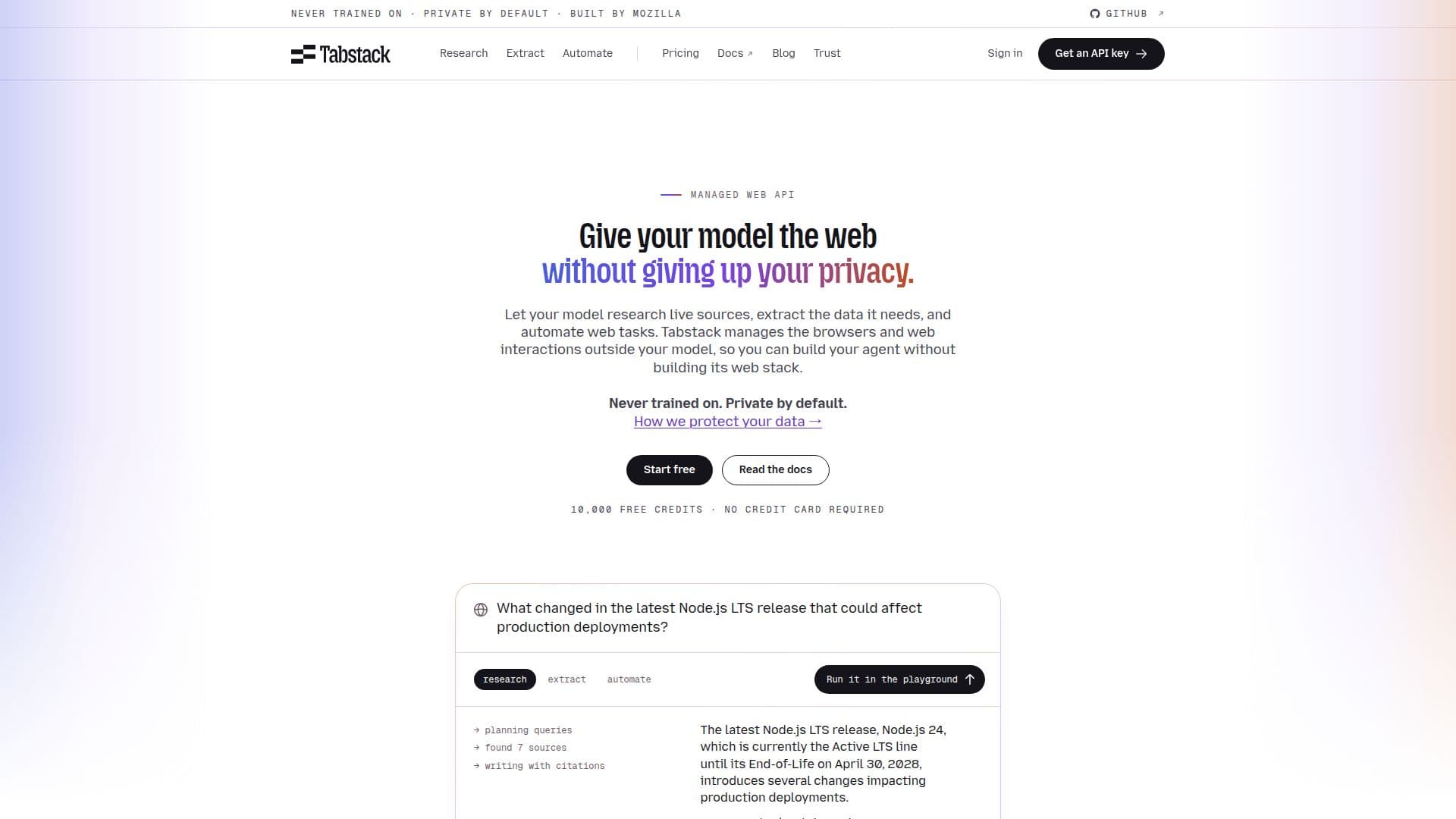
Description
Tabstack offers a comprehensive managed web API designed to give AI models access to the internet while prioritizing privacy. It allows models to perform web research, extract structured data, and automate browser tasks without requiring them to manage complex web infrastructure. This means developers can build sophisticated AI agents without needing to develop and maintain their own web stack for fetching, rendering, and interacting with web pages.
Read More
The platform provides several key capabilities through its API. The Research endpoint enables models to ask questions and receive cited answers from live web sources, eliminating the need for the model to run every search and read every page itself. For data extraction, users can pass a URL and an optional JSON schema, and Tabstack will fetch, render, and clean the page content, returning it as plain text or structured JSON that matches the specified schema. Additionally, the Automate endpoint allows models to describe a web task and a starting URL, with Tabstack handling the navigation and interaction, returning the results and task events.
Tabstack emphasizes data privacy and security. It is built by Mozilla and commits to never training models on customer payloads. Data is private by default, with organization administrators having control over request history collection. Detailed data collection, which retains request content for 90 days for troubleshooting, can be turned off in the console. Operational and security logs, however, still apply. For workflows requiring authentication or complete control over the browser environment, Tabstack offers Pilo, an open-source automation engine for self-hosting.
The service integrates seamlessly with existing AI agent frameworks and SDKs, including Python, TypeScript, CLI, Hermes, LangChain, LlamaIndex, Mastra, Vercel AI SDK, OpenAI Agents, and Claude Agent. This allows developers to incorporate web access into their current workflows using familiar tools. Tabstack operates on a credit-based system, offering 10,000 free credits upon account creation without requiring a credit card. Paid plans — Starter, Team, and Pro — scale by included credits, research modes (Fast and Balanced), rate limits, and overage pricing, ensuring flexibility for individual workflows to production-level workloads. Enterprise options are available for custom quotas and support.
- CategoryBrowser & Web Automation
- Pricing ModelFreemium
- DeploymentCloud
- PlatformsWeb
Tabstack's Core Features
Managed Web API for AI Models
Private by Default Data Handling
Never Trains on Customer Payloads
Web Research with Citations
Structured Data Extraction from URLs
Browser Automation for Web Tasks
Supports Multiple Research Modes (Fast, Balanced)
Open-Source Automation Engine (Pilo) for Self-Hosting
Integrations with Popular AI Frameworks and SDKs
Python SDK Available
TypeScript SDK Available
CLI for Shell and Agent Workflows
Customizable Request History Collection
90-Day Request History Retention (when enabled)
Free Credits for Evaluation
How to use Tabstack?
Create Account: Sign up for a free account on Tabstack.ai to receive 10,000 free credits.
Install SDK/CLI: Install the Tabstack SDK for Python or TypeScript, or the CLI for shell workflows.
Authenticate: Obtain your API key and use it to authenticate your calls.
Make a Research Call: Use the `/research` endpoint with a query to get cited answers from live web sources.
Extract Data: Pass a URL and an optional JSON schema to the `/extract/json` or `/extract/markdown` endpoint to get clean, structured data.
Automate Tasks: Describe a public web task and a starting URL to the `/automate` endpoint for browser interaction.
Monitor Usage: Track your credit usage and manage detailed data collection settings in the console.
Upgrade Plan: Choose a paid plan (Starter, Team, Pro) based on your usage needs for more credits and higher rate limits.
Tabstack's Use Cases
- Web Research for AI Agents
- Structured Data Extraction
- Automated Web Tasks
- Knowledge Base Updates
- Content Generation with Citations
- Competitive Analysis
- Market Intelligence Gathering
- Documenting Live Sources