Description
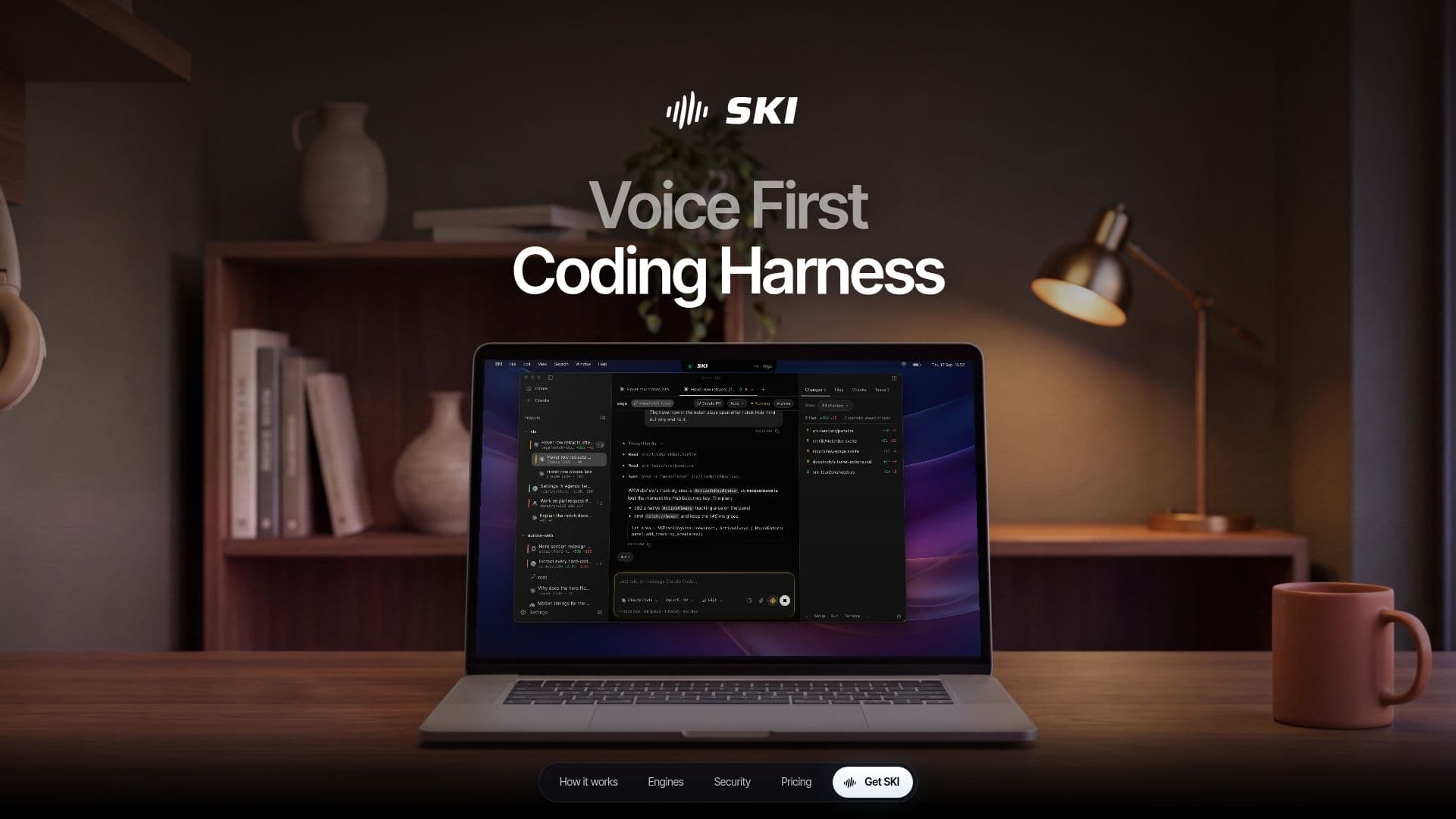
SKI is presented as a voice-first coding harness designed specifically for Mac users, aiming to revolutionize how developers interact with AI coding agents. The core premise is to overcome the human limitation in managing multiple AI agents in parallel, allowing developers to handle more code, faster, without losing track of any agent's progress.
Read More
The platform integrates with various popular coding agents, including Claude Code, Codex, Cursor, OpenCode, Antigravity, and pi. It enables these agents to run side-by-side, with SKI acting as an intelligent orchestration layer. Users can talk to their coding agents and hear them talk back, receiving real-time updates and prompts without needing to constantly monitor the screen or return to the keyboard. This hands-free interaction is particularly beneficial for developers who might be pacing, sketching, or performing other tasks away from their desk.
Key capabilities include real-time talkback, allowing for continuous interaction and immediate feedback on agent actions. SKI interprets natural language instructions, even when mixing languages, and translates them into precise commands for the agents. It maintains the context of every project, branch, and chat, providing spoken summaries and status updates. A unique feature is its ability to manage agent chains, where one agent's output is automatically handed off to the next, with the user being notified upon completion of the entire chain.
SKI emphasizes safety and control, rebuilding instructions from project context and presenting interpretations for user correction before execution. Irreversible actions always require explicit confirmation. The system also allows users to bring their existing agent accounts and choose the appropriate engine for each task, optimizing cost by directing complex reasoning to expensive engines and bulk work to more affordable open-weight ones. All user code, projects, and chats remain on the user's Mac, with voice commands processed in the cloud for understanding and response, but not stored.
Available with a free plan, SKI offers a full harness experience, not a crippled trial. The Pro plan allows interaction with more agents simultaneously, while an Enterprise option caters to teams. It addresses common concerns by clarifying that it's not dictation, the speed advantage comes from reduced reading time, and its orchestration differs from traditional click-based systems by enabling steering agents without visual monitoring.
- CategoryAI Coding Assistants
- Pricing ModelFreemium
- DeploymentCloud
- PlatformsMac
SKI's Core Features
Voice-first interaction for coding agents
Supports Claude Code, Codex, Cursor, OpenCode, Antigravity, and pi
Real-time talkback and spoken updates
Intelligent orchestration layer for project context
Natural language instruction interpretation (including mixed languages)
Agent chaining for multi-step tasks
Pre-execution instruction review and correction
Confirmation for irreversible actions
Bring your own agent accounts and choose engine per task
Local code and project storage on Mac
Free plan available with full harness features
Pro plan for increased concurrent agent interaction
Enterprise plan for teams
Dedicated branch and worktree for each chat
Diff visualization during agent work
How to use SKI?
Install SKI: Download and install the SKI application on your Mac.
Connect Agents: Link your existing accounts for supported coding agents like Claude Code, Codex, or Cursor.
Start a Project: Begin a new coding project or open an existing one within SKI.
Give Voice Commands: Speak instructions naturally to your agents, mixing languages if needed.
Review and Confirm: Observe the interpreted instructions and confirm irreversible actions before execution.
Receive Spoken Feedback: Listen for real-time updates, summaries, and questions from your agents.
Manage Workflows: Orchestrate multiple agents in parallel or chain them for complex tasks.
Open Pull Requests: Command SKI to open a pull request once agent work is complete.
SKI's Use Cases
- Parallel Agent Management
- Voice-First Development
- Hands-Free Coding
- Automated Task Chaining
- Contextual Project Management
- Cost-Optimized Agent Usage
- Secure Local Development