Description
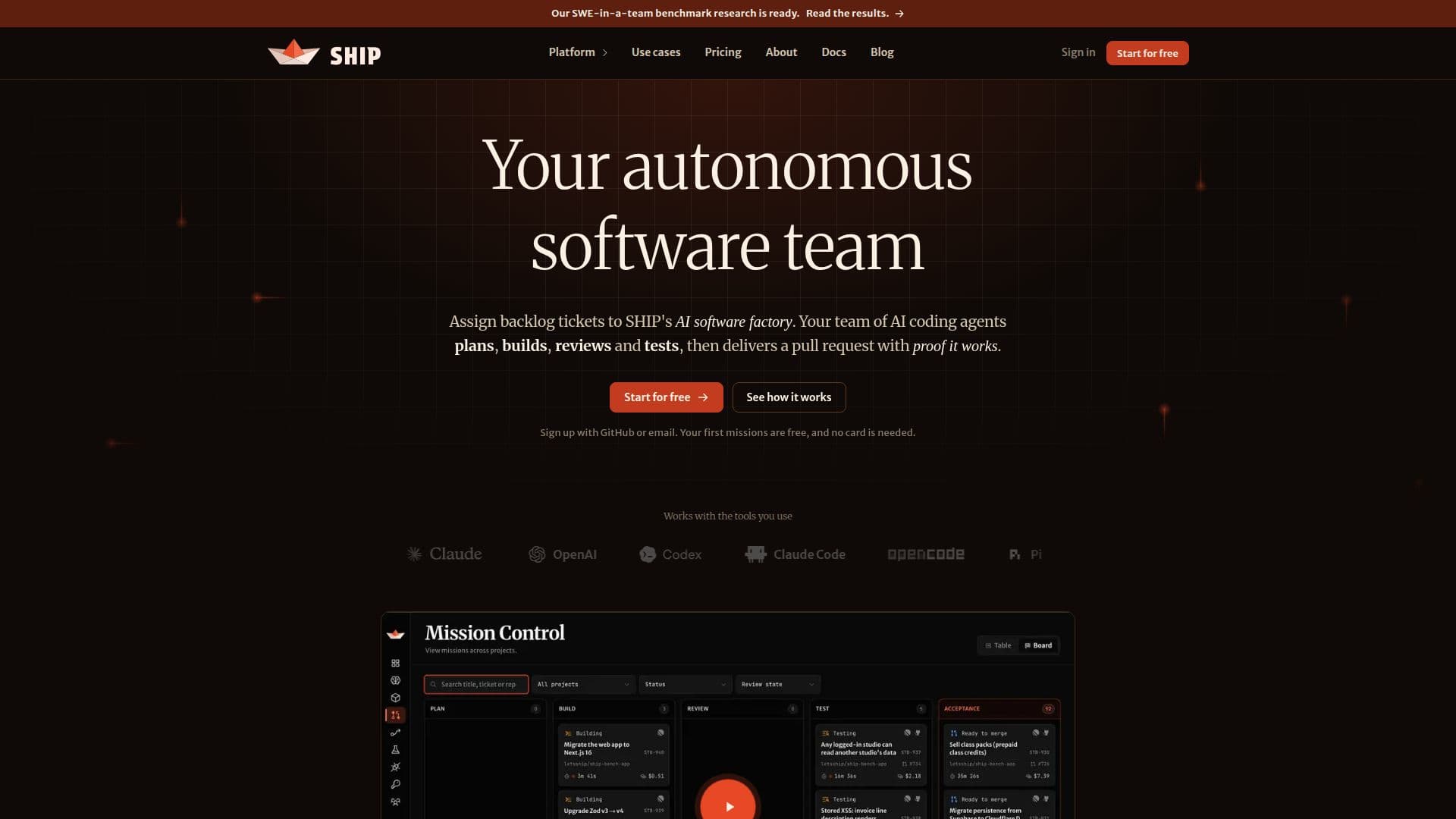
SHIP is an agentic engineering platform designed to automate and optimize the software development lifecycle (SDLC) through a team of AI coding agents. The platform allows users to assign backlog tickets to its AI software factory, where agents autonomously plan, build, review, and test code. Each mission culminates in a pull request, complete with proof that the changes work, and a detailed report of the mission's cost.
Read More
The core functionality of SHIP revolves around its autonomous software team, which includes specialized agents for planning, building, reviewing, and testing. When an issue is assigned, the Planner agent initiates the process, followed by the Builder who writes the code. The Reviewer then conducts code reviews, and the Tester ensures functionality. The platform integrates with existing delivery pipelines for deployment and testing, providing a comprehensive solution from issue assignment to a verified pull request.
SHIP offers significant benefits in cost optimization and AI sovereignty. Users can bring their own AI contracts, keys, harnesses, and models, ensuring that secrets remain encrypted and inference runs on their own accounts and regions. This flexibility allows teams to maintain control over their stack while leveraging the platform's agentic capabilities. The system also provides transparency by reporting the cost of each stage of a mission, enabling users to see the return on their AI investment.
The platform supports various coding agents and models, including Claude Code, Codex, Pi, OpenCode, and Kilo Code as agent harnesses. For models, it integrates directly with Anthropic, OpenAI, and Z.ai, as well as any model available through OpenRouter. This allows users to assign different harnesses and models to each role, optimizing for budget or performance without altering code. SHIP is compatible with popular issue trackers like Linear, Jira, and GitHub Issues, or can be managed via a command-line interface (CLI) for projects without a tracker.
Pricing for SHIP is credit-based, with users paying per mission rather than per token. One credit covers a mission of up to three agent-hours, taking an issue to a reviewed and tested pull request. The platform offers free credits for new users, one-time credit packs, and monthly subscription plans (Starter and Scale) for teams. Enterprise options are available for larger organizations with yearly commitments. SHIP ensures that credits are refunded for missions that fail or require attention without producing a pull request, providing a fair and transparent billing model.
- CategoryCoding & Development
- Pricing ModelFreemium, One-time Purchase, Subscription
- DeploymentCloud
- PlatformsWeb
SHIP's Core Features
Autonomous Software Development Lifecycle (SDLC)
AI Coding Agent Team for Planning, Building, Reviewing, Testing
Automated Pull Request Generation with Proof of Work
Cost Reporting per Mission and Stage
Integration with Existing Issue Trackers (Linear, Jira, GitHub Issues)
Support for Multiple Coding Agents and Models (Claude Code, Anthropic, OpenAI, OpenRouter)
Configurable Agent and Model Assignments per Role
Human Checkpoints for Pipeline Control
Credit-Based Pricing per Mission
Refunds for Failed Missions
Own Your AI Stack and Keys
Scheduled Code Maintenance
Command-Line Interface (CLI) and API Access
Isolated Sandbox for Agent Execution
No Copy of User Code Stored
How to use SHIP?
Sign Up: Create an account using GitHub or email.
Connect Repository: Link your GitHub repository to SHIP.
Assign Issue: Assign a backlog ticket or issue to the SHIP agent.
Monitor Progress: Track agent updates, stages, costs, and logs in the console or via issue tracker comments.
Review Pull Request: Inspect the generated pull request with visual proof and approve changes.
Manage Costs: Monitor mission costs and utilize credit refunds for failed missions.
SHIP's Use Cases
- Autonomous SDLC
- Spec-Driven Development
- Agent to PR
- Production Vibe Coding
- Auto Maintenance
- Agentic Testing
- Code Migrations
- Incident Follow-Through
- Backlog Clearing
- Cost Optimization