Description
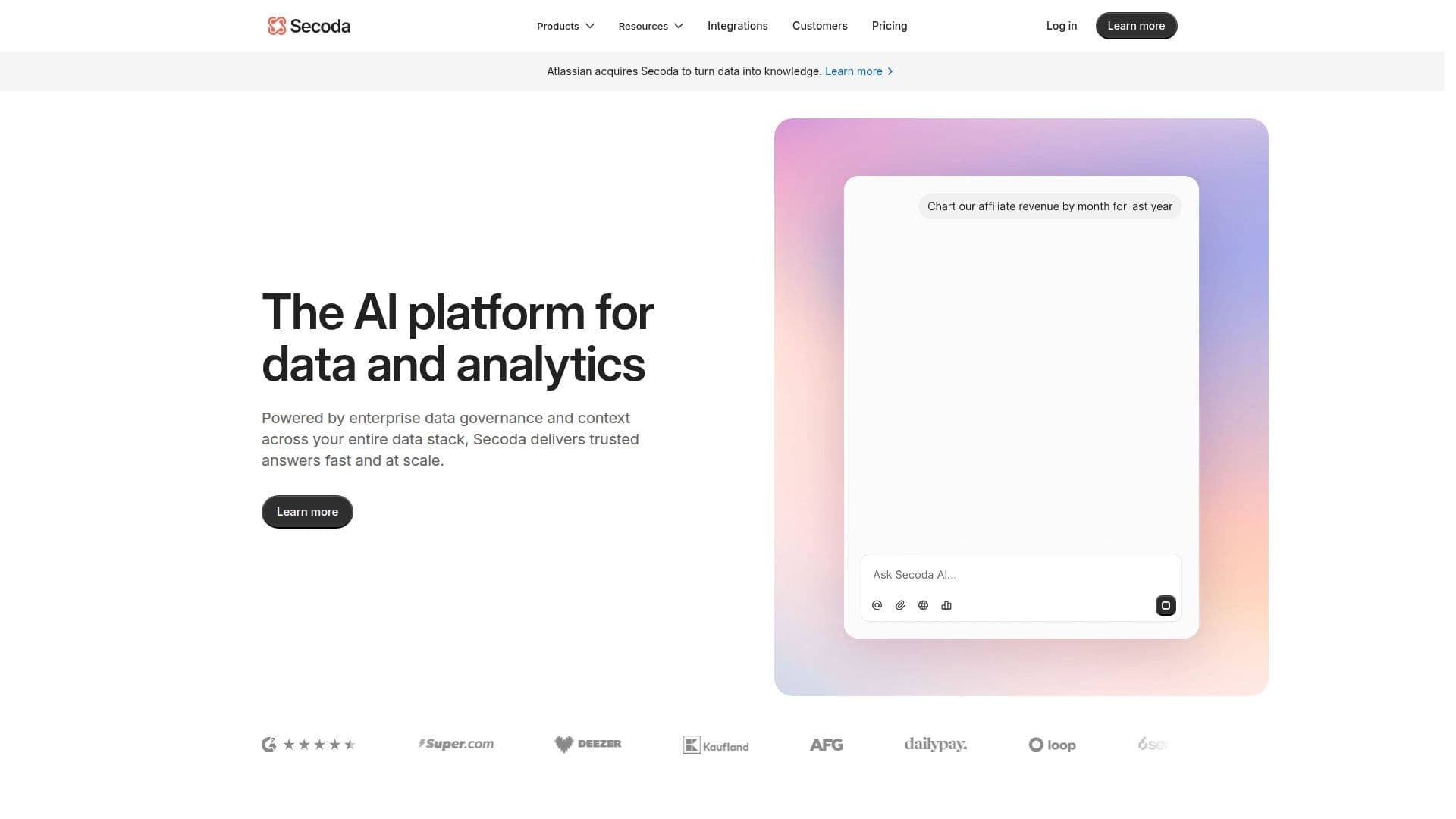
Secoda is a unified data management platform that brings data cataloging, lineage, observability, quality, and governance together in one place. It connects directly to an organization's data sources, models, pipelines, databases, warehouses, and visualization tools to build a single source of truth enriched with business context.
Read More
Because Secoda is built on a foundation of governance, metadata, lineage, and documentation, its AI agents can deliver accurate, secure answers at scale. Specialized agents handle analysis, automation, search, memory, observability, governance, documentation, visualization, and cataloging, so data teams can focus on insights rather than manual upkeep.
For governance, Secoda acts as a command center with granular role-based access control, built-in policies for standards such as GDPR and HIPAA, automated PII identification, Git-based version history, and streamlined access-request workflows. Teams can submit and approve requests through Slack or Secoda with audit trails, expiration dates, and automated provisioning.
Secoda integrates with more than 50 tools including Snowflake, BigQuery, dbt, Tableau, and Looker, and offers flexible deployment through self-hosted, VPC, or VPN options. It is used by data teams at companies such as Chipotle, Cardinal Health, Panasonic, and Vanta.
- CategoryBusiness Intelligence
- Pricing ModelContact sales
- DeploymentSelf-hosted
- PlatformsWeb
Secoda's Core Features
AI-powered data catalog and searchable glossary
End-to-end automated data lineage
Data observability and quality monitoring with alerts
Specialized AI agents for analysis, search, documentation, and governance
Unified data governance with granular RBAC and PII protection
Automated access requests and approvals via Slack or Secoda
50+ integrations across the data stack
Flexible deployment: self-hosted, VPC, or VPN
How to use Secoda?
Connect sources: Link your databases, warehouses, pipelines, and BI tools with no code.
Build context: Let Secoda catalog assets, generate lineage, and enrich metadata.
Search and ask: Use AI agents to find assets and turn raw data into insights.
Govern access: Set RBAC roles, apply compliance policies, and manage access requests.
Monitor: Create monitors for anomalies, costs, and job performance across your stack.
Secoda's Use Cases
- Data cataloging and discovery
- Data governance at scale
- Access request management
- Data observability
- Automated documentation