
Description
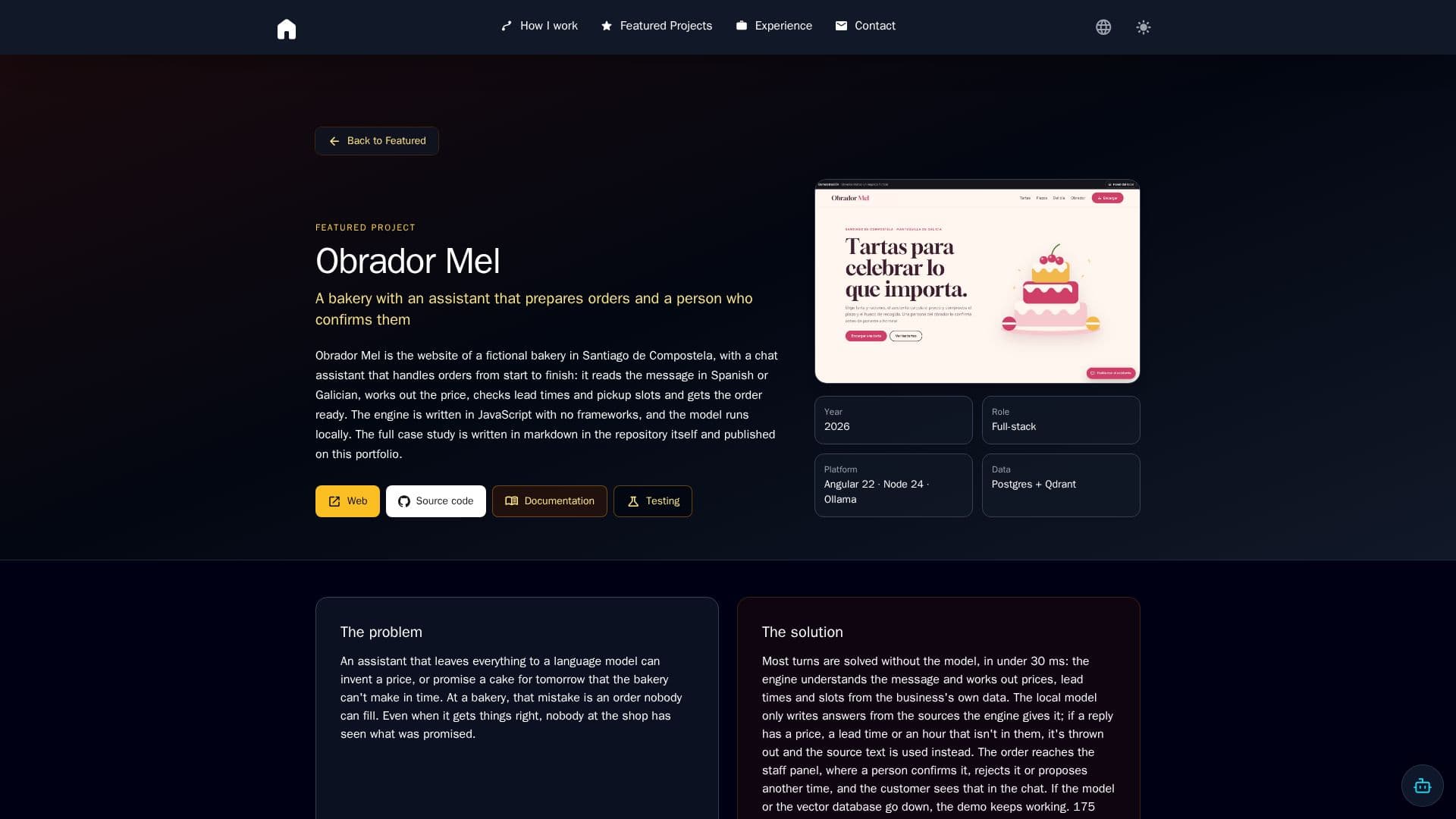
Obrador Mel is an AI-native software solution developed by Cristian Damil, specifically designed to streamline operations for businesses such as bakeries or restaurants. The core of the system is an AI assistant that handles customer interactions directly through a web interface, allowing clients to inquire about products, place orders, and make reservations at any time. This assistant is capable of understanding and responding in multiple languages, including Spanish and Galician, making it accessible to a broader customer base.
Read More
The system is built with a robust architecture that integrates various technologies. The web layer uses Angular 22.2, while the engine runs on Node 24. Data is managed with Postgres 16, storing customer requests, messages, and order traces. For AI capabilities, Obrador Mel leverages Qdrant 1.19 for vector search and Ollama (qwen3.5:9b-mlx for responses, nomic-embed-text for embeddings) for natural language processing, which can be run locally. This setup ensures a high degree of control over data and AI model deployment.
Key functionalities include an intelligent assistant that can answer questions about opening hours, product prices, allergens, and location details. It can also process complex orders, handling product quantities, options, and special requests. For the business staff, Obrador Mel provides a dedicated panel to review and confirm pending orders, address unanswered questions, and manage the daily schedule, including pickup slots. This human-in-the-loop approach ensures that critical decisions are always approved by a person, combining AI efficiency with human oversight.
The system is designed for resilience, with fallback mechanisms in place. For instance, if Ollama is unavailable, the search defaults to keyword-based retrieval, and the model continues to draft responses. If Qdrant is down, keyword search persists, and the model still functions. The architecture emphasizes data privacy, with personal identifiable information (PII) being scrubbed and redacted before storage, and all data remaining on the local machine.
Obrador Mel is a testament to a deterministic approach to AI, where the engine, with its predefined rules and data, makes decisions first, and the AI model acts within a defined framework. This ensures predictable and reliable behavior, avoiding common pitfalls of generative AI like hallucination. The project includes extensive testing, covering unit, integration, and end-to-end conversations, to ensure stability and accuracy across all functionalities.
- CategoryAI Support Chatbots
- DeploymentLocal
- PlatformsWeb
Obrador Mel's Core Features
AI Assistant for Customer Interaction
Multi-language Support (Spanish, Galician)
Order Taking and Management
Product Catalog and Allergen Information
Business Rule-Based Decision Engine
Staff Panel for Order Review and Confirmation
Schedule and Pickup Slot Management
Hybrid Search (Vector and Keyword)
Local AI Model Deployment (Ollama)
Data Privacy and PII Redaction
Robust Error Handling and Fallback Mechanisms
Comprehensive Unit and Integration Testing
End-to-End Conversation Testing
Customizable Business Data (JSON files)
API for Conversation and Business Data
How to use Obrador Mel?
Set up Environment: Install Node 24, Docker, and optionally Ollama for local AI models.
Initialize Database: Run `./scripts/up.sh` to set up Postgres and Qdrant, install the engine, and create tables.
Ingest Knowledge: Execute `./scripts/ingest.sh` to embed business knowledge into Qdrant.
Start Engine: Launch the AI engine with `npm --prefix engine start`.
Launch Web Interface: Start the web application in development with `npm --prefix web start` or serve a production build.
Configure Business Data: Customize `business.json` and `catalog.json` with your specific products, hours, and rules.
Interact with Assistant: Customers can use the web interface to ask questions, place orders, and make reservations.
Manage Orders: Staff can use the dedicated panel to review, confirm, deny, or propose changes to customer requests.
Obrador Mel's Use Cases
- Automated Customer Service
- Online Order Management
- Staff Workflow Optimization
- Multi-language Customer Engagement
- Business Rule Enforcement
- Knowledge Base Interaction
- Secure Data Handling