Description
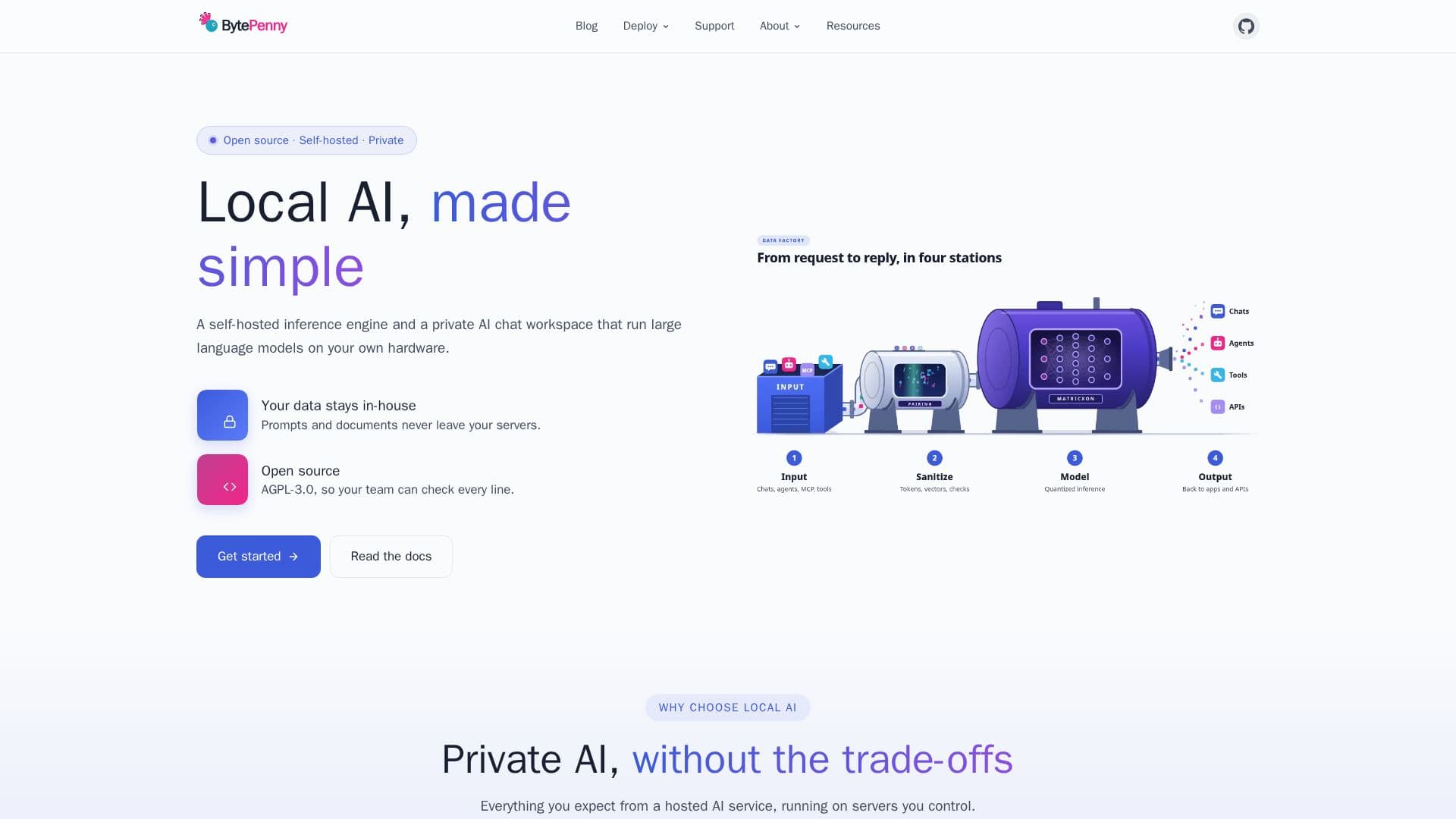
BytePenny provides a comprehensive suite of open-source, self-hosted AI tools designed for privacy and control. The core offering includes Matricxon, an open-source GGUF inference engine, and pAIring, a private AI chat workspace tailored for teams. These products allow organizations to run large language models directly on their own hardware, ensuring that prompts, documents, and chat data never leave their servers.
Read More
The platform emphasizes data privacy, operating fully offline to keep all sensitive information in-house. It supports various GGUF models from sources like Hugging Face, llama.cpp, or Matricxon engines, and can integrate with MCP tool servers. BytePenny is built with an open-source philosophy, using an AGPL-3.0 license, which allows teams to inspect and modify every line of code, fostering transparency and trust.
Matricxon, the inference engine, is a lightweight, readable LLM runtime written in Python and PyTorch, featuring native C kernels for accelerated performance. It supports GGUF models for tasks such as chat, text generation, embeddings, reranking, vision-language models, and time-series forecasting, serving them via an HTTP API. It runs efficiently on CPUs and offers BETA support for NVIDIA GPUs, with plans to expand to AMD and Apple Silicon GPUs. Matricxon also supports a cluster mode for shared models and chat caches across multiple nodes, managed from the pAIring UI.
pAIring, the private AI chat workspace, is designed for team collaboration, offering features like role-based access, shared channels, and an integrated knowledge base. It provides encrypted chat caches and ensures that prompts are never used for model training. The system is scalable, allowing users to start with a single server and expand by adding nodes with load balancing and failover capabilities. For scenarios requiring more power, pAIring can connect to various cloud providers like Bedrock, Vertex AI, Azure OpenAI, Gemini, Groq, and more, offering flexibility to mix local and cloud engines.
BytePenny eliminates per-token billing, allowing organizations to leverage existing hardware and maintain flat costs as usage grows. The entire stack is designed to be open, from the AGPL-3.0 code to open-weight models, making it ideal for private and closed networks. Security is a paramount concern, with features like bcrypt hashed passwords, encrypted stored secrets, AES-256-GCM encrypted chat caches, and server-side role checks for admin actions. Both Matricxon and pAIring have earned the OpenSSF Best Practices 'passing' badge, demonstrating a commitment to secure development practices.
- CategoryMLOps & Model Deployment
- Pricing ModelOpen Source (AGPL-3.0), No Per-Token Bills
- DeploymentSelf-Hosted, On-Premise, Cloud (Hybrid)
- PlatformsWindows, Linux
BytePenny's Core Features
Self-hosted AI inference engine (Matricxon)
Private AI chat workspace for teams (pAIring)
Run large language models on your own hardware
Data stays in-house; prompts and documents never leave servers
Open-source with AGPL-3.0 license
Works fully offline
Encrypted chat caches with AES-256-GCM
Role-based access for teams
Prompts never used for model training
Supports GGUF models from Hugging Face, llama.cpp, Matricxon
Quantized kernels for CPU and NVIDIA GPU support
No per-token billing; flat costs with usage growth
Scalable deployment: single node, shared cluster, or separate servers
Connects to 12+ cloud providers (Bedrock, Vertex AI, Azure OpenAI, Gemini, Groq, etc.)
Written from scratch in Python for readability and customizability
How to use BytePenny?
Deploy BytePenny: Install Matricxon and pAIring on your own servers or cloud infrastructure.
Configure Inference Engine: Set up Matricxon as the local inference engine or connect pAIring to a preferred cloud provider.
Add Models: Integrate GGUF models from Hugging Face or other sources, or utilize cloud-hosted models via connectors.
Manage Users and Teams: Configure role-based access, create shared channels, and establish a knowledge base within pAIring.
Start Chatting: Begin private AI conversations and leverage the knowledge base for team collaboration.
Monitor and Scale: Observe system status, manage cluster nodes, and expand hardware as usage grows without incurring per-token costs.
BytePenny's Use Cases
- Private Team Chat
- Local LLM Inference
- Secure Document Analysis
- Cost-Controlled AI Operations
- Offline AI Workflows
- Custom Model Deployment
- Scalable AI Infrastructure
- Open-Source AI Development