Description
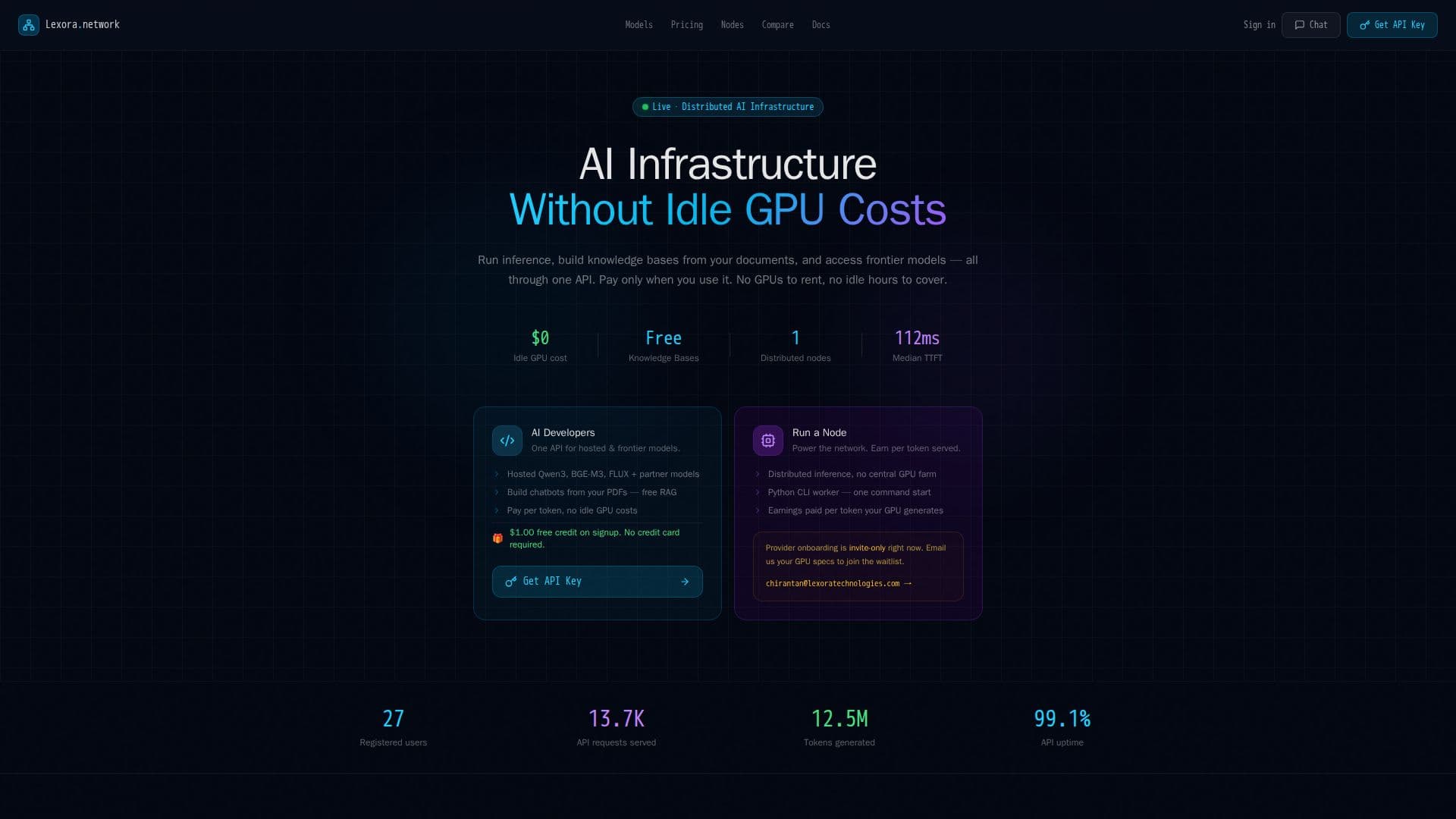
Lexora offers a distributed AI infrastructure platform designed for developers, providing a cost-effective solution for running AI inference and accessing a wide range of frontier models. The core value proposition is the elimination of idle GPU costs, as users pay per token or per image generated, rather than renting GPUs or covering unused compute time. This makes advanced AI capabilities more accessible and affordable for various applications.
Read More
The platform allows developers to run inference, build knowledge bases from their documents, and access models like Qwen3, DeepSeek, Kimi, and FLUX through a unified, OpenAI-compatible API. A key feature is the ability to create AI chatbots grounded in custom data by uploading PDFs and other documents. Lexora includes a free RAG (Retrieval Augmented Generation) knowledge base with 200 MB storage upon signup, requiring no credit card to start.
Lexora's infrastructure is built on a decentralized edge network, utilizing community-contributed GPUs. This architecture routes inference requests to the most suitable available GPU node based on factors like model availability, node health, and network latency. This approach not only reduces costs by up to 50% compared to centralized providers but also enhances resilience and lowers latency. The system is fault-tolerant, automatically re-dispatching jobs if a node goes offline.
For AI developers, Lexora provides one API for both hosted and partner models, including Qwen3, BGE-M3, FLUX, Llama 3.1, Stable Diffusion XL, DeepSeek, Kimi, Gemini, and GPT models. The platform offers a pay-as-you-go pricing model, with a $1.00 free credit on signup. Developers can integrate Lexora by simply changing the base URL in their existing OpenAI SDK, requiring zero refactoring.
Beyond consumption, Lexora also enables GPU owners to contribute their idle VRAM to the network and earn per token served. This is facilitated through a Python CLI worker, allowing individuals to power the network without complex cloud setups. The network maintains transparency, providing live telemetry that traces every token to its source GPU, showing node ID, GPU model, tokens-per-second, and cost savings.
- CategoryMachine Learning Platforms
- Pricing ModelFreemium
- DeploymentCloud
- PlatformsWeb
Lexora's Core Features
Distributed AI inference network
Pay-per-token or per-image pricing model
Elimination of idle GPU costs
OpenAI-compatible API for seamless integration
Build AI chatbots from custom documents (PDFs, plain text)
Free RAG knowledge base (200 MB storage on signup)
Access to frontier models: Qwen3, DeepSeek, Kimi, FLUX, Llama 3.1, Stable Diffusion XL, Gemini, GPT
Global node network for real-time job routing
Up to 50% cost reduction compared to centralized providers
JWT-authenticated worker nodes with reputation slashing
Fault-tolerant dispatch for continuous operation
Opportunity for GPU owners to earn from idle VRAM
Live telemetry for transparent inference tracking
Free signup credit available
How to use Lexora?
Sign up: Create an account and generate an API key from the dashboard.
Integrate API: Point your existing OpenAI SDK to Lexora's endpoint (api.lexora.network/v1) by changing the base URL.
Send requests: Use the OpenAI-compatible API to send requests for chat completions or image generations.
Build chatbots: Upload PDFs or plain text documents to create custom knowledge bases for AI chatbots.
Monitor usage: Track live telemetry for inference requests, including node ID, GPU model, TPS, and cost savings.
Add credits: Purchase credits from the dashboard to continue using services beyond the free tier.
Lexora's Use Cases
- AI Chatbot Development
- Image Generation for Apps
- Startup MVP Development
- Hackathon Projects
- Internal AI Tools
- Rapid Prototyping
- Serverless Inference
- Knowledge Base Creation