
Description
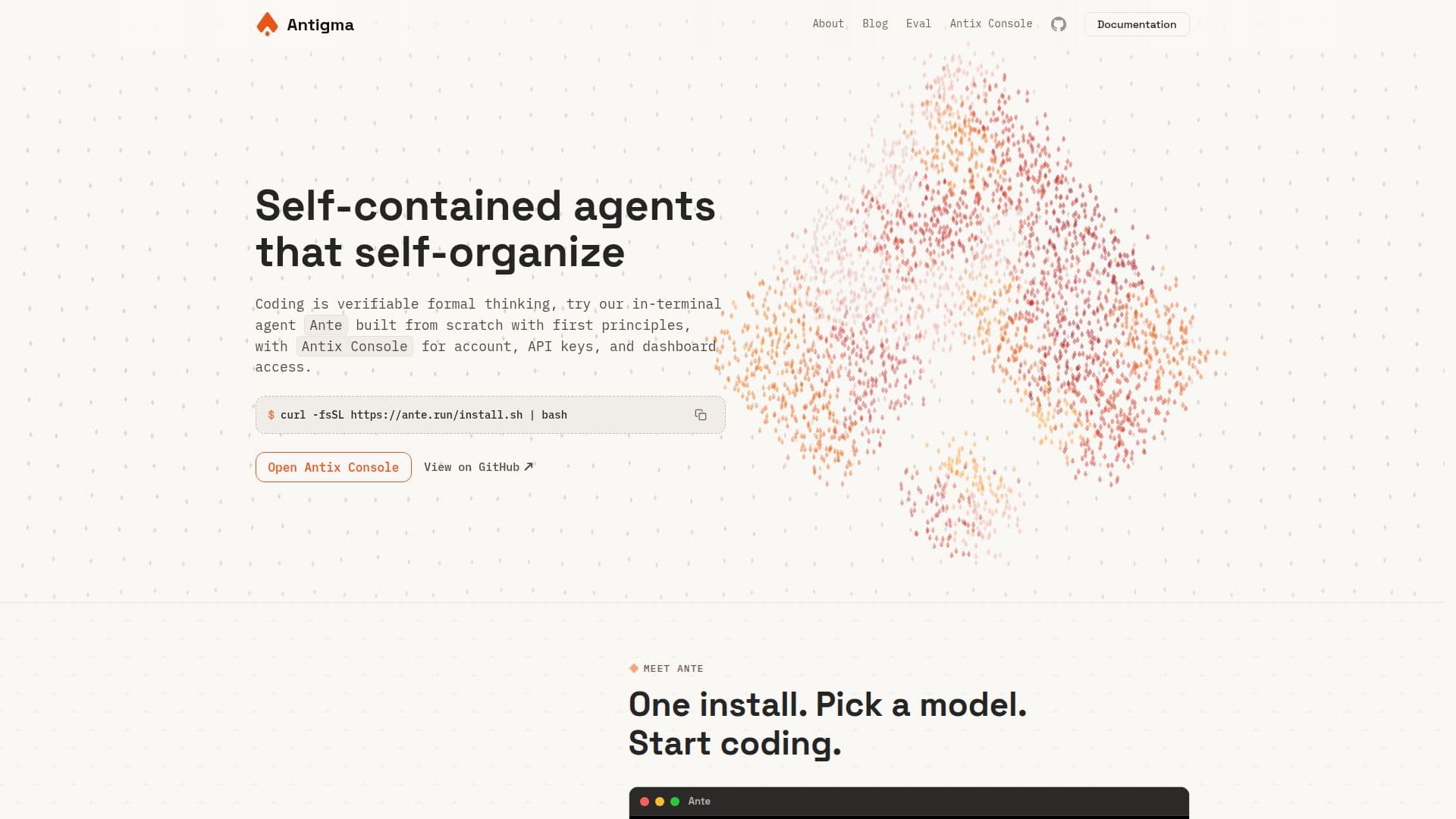
Antigma Ante is a cutting-edge, self-contained coding agent developed by Antigma Labs, designed to empower developers with a robust and flexible environment for building and orchestrating AI agents. Built from the ground up in native Rust, Ante is a single, lightweight binary with zero external runtime dependencies, ensuring minimal overhead and maximum throughput. This architecture makes it ideal for running thousands of cellular-native agents, where each instance is tiny, expendable, and massively replicable, contributing to a self-healing and resilient system.
Read More
The core philosophy behind Ante emphasizes simplicity and efficiency. It eliminates the need for accounts, configuration files, or complex setup guides, allowing developers to install it with a single command and start coding immediately. The platform offers unparalleled flexibility in model selection, enabling users to switch between various cloud or local providers and models mid-session, and adjust the effort from faster to smarter outputs. This includes native integration with llama.cpp, allowing models to run entirely on the user's machine without API keys, internet access, or data leaving the device.
Ante champions zero vendor lock-in, providing developers with the freedom to bring their own API keys, subscriptions, or local models. It supports a wide array of providers, including Anthropic, OpenAI, Gemini, Grok, and Open Router, ensuring broad compatibility and choice. The system is designed for closed-loop, declarative intent with automatic reconciliation, meaning individual agents are expendable while the overall organism persists and self-organizes around complex tasks through multi-agent orchestration.
Developers can leverage Ante's eval-verified agent engine, protected behind a typed stream, to build custom interfaces, IDE integrations, and team workflows without coupling them directly to the core. It supports extensible features like custom skills, sub-agents, and persistent memory across sessions. Ante operates on a client-daemon architecture, where the daemon manages structured turn lifecycles, channeling model power through a safe and predictable loop. The client can be an interactive TUI, a headless CLI, an external process, or a channel bot via the Ante gateway. It also supports running as a long-lived server for building editor plugins, web UIs, and custom integrations via a structured JSONL protocol.
Currently in preview, Ante supports macOS and Linux, with active development promising continuous improvements and experimental features. Its performance is benchmarked publicly, consistently ranking as a top same-model agent on Terminal-Bench 2.1, demonstrating superior efficiency in memory, CPU, and disk I/O compared to alternatives like Claude Code. Antigma's commitment to customer obsession and moving fast ensures a product that evolves rapidly while maintaining high quality and trust.
- CategoryAI Agent Builders
- DeploymentLocal, Cloud
- PlatformsmacOS, Linux
Antigma Ante's Core Features
Self-contained coding agents
Single 13 MB binary install
Zero runtime dependencies
Native Rust implementation
Switch between AI models and providers mid-session
Supports cloud and local models
Built-in llama.cpp integration for local inference
Zero vendor lock-in (bring your own API key)
Supports Anthropic, OpenAI, Gemini, Grok, Open Router
Multi-agent orchestration for complex tasks
Extensible with custom skills and sub-agents
Persistent memory across sessions
Client-daemon architecture
Runs as interactive TUI, headless CLI, or channel bot
Long-lived server mode for integrations
How to use Antigma Ante?
Install Ante: Execute a single curl command to download and install the 13 MB binary.
Pick a Model: Select your preferred AI model and provider, or run local models with built-in llama.cpp integration.
Start Coding: Begin interacting with the agent in your terminal, providing a single sentence to scaffold a working API.
Observe and Refine: Watch Ante run test suites, fix its own mistakes, and complete tasks automatically.
Build Custom Interfaces: Utilize the typed stream to develop custom interfaces, IDE integrations, or team workflows.
Orchestrate Agents: Coordinate multiple agents for complex tasks, leveraging self-organization capabilities.
Integrate Programmatically: Drive Ante programmatically over stdio, Unix socket, or WebSocket for custom applications.
Antigma Ante's Use Cases
- Automated API Generation
- Local AI Development
- Multi-Agent System Orchestration
- Custom IDE Integrations
- Team Workflow Automation
- Benchmarking Agent Performance
- Building Chatbots and Assistants
- Developing Editor Plugins