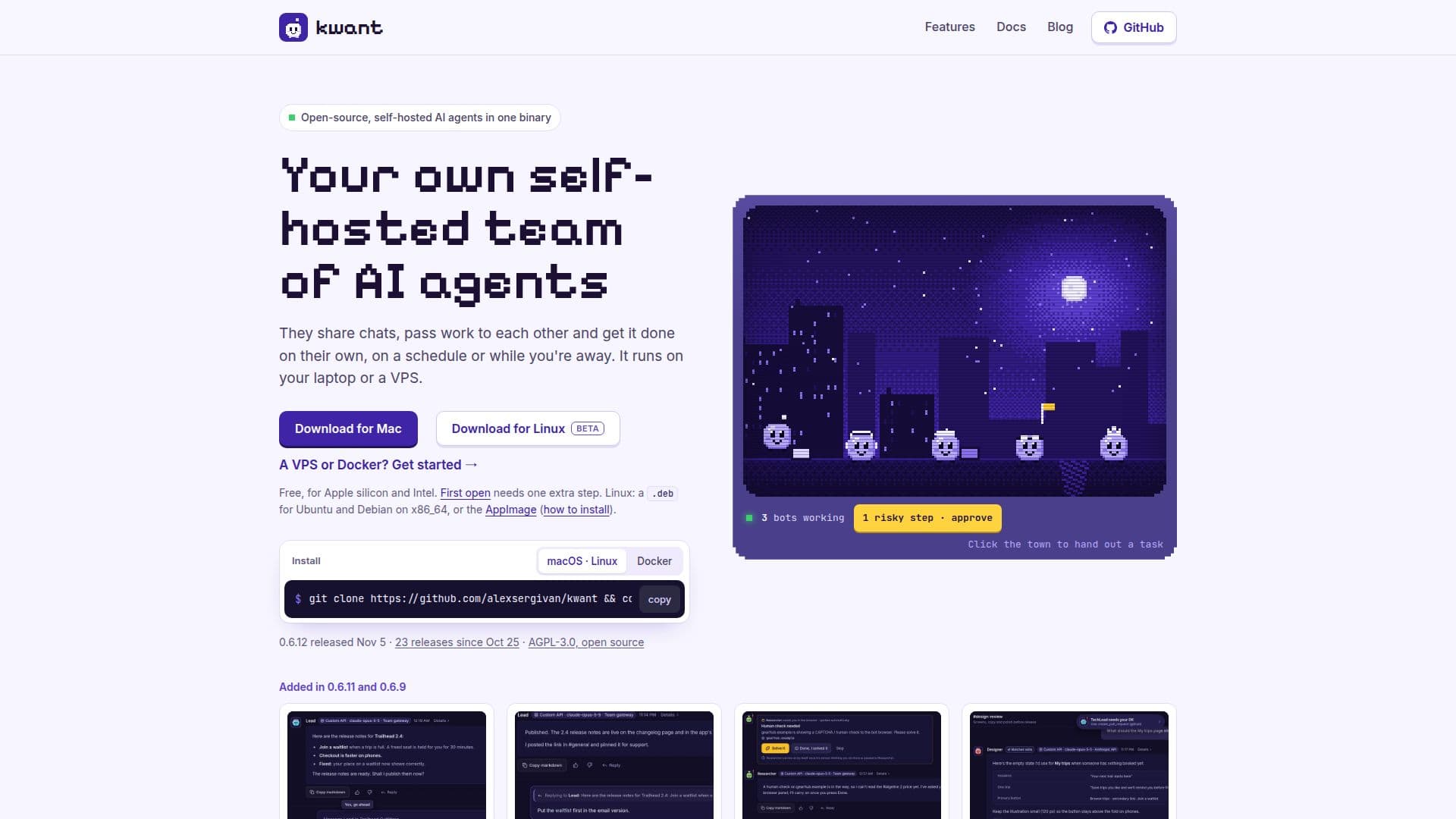
Description
kwant is an open-source, self-hosted platform designed to run a team of AI agents directly on your laptop, home server, or VPS. It provides a robust environment for orchestrating AI agents that can share conversations, hand off tasks to each other, and execute routines on a schedule. The core of kwant is a single Rust binary (`kwnt`) that includes both the web application and a built-in SQLite database, eliminating the need for Node.js at runtime after the initial build.
Read More
This platform offers significant autonomy and control, allowing users to connect their existing AI model accounts (such as Claude, Codex, Grok, Anthropic, OpenAI, xAI API keys, or local Ollama models). Unlike cloud-based solutions, kwant keeps all chats, settings, and data in a local folder on your machine, ensuring privacy and data ownership. While prompts are sent to the respective model providers, the core orchestration and data management remain self-contained.
Key capabilities include intelligent task routing, where the Laya router picks the most suitable bot, model, and effort for a given message. It supports automatic model failover, switching to another account if one runs out of usage. Users can define separate "spaces" for different aspects of their life, like work, side projects, and home, each with its own bots, accounts, routines, and approval rules.
kwant emphasizes safety and transparency through approval cards that appear before risky steps, such as running commands, editing files, or making payments. Users can choose from different approval modes, including "ask only when risky" or "ask before running commands." Bots can earn different tiers of freedom (Observe, Sandbox, Act) based on their performance, with users granting promotions. The Truth Ledger feature helps manage conflicting facts, presenting both sides for user resolution.
For developers and power users, kwant is free under the AGPL-3.0 license, with commercial licenses also available. It requires Rust and Node.js for building, and Docker is optional for VM mode and the bots' shared browser. The platform is designed to be lightweight, running efficiently on macOS, Linux, or a server, and continues to operate routines even when the user is away, provided the host machine remains on.
- CategoryAI Agent Builders
- Pricing ModelFree and Open Source
- DeploymentSelf-hosted
- PlatformsmacOS, Linux, Docker
kwant's Core Features
Self-hosted AI agent team orchestration
Open-source and free under AGPL-3.0 license
Runs on macOS, Linux, and Docker
Supports Claude, Codex, Grok, Anthropic, OpenAI, xAI API keys, and Ollama
Automatic model failover across multiple accounts
Separate spaces for work, side projects, and home
Approval cards for risky actions and payments
Routines for scheduled tasks and follow-ups
Truth Ledger for managing conflicting facts
Bots learn and earn freedom tiers (Flight School)
Smart Results with sortable replies and goals
Browser sites for each bot with human checks
Team discussions and @mention handoffs
No code needed for basic operation
One binary with app and database built-in
How to use kwant?
Build kwant: Clone the repository and run `make run` to open the web app locally or get a link for server deployment.
Add AI accounts: Connect your existing Claude, Codex, or Grok CLI logins, or paste Anthropic, OpenAI, or xAI API keys in settings.
Ask your team: Start by asking a question or setting up a routine, such as "Every weekday at 9, check the deploys."
Manage approvals: Respond to approval cards for risky steps, payments, or sign-ins with a tap or by taking over the bot's browser.
Create routines: Define scheduled tasks for your bots, or accept suggested routines based on repeated actions.
Organize with spaces: Set up separate spaces for different projects or areas of your life, each with its own bots and rules.
kwant's Use Cases
- Automated Review Summaries
- Competitor Price Monitoring
- Drafting Replies for Loose Ends
- Scheduled Deployment Checks
- Financial Transaction Approvals
- Cross-Functional Task Handoffs
- Personalized Workflows
- Content Verification
- Risk Auditing for Tasks
- Skill Development for Bots