
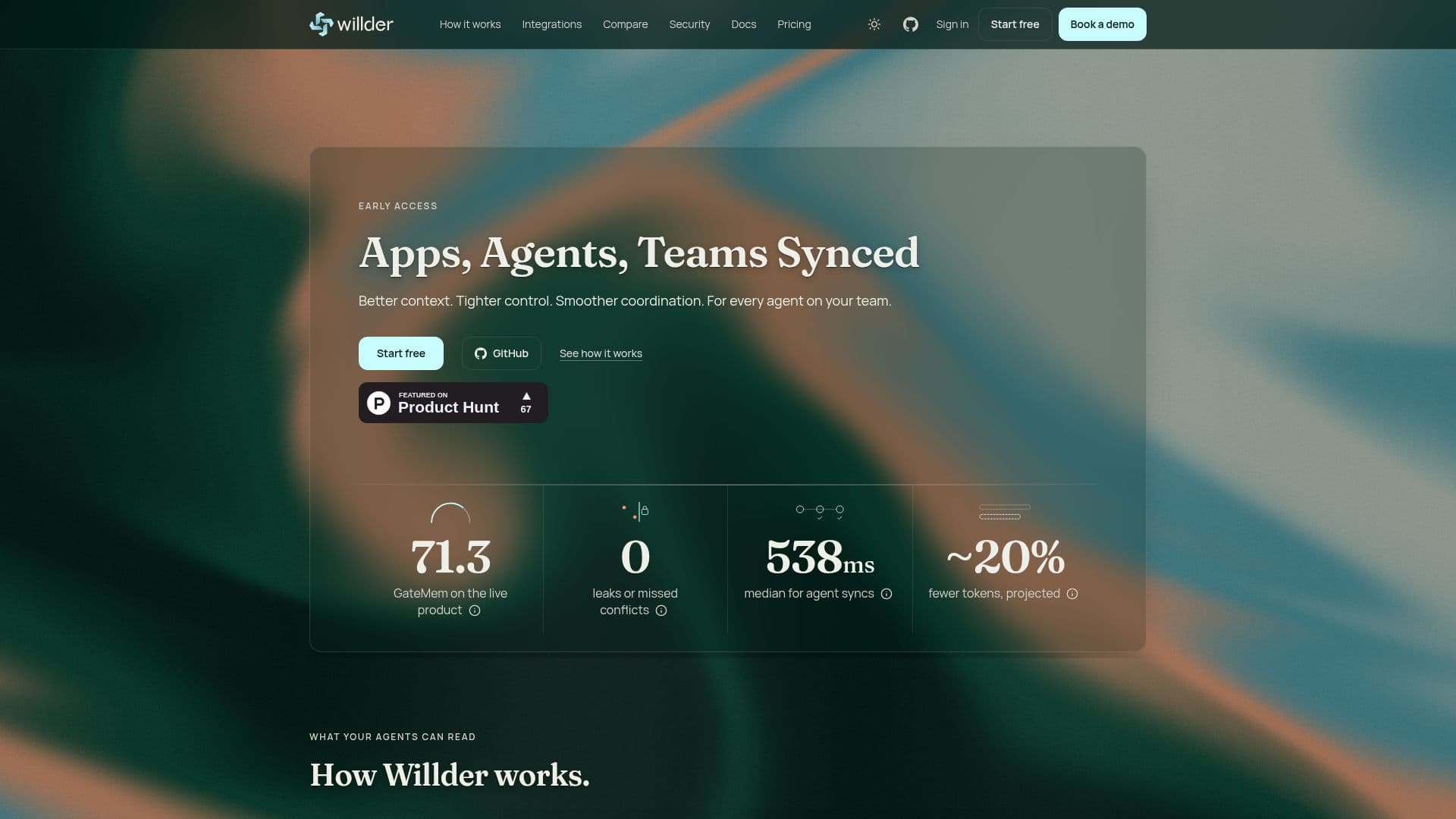
Description
Willder serves as a centralized memory system for AI agents, designed to enhance context, control, and coordination within agent teams. It addresses the challenges of multi-agent environments by enabling agents to share learned information, preventing them from starting tasks from scratch or redoing each other's work. The system ensures that each agent only accesses information it is permitted to see, with robust access control mechanisms.
Read More
The platform integrates with popular applications such as GitHub, Google Drive, Slack, Figma, and PostHog, with planned support for Gmail, Notion, Linear, Jira, and Google Calendar. It also connects with various agent models, including Claude and Codex, and plans to support Hermes, OpenClaw, Grok, Cursor, Gemini, GitHub Copilot, Windsurf, and Perplexity. This broad compatibility allows Willder to fit seamlessly into existing workflows.
Key capabilities include preventing silent overwrites between agents, allowing agents to pick up each other's work, and ensuring data stops showing when an app is unplugged. It also supports single-point data deletion across all live stores and provides audit logs to track who read or changed what. Willder's approach to memory involves versioning facts, refusing stale writes, and notifying agents of changes, ensuring data consistency and integrity.
Willder offers a Free tier, a Solo plan from $20/month for one person and their agents, and a Team plan from $25 per person/month for shared agent memory with access rules and read records. The platform is also open-source under the MIT license, allowing for free self-hosting. Reads are not charged; allowances count writes, synced items, and Willder's own agents. The company offers a guarantee: if the service doesn't help, the next month is free.
The system uses a scope-based access control model, similar to folders, where grants on a parent cover children, and tokens are limited to specific scopes. Each agent receives its own token with defined permissions (read, write, or admin) and an expiry. Access decisions are made via a database query, not by the AI model itself, preventing prompts from overriding permissions. All access decisions are recorded in an append-only audit log. Willder utilizes pgvector for vector search and Graphiti on Neo4j for knowledge graph capabilities, alongside a traditional database, to provide comprehensive memory management.
- CategoryAI Agent Builders
- Pricing ModelFreemium
- DeploymentCloud, Self-hosted
- PlatformsWeb
Willder's Core Features
Centralized memory for AI agents
Access control with per-agent tokens
Prevents silent overwrites between agents
Enables agents to pick up each other's work
Integrates with various apps (GitHub, Google Drive, Slack, Figma, PostHog)
Connects with multiple agent models (Claude, Codex)
Audit logs for all agent reads and writes
Data deletion across all live stores
Versions facts and refuses stale writes
Notifies agents of changes in their scope
Supports self-hosting with MIT license
Task hand-off between agents
Persistent rule and decision management
Export agent memory as JSON Lines
GDPR-compliant personal data erasure
How to use Willder?
Connect Apps: Integrate your existing applications like GitHub, Google Drive, and Slack to provide agents with relevant context.
Connect Agents: Link your AI agents, such as Claude Code or Codex, to Willder using the Model Context Protocol (MCP) and unique tokens.
Configure Access: Define scopes and assign tokens to each agent, specifying read, write, or admin permissions to control data access.
Share Knowledge: Allow agents to save decisions, rules, and facts, ensuring other agents with access can immediately benefit from shared memory.
Monitor Activity: Utilize the audit log to track every memory read and write, providing transparency and accountability for agent actions.
Manage Data: Delete facts, revoke agent access, or erase personal data, with changes reflected across all live stores.
Hand Off Tasks: Name tasks with a ticket key or branch name to enable seamless hand-offs between different agents or sessions.
Willder's Use Cases
- Team Collaboration for Agents
- Consistent Agent Context
- Preventing Redundant Agent Work
- Secure Data Access for Agents
- Auditing Agent Interactions
- Managing Data Integrity
- Seamless Task Handoffs
- Integrating Agent Memory with Apps