Description
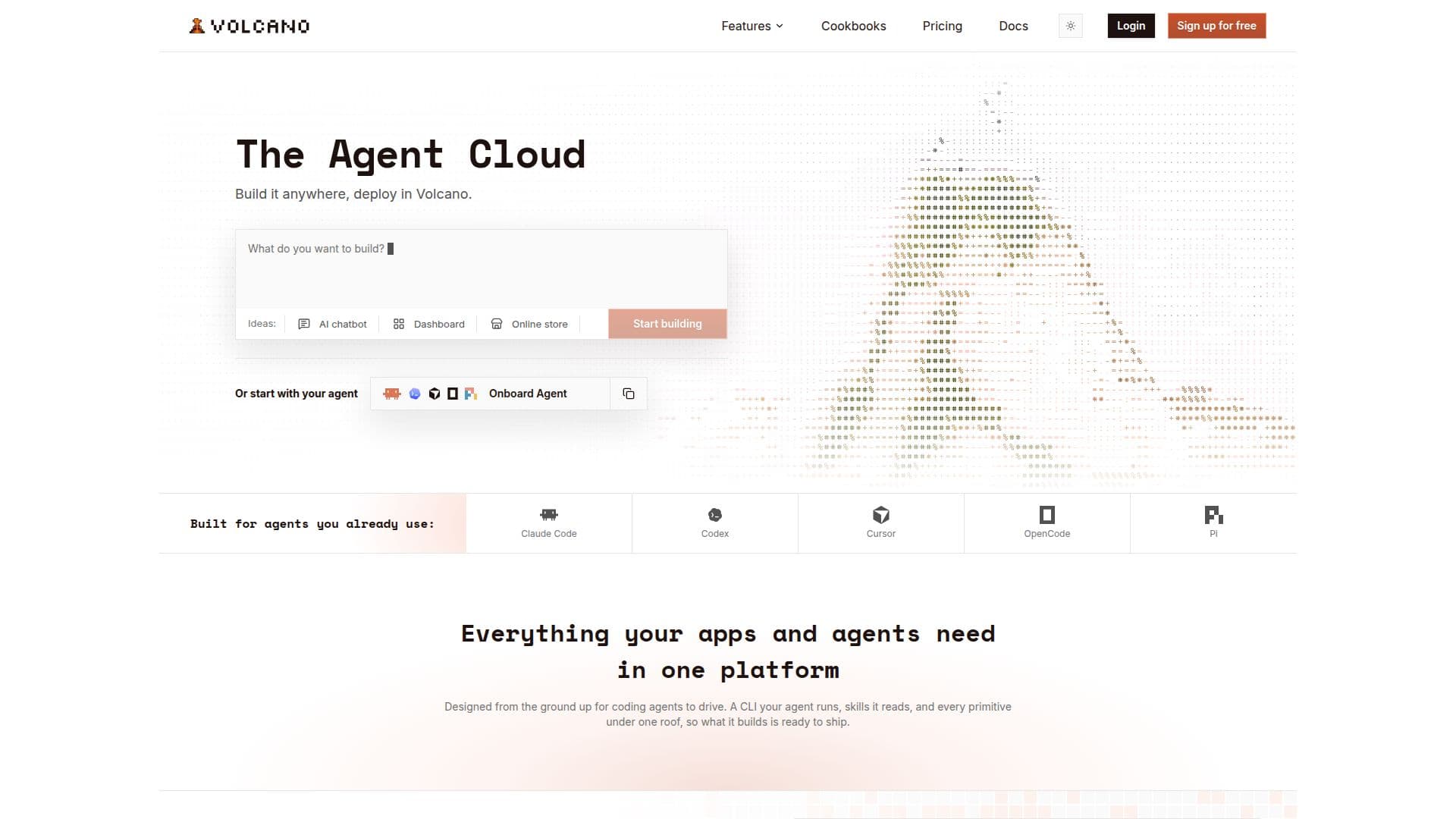
Volcano is an agent cloud platform that provides the infrastructure for building and deploying AI agents and modern applications. It is designed to integrate seamlessly with existing agentic coding tools, offering a unified environment for development and deployment. The platform emphasizes a "build anywhere, deploy in Volcano" approach, supporting agents developers already use.
Read More
At its core, Volcano offers a comprehensive set of primitives essential for agent-driven development. This includes a command-line interface (CLI) for agents, skills they can read, and all necessary components under one roof, ensuring that what agents build is ready for production. A key feature is LavaFlow, which enables self-healing applications and agents, allowing the platform to autonomously improve software without requiring IDEs or human intervention.
Volcano provides several robust functionalities. Durable functions support multi-step workflows with checkpointing, allowing processes to pause and resume for up to a year. An approvals system can pause a run until a human intervenes, then continues exactly where it left off. Sandboxes offer isolated virtual machine environments with files, a shell, and execution capabilities for running agent-generated code safely. Distributed locks ensure that only one worker handles a task at a time, with renewing leases.
For data management, Volcano includes real PostgreSQL databases with pgvector and row-level security, allowing users to branch a copy in under a minute. Authentication is comprehensive, supporting sign-in with Google, GitHub, Microsoft, or Apple, with unlimited users and anonymous users that can convert. File storage provides private buckets with SQL-style access policies and resumable uploads. Real-time capabilities deliver database events, broadcast, and presence, enabling applications and agents to react dynamically to changes.
Volcano supports various use cases, such as deploying the Petstore API from a Swagger spec onto Postgres, hosting MCP servers as functions, and creating GitHub webhook PR summarizers using durable functions. The platform is compatible with coding agents like Claude Code, Codex, Cursor, OpenCode, and Pi, automatically setting up skills for agents detected on a user's machine. Volcano offers a free Hobby plan with essential features and a Superagent plan for higher limits and advanced capabilities like database backups and custom domains.
- CategoryAI Agent Builders
- Pricing ModelFreemium
- DeploymentCloud
- PlatformsWeb
Volcano's Core Features
Agent Cloud Platform
Self-Healing Applications (LavaFlow)
Durable Functions with Checkpointing
Approvals for Human Intervention
Isolated Sandboxes for Code Execution
Distributed Locks for Task Management
PostgreSQL Databases with pgvector
Comprehensive Authentication (Google, GitHub, Microsoft, Apple)
Private File Storage with SQL-style Policies
Real-time Database Events and Presence
Command-Line Interface (CLI) for Agents
JavaScript SDK for Web and Node Apps
Frontend Hosting
Custom Domains
Database Backups & Point-in-Time Restore
How to use Volcano?
Install CLI and SDK: Get the Volcano CLI and JavaScript SDK to begin.
Create Account: Sign up for a Volcano account in your browser or via the CLI.
Configure Coding Agent: Volcano sets up skills for coding agents like Claude Code or Cursor found on your machine.
Paste Prompt: Provide your coding agent with a prompt for the desired application or agent.
Tell it to Build: Instruct your agent on what to build, leveraging Volcano's integrated primitives.
Deploy Project: Deploy your project using Volcano's platform, whether it's an API, an MCP server, or a webhook summarizer.
Test and Scale: Test your deployed applications and agents, then scale them on the Volcano platform.
Volcano's Use Cases
- Building AI Agents
- Modern Application Development
- Self-Healing Software
- Multi-Step Workflow Automation
- Safe Code Execution
- API Deployment
- Webhook Processing
- Real-time Application Interactions
- User Authentication Management
- Secure File Storage