
Description
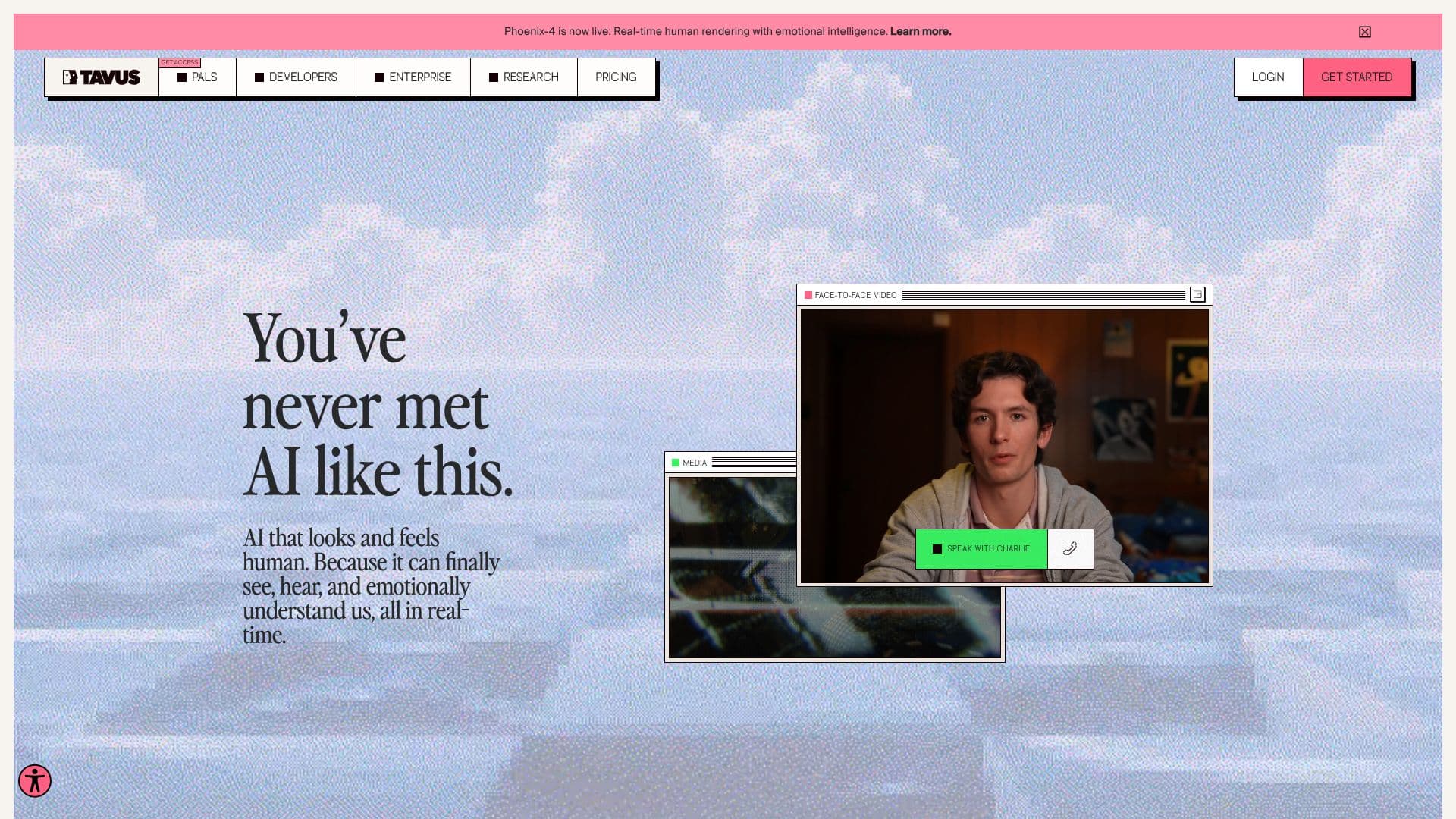
Tavus describes itself as the human computing company, building AI agents, which it calls PALs, that hold a real-time, face-to-face video conversation rather than a text chat. Its latest rendering model, Phoenix-4.5, is presented as the fastest and most expressive real-time human-rendering model the company has released.
Read More
Tavus offers two ways in: a Developer Account for teams building PALs into a product with APIs and tools, and a PALs Account for individuals who want a personal AI companion to talk with directly. On the developer side, PAL Maker is a no-code way to create and launch a PAL in minutes, while the Developer API (built on what Tavus calls its CVI, or conversational video interface) lets a team build a more deeply customized PAL experience in code.
A PAL is built from four capabilities working together: facial rendering with real expression and micro-motion, voice and turn-taking so it knows when to speak versus listen, audio-visual perception so it reacts to what is actually in frame, and memory so a PAL carries context from earlier conversations forward. Tavus attributes these to three research models: Phoenix for rendering (134ms latency, able to render a new identity zero-shot from a single image), Raven for perception (reads voice, video, and screen context together), and Sparrow for conversational turn-taking, which Tavus says ranks first on the TurnBench benchmark.
PALs also support features aimed at real work, not just conversation: Presentation Mode to talk through a slide deck, Browser Mode to share and click through a product live while talking, a Knowledge Base so a PAL answers from a company's own documents, Magic Canvas to generate interactive visuals like charts or scheduling pages mid-conversation, and the ability to join a live Google Meet or Zoom call as a participant.
Tavus lists prebuilt use cases including a sales assistant that answers product questions on a website or live sales call, an interviewer that screens candidates at scale, HIPAA-compliant healthcare agents for patient intake and education, and learning-and-development agents for training simulations. The company says it powers PALs for more than 100,000 developers. Pricing for developers is usage-based through the API platform, and larger deployments are available as fully managed Enterprise solutions built with Tavus's own team.
- CategoryAI Agent Builders
- Pricing ModelUsage-based
- DeploymentCloud
- PlatformsWeb
Tavus's Core Features
Real-time, face-to-face video AI agents (PALs) rather than text-only chat
No-code PAL Maker to create and launch a PAL without engineering
Developer API (CVI) for deeply customized PAL builds
Phoenix rendering model: 134ms latency, zero-shot rendering from a single reference image
Raven perception model reading voice, video, and screen context together
Sparrow turn-taking model for natural conversational timing
Knowledge Base grounding so a PAL answers from a company's own documents
Magic Canvas for generating interactive visuals during a live conversation
Live participation in Google Meet and Zoom calls
Prebuilt solutions for sales, healthcare intake, interviewing, and training
How to use Tavus?
Choose an account type: pick a Developer Account to build with APIs, or a PALs Account to talk with a personal AI companion.
Build a PAL: use the no-code PAL Maker, or the Developer API for a fully custom build.
Give it a face and voice: select or generate the appearance and voice your PAL will use.
Add knowledge and tools: connect a Knowledge Base, Presentation Mode, or Magic Canvas as needed.
Deploy it: embed the PAL on your site, in a sales call, or in a live Google Meet or Zoom session.
Talk to sales for Enterprise: request a fully managed, custom-built PAL solution for larger deployments.
Tavus's Use Cases
- Sales assistant agent
- Candidate screening
- Healthcare patient intake
- Training simulations