
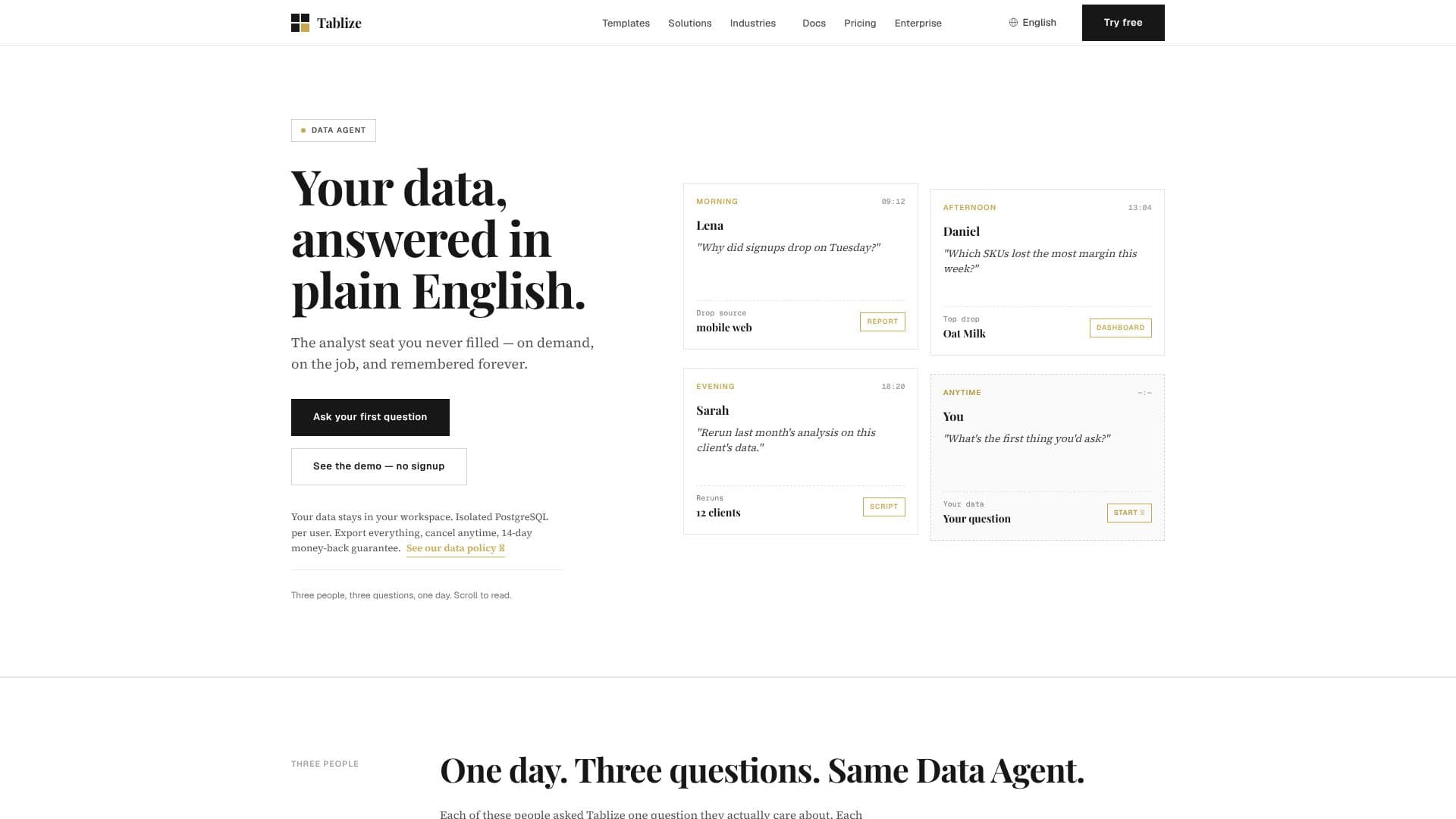
Description
Tablize is built for a specific failure mode: a coding agent's data-extraction prompt works well on a small sample, then gets shakier and less reliable as a table grows into thousands of rows, and a session that dies partway has to start over. Tablize turns that one-off prompt into a durable, resumable pipeline instead.
Read More
The workflow runs through the Tablize CLI, installed with a package manager and paired with a coding agent's skill system. An agent pulls one batch of rows at a time rather than holding an entire table in context, processes it, and submits the result; the state of the pipeline, including open batches, leases, and past verdicts, lives on the Tablize server rather than in the chat session, so a new session or a different agent can resume exactly where the last one left off instead of reconstructing progress from a transcript.
Every batch attempt is recorded on a ledger that tracks which model produced it, how many rows it covered, and how many times it was submitted, with rejected attempts kept as a visible part of the record rather than cleared away. An optional quality gate compares each batch against a golden file the user supplies, a check the agent itself cannot see; with no golden file, the gate runs in an unenforced mode where nothing is judged and rows land unverified rather than accepted. Moving the gate to an enforcing mode requires goldens to be pinned first, and Tablize is explicit that only an enforcing gate should be trusted to mark a row as verified.
Tablize runs on the user's own machine using the user's own model key or coding-agent subscription; it does not supply a model or a runtime itself. It also states plainly what it does not guarantee: it can confirm a row passed its rules at a given point in time, but not that anything downstream actually used the accepted result.
Pricing has three tiers on the same underlying engine: a free tier with a shared, quota-capped server; a usage-based Pro tier with persistent private workspaces; and a self-hosted Enterprise tier for running on a company's own infrastructure. The product is in public beta and currently free to use. Tablize is aimed at developers and data teams using coding agents to build structured tables from unstructured sources, particularly where a wrong row could silently affect downstream work; the product itself says a simple one-off CSV export is the better choice for small, low-stakes jobs.
- CategoryAI Data Analysis
- Pricing ModelFreemium
- DeploymentCloud
- PlatformsWeb
Tablize's Core Features
Server-side pipeline state that persists across agent sessions and restarts
Batch-based processing so an agent never holds an entire table in context
Optional golden-file gate that checks each batch before rows are marked accepted
Ledger recording every batch attempt, including rejected ones, by model and submission count
CLI installable as a coding-agent skill, with browser-based pairing instead of pasted API keys
MCP support for integrating with coding agents
Works with any LLM or coding agent, using the user's own model key
Visual workspace canvas showing source rows, extraction, and gate results
How to use Tablize?
Install the CLI: Run the Tablize CLI installer and add the bundled agent skill.
Pair your agent: Log in and approve the pairing request in your browser.
Check setup: Run the doctor command to confirm the CLI, skill, and server are aligned.
Define the pipeline: Have your agent propose the raw evidence contract and extraction schema.
Run in batches: Pull a batch, let the agent process it, submit it, and repeat until the table is complete.
Add a gate (optional): Supply a golden file and set the gate to enforcing mode so only verified rows are accepted.
Tablize's Use Cases
- Agent-built data pipelines
- Large-scale structured extraction
- Auditable AI data work
- Quality-gated data columns