Description
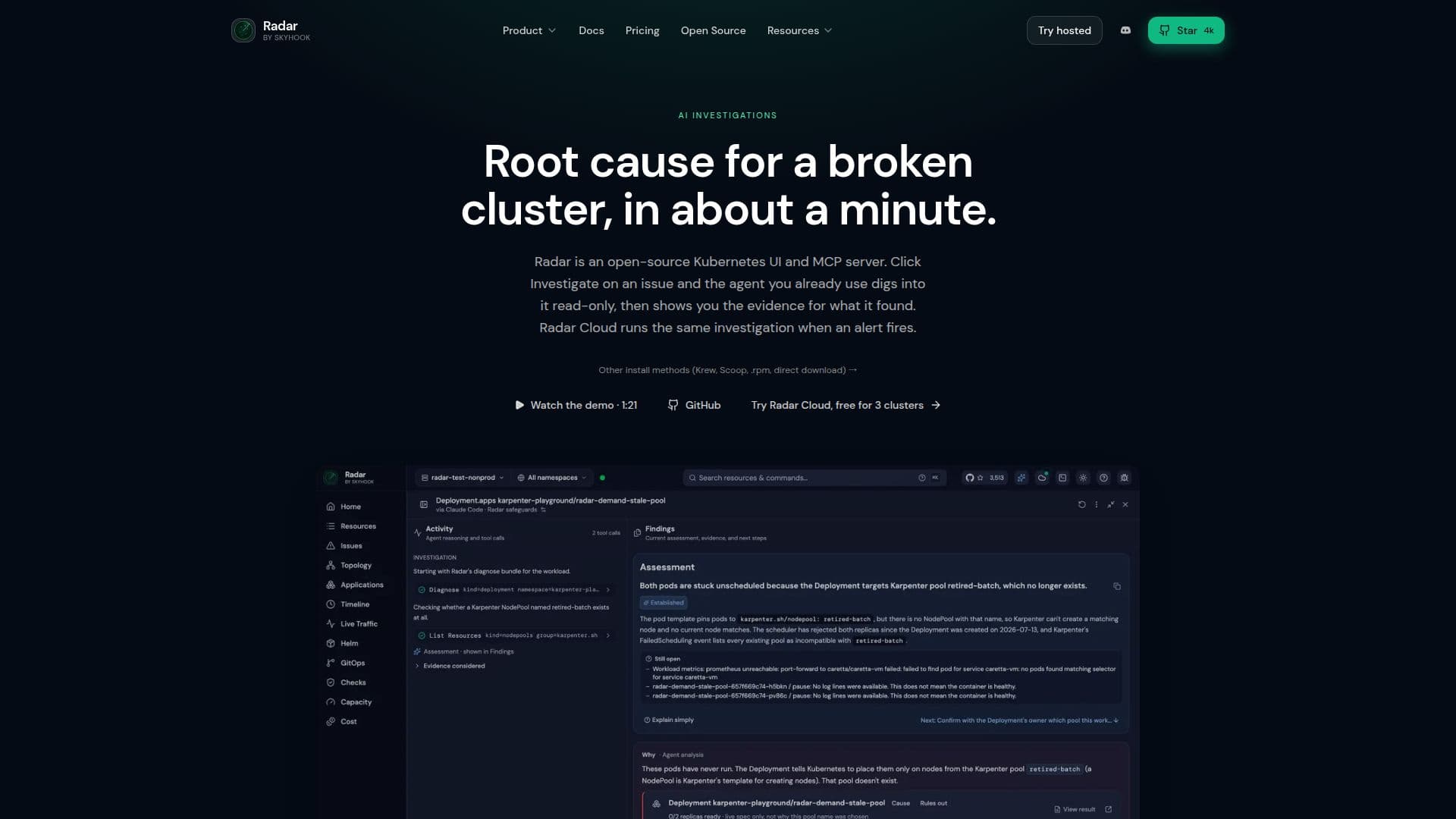
Radar is an open-source Kubernetes UI that integrates a built-in MCP server for AI agents, providing comprehensive visibility and diagnostic capabilities for Kubernetes clusters. It allows users to quickly identify the root cause of issues, understand underlying changes, and implement proposed fixes. The platform is designed to be significantly faster and more economical than many dedicated AI SRE tools, with benchmarks showing 1.6–3.6 times faster analysis and 30–85% lower costs.
Read More
At its core, Radar facilitates AI investigations where an AI agent analyzes a Kubernetes cluster's live model to pinpoint the root cause of a problem. It provides evidence supporting the diagnosis and suggests a fix. Users can run investigations using their own agents over MCP, through Radar's UI with an agent CLI, or automatically via Radar Cloud when an alert is triggered. This flexibility allows teams to leverage existing AI agents like Claude Code, Codex, Cursor, GitHub Copilot, OpenCode, and Google Antigravity, providing the necessary cluster context for effective analysis.
Radar offers both an open-source version and Radar Cloud. The open-source engine, licensed under Apache 2.0, provides essential features for single-cluster visibility, including topology, resource management, Helm, image filesystem inspection, cluster audits, and local AI agent diagnosis. Radar Cloud, available hosted or self-managed, enhances these capabilities with advanced features such as alerts, AI investigations with detailed evidence, shared views across an entire fleet of clusters, and extended historical data retention.
For data privacy, open-source Radar runs investigations on the user's machine, with data sent only to their chosen model provider. Radar Cloud processes investigations as sandboxed jobs with read-only access, and for self-managed deployments, all cluster data remains within the user's infrastructure, except for AI model interactions and daily license checks. Investigations are typically read-only, but users connecting their own agents via MCP can enable write tools, with changes requiring explicit approval and respecting RBAC limits. Radar aims to simplify Kubernetes operations, reduce troubleshooting time, and improve overall cluster health and compliance.
- CategoryAI DevOps & Cloud Tools
- Pricing ModelFreemium
- DeploymentCloud, Self-Managed, On-Premise
- PlatformsKubernetes
Radar's Core Features
AI Root Cause Analysis for Kubernetes
Open-source Kubernetes UI with MCP server
Live model of Kubernetes cluster for AI agents
Evidence-backed root cause identification and proposed fixes
Integration with various AI agents (Claude Code, Codex, Cursor, GitHub Copilot, OpenCode, Google Antigravity)
Three ways to run investigations: via user's agent over MCP, Radar's UI, or Radar Cloud's agent
Alerts for Kubernetes issues (Radar Cloud)
Shared views of every cluster (Radar Cloud)
History retention of events and resource changes (Radar Cloud)
Multi-cluster operations and fleet management
GitOps visibility for Argo CD and Flux
Helm release management and auditing
Compliance auditing and SOC 2 evidence export
Workload-level cost attribution with OpenCost integration
Air-gapped deployment capability
How to use Radar?
Install Radar OSS: Deploy the Helm chart to your Kubernetes cluster or run the native binary locally.
Connect your cluster: Paste a token to connect your Kubernetes cluster to Radar Cloud.
Configure AI agents: Integrate your preferred AI agent (e.g., Claude Code) over MCP or via Radar's UI.
Run AI investigations: Initiate an investigation from Radar's UI, via your agent, or automatically through Radar Cloud alerts.
Review root causes: Analyze the identified root cause, supporting evidence, and proposed fixes provided by the AI agent.
Approve and apply fixes: If write tools are enabled, approve and apply fixes in a separate, controlled session.
Monitor cluster health: Use Radar's UI to view event timelines, application topology, and GitOps status across your fleet.
Radar's Use Cases
- Incident Troubleshooting
- Multi-Cluster Operations
- GitOps Visibility
- Helm Management
- Compliance Auditing
- Cost Optimization
- On-Call Productivity
- Proactive Alerting