
Description
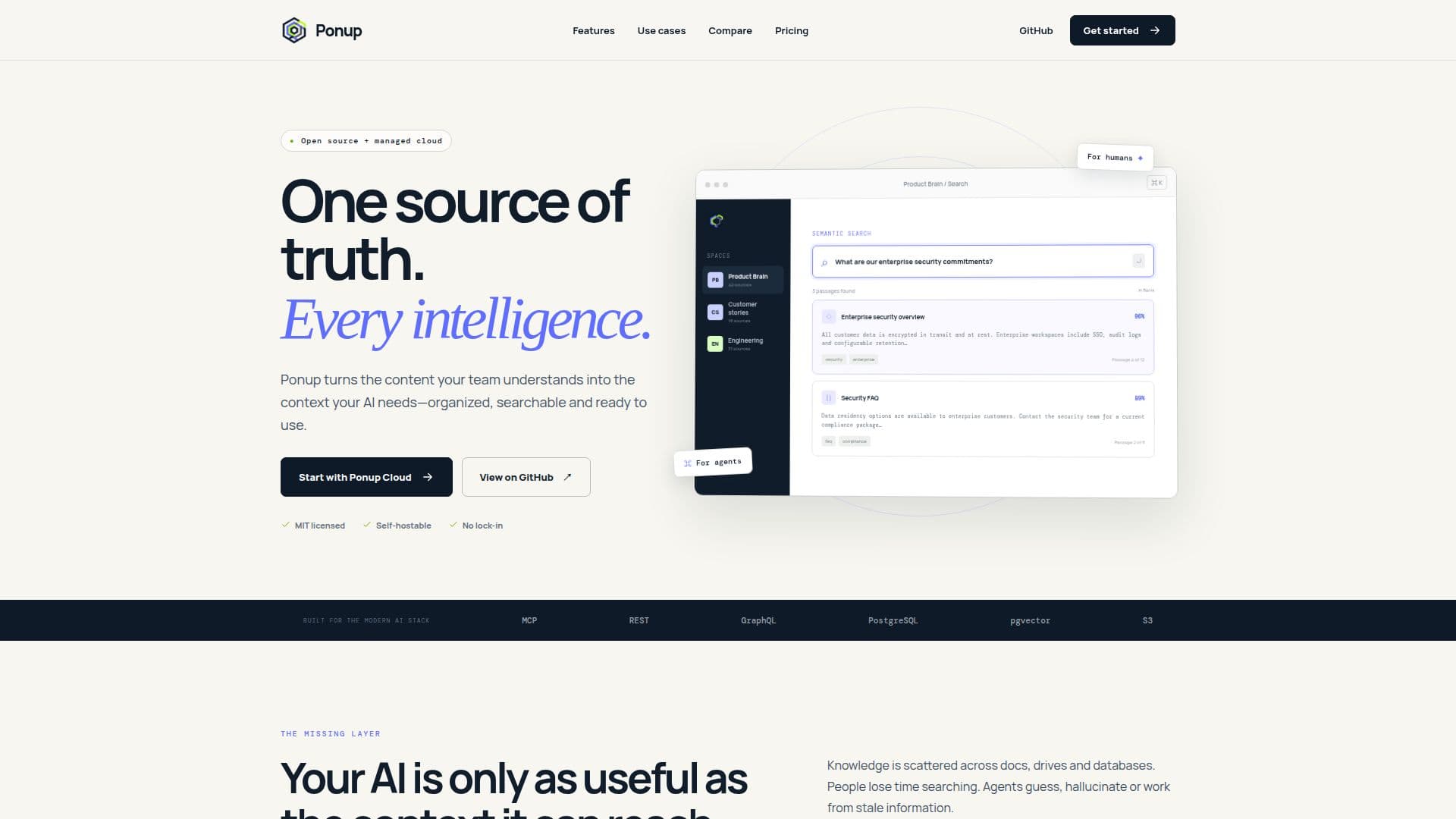
Ponup is a versatile tool for context engineering and content management, aimed at optimizing knowledge organization for humans and AI agents. It provides a unified source of truth, ensuring that both people and AI models can access consistent and accurate information. Ponup allows users to self-host using the MIT license or choose Ponup Cloud for a managed experience.
Read More
The platform is designed to transform scattered organizational knowledge into structured, searchable context. Users can organize information by product, team, client, or agent, creating focused spaces that are easy to navigate. Ponup supports various content formats, including Markdown, structured JSON, PDFs, text files, and images, preserving the original source while preparing it for context delivery.
Ponup's retrieval capabilities are centered around meaning-first search, allowing users to find relevant passages based on intent rather than exact keywords. The platform offers semantic vector search, ranked passages, and tag-filtered search, with source attribution and local embeddings. It is compatible with OpenAI embeddings, ensuring seamless integration with existing AI stacks.
For delivery, Ponup provides MCP tools, REST API, GraphQL queries, and public content links, enabling users to access raw source data and manage context effectively. The platform operates with PostgreSQL and S3-compatible storage, ensuring data security and privacy.
Ponup offers a free open-source version with unlimited spaces and content, semantic search, and various APIs. The Cloud plan includes managed hosting, automatic updates, backups, and email support, while the Scale plan offers custom usage, storage, and priority support. Ponup is ideal for product, support, and AI teams looking to leverage organizational knowledge efficiently.
- CategoryAI Knowledge Management
- Pricing ModelFreemium
- DeploymentCloud
- PlatformsDocker
Ponup's Core Features
Open-source context engineering
Content management for AI agents
Self-hosting with MIT license
Ponup Cloud managed services
Semantic vector search
REST and GraphQL API access
Markdown and JSON authoring
Data encryption and privacy
How to use Ponup?
Configure: Set up spaces and organize content
Use: Retrieve context using semantic search
Deploy: Choose self-hosting or Ponup Cloud
Optimize: Manage and update context pipelines
Ponup's Use Cases
- Product Knowledge Management
- Support Team Integration
- AI Agent Context Delivery
- Enterprise Knowledge Organization
- Semantic Search Implementation