
Description
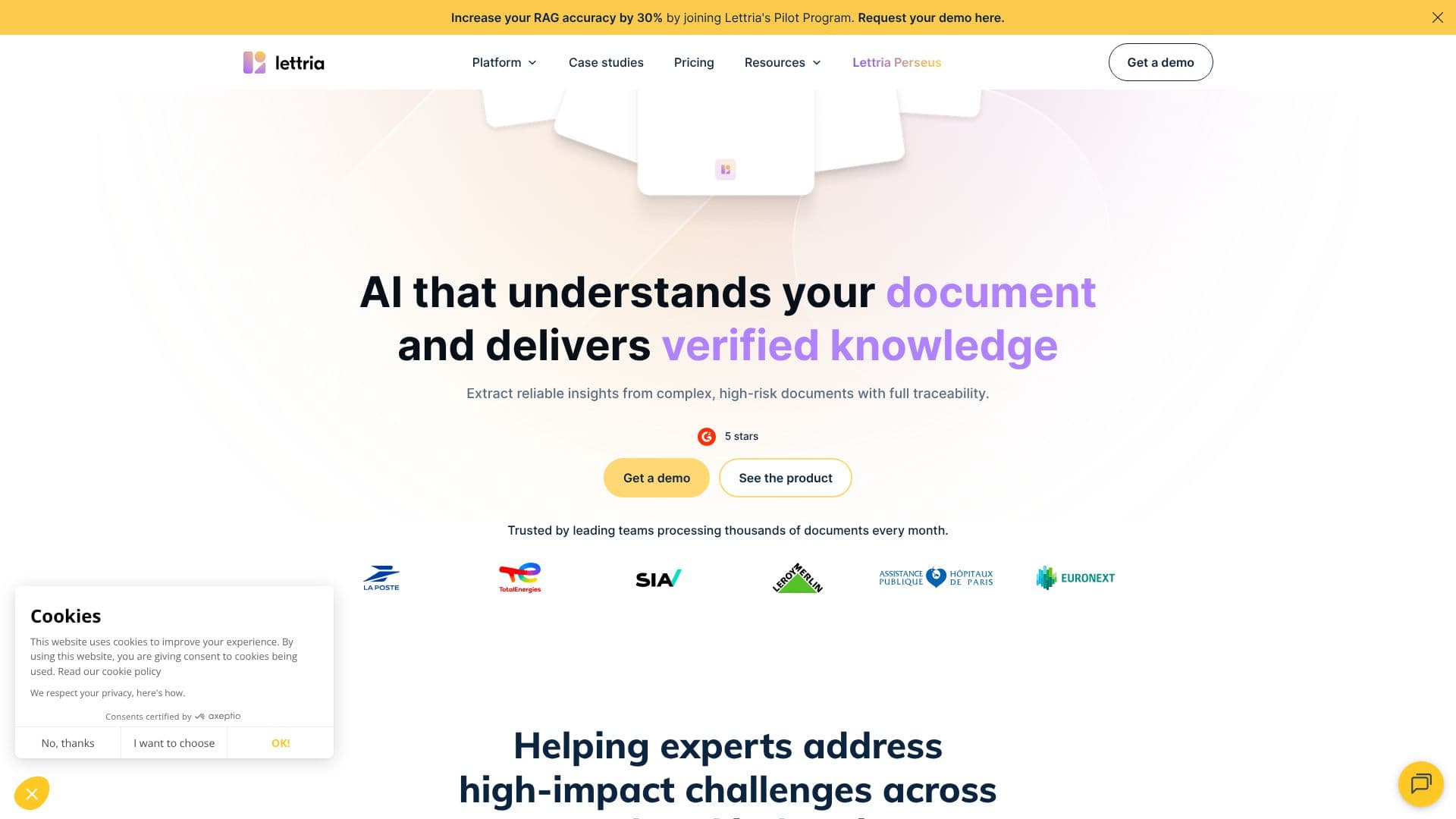
Lettria builds what it calls a Graph Context Layer: a way of turning an organization's structured and unstructured data into ontology-powered knowledge graphs that AI systems can reason over, rather than relying only on vector-based retrieval. The company's argument is that vector search works for simple lookups but breaks down on multi-hop reasoning, verifiable answers and connecting scattered structured and unstructured sources, which graphs are better suited to handle.
Read More
Lettria offers two entry points into this layer. Knowledge Studio is a graph-native document-intelligence platform built for regulated industries, including finance, healthcare, legal and engineering, where traceability and auditability matter as much as accuracy. Perseus is aimed at developers and technical teams, letting them generate and version ontologies and knowledge graphs for their own domain data, with business experts kept in the loop, so production-grade graphs can be built in days rather than months.
The platform is built around three core capabilities. Ontology Building auto-generates ontologies from an organization's domain data rather than requiring them to be hand-modeled, with version control built in. Text-to-Graph converts unstructured material such as documents, tables and SAP exports into a structured, queryable knowledge graph; Lettria states this step is more than 30 percent more accurate and up to 400 times faster than general-purpose LLMs at the same task, and covers native tables, layouts and multimodal content. Graph Retrieval, or GraphRAG, then answers questions by following relationships across the graph rather than keyword or single-chunk matching, with every answer tracing back to its source documents, which the company frames as "zero hallucinations by design."
Lettria publishes benchmark comparisons showing its graph-based approach outperforming plain vector retrieval agents on multi-hop reasoning, numerical reasoning and temporal reasoning, with an overall accuracy of 81.7 percent versus 57.5 percent for vector agents in its own testing. The company also cites production case studies: Alfa Laval used it to unify technical manuals and specifications into one engineering knowledge graph, reporting a 30 percent gain in extraction accuracy; Wisecube structured 108GB of biomedical text into a knowledge graph spanning more than 500 classes; Leroy Merlin unified a retail product catalog into more than 10,000 product classes; and AP-HP used it to structure fragmented biomedical research, reporting 60 percent faster research turnaround.
Lettria is built for regulated or knowledge-intensive organizations, such as healthcare, finance, legal and engineering teams, that need AI answers grounded in traceable sources, plus the developer and data teams building the graph infrastructure behind those answers.
- CategoryAI Knowledge Management
- DeploymentCloud
- PlatformsWeb
Lettria's Core Features
Ontology Building that auto-generates domain ontologies instead of hand-modeling them
Text-to-Graph conversion of documents, tables and SAP exports into structured knowledge graphs
GraphRAG-based retrieval with full source traceability for every answer
Knowledge Studio for document intelligence in regulated industries
Perseus developer tool for generating and versioning knowledge graphs
Sector-specific use across finance, healthcare, legal and engineering data
Published benchmark comparisons of graph-based versus vector-based retrieval accuracy
Support for structured and unstructured, multimodal enterprise data in one graph
How to use Lettria?
Choose Knowledge Studio for document intelligence or Perseus for developer-built graph agents
Connect your enterprise documents, tables or data exports (such as SAP data)
Let Lettria auto-generate an ontology from your domain data, with business experts reviewing it
Run Text-to-Graph to convert your unstructured and structured content into a knowledge graph
Query the graph through GraphRAG to get answers with full source traceability
Version and expand the graph over time as new documents and data sources are added
Lettria's Use Cases
- Regulated document intelligence
- Enterprise knowledge graphs
- GraphRAG for enterprise AI