
Description
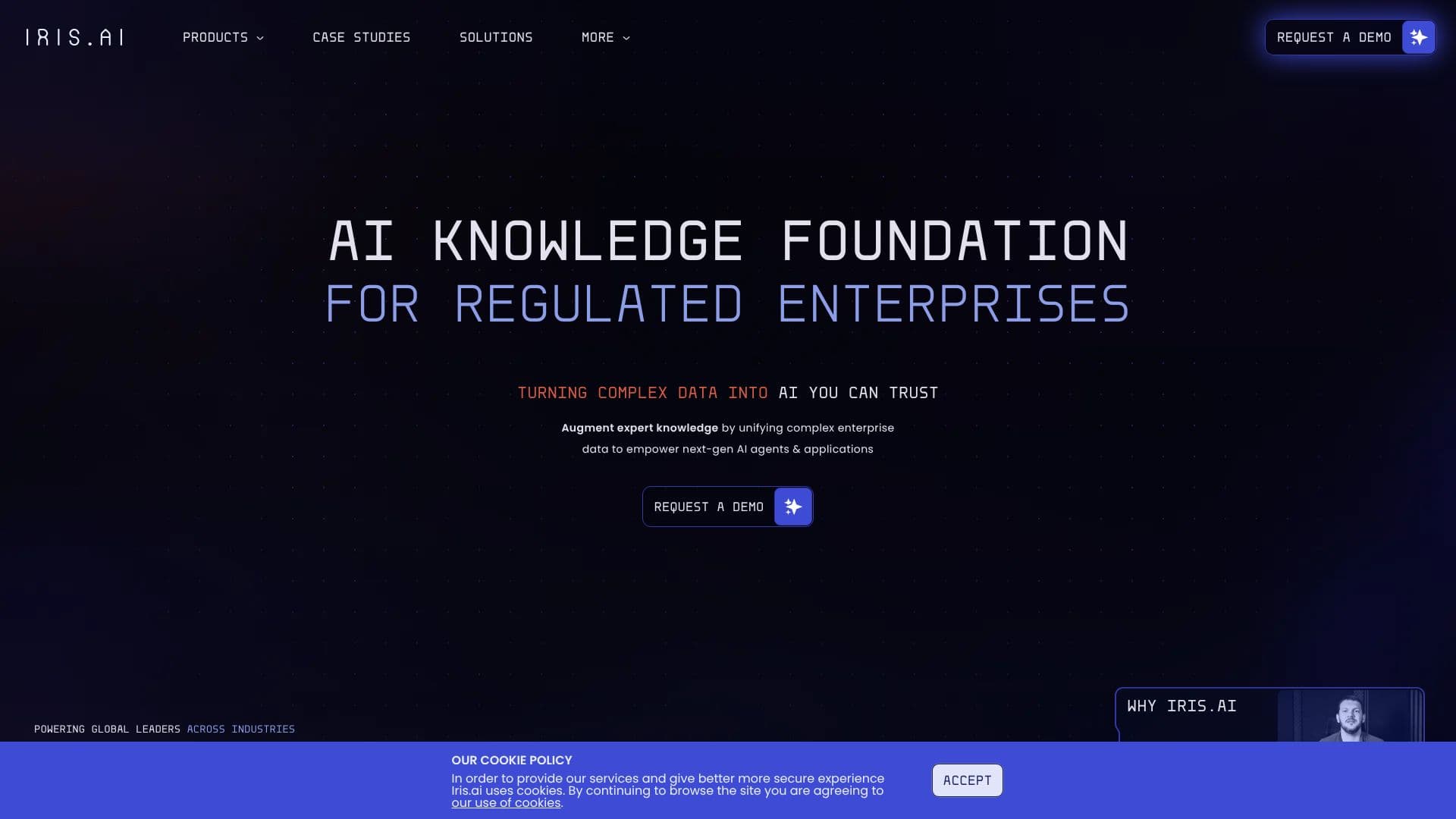
Iris.ai builds AI tools for organizations where an AI's answer has to be checked and traceable, not just plausible. The company describes its focus as AI Harnessing for expert knowledge: systems that control what a model reads and measure every step of how it produces an answer, aimed at manufacturing, life sciences, energy and telecom teams working on their own documents and internal systems.
Read More
The platform is organized into three products. Axion converts unstructured enterprise data, PDFs (native and scanned), Word, Excel and PowerPoint files, plain text, HTML, images with embedded text via OCR, and graphs and charts, into structured, indexed data that AI systems and retrieval-augmented generation (RAG) workflows can actually use. It supports more than 68 languages, connects to internal databases, CRMs, BI tools and cloud storage, and includes automated contextual chunking and indexing plus industry-specific schema templates. Iris.ai frames the need for this around its own estimate that 90% of enterprise data stays unstructured and unusable by AI as-is.
Neuralith turns that structured enterprise knowledge into what Iris.ai calls an AI engine, built around AI agents with every step checked, aimed at giving organizations traceable, verifiable agent behavior rather than an opaque model output.
RSpace is positioned as an AI-powered literature review tool for R&D teams, built for the complexity and precision that research work in industries like life sciences and energy demands, rather than as a general-purpose research assistant.
Iris.ai reports results from named enterprise deployments: a patent intelligence use case with ArcelorMittal it says reached 94% precision in data extraction, and a contact center use case it says reached 95% contextual accuracy in query handling. It also cites Axion use in competitive monitoring across global R&D teams.
The company is ISO 27001 certified, GDPR compliant, and offers on-premise deployment for organizations with strict data-residency requirements. Access runs through a requested demo rather than self-service signup, and the site does not publish pricing. Public detail on how Neuralith and RSpace work day to day is thinner than for Axion; prospective customers evaluating those two products will likely need a demo or case study to see the workflow firsthand.
- CategoryAI Knowledge Management
- Pricing ModelContact sales
- DeploymentCloud
- PlatformsWeb
Iris.ai's Core Features
Axion converts unstructured documents (PDF, Word, Excel, PowerPoint, images, charts) into structured, AI-ready data
Supports over 68 languages including Chinese
Automated contextual chunking and indexing with industry-specific schema templates
Connects to internal databases, CRMs, BI tools and cloud storage
Neuralith runs enterprise AI agents with governance that checks every step
RSpace supports AI-assisted literature review for R&D teams
ISO 27001 certified and GDPR compliant, with on-premise deployment options
Built for regulated industries: manufacturing, life sciences, energy and telecom
How to use Iris.ai?
Request a demo: Contact Iris.ai to review which product, Axion, Neuralith or RSpace, fits your use case.
Connect your data: Axion ingests documents and connects to your internal databases, CRMs and cloud storage.
Structure your knowledge: Axion chunks and indexes content into AI-ready, structured data.
Deploy an AI agent: Neuralith turns that structured knowledge into agents with each answer step checked.
Review for R&D: RSpace supports literature review workflows for research teams.
Iris.ai's Use Cases
- Enterprise data structuring
- Governed AI agents
- R&D literature review
- Patent and competitive intelligence