
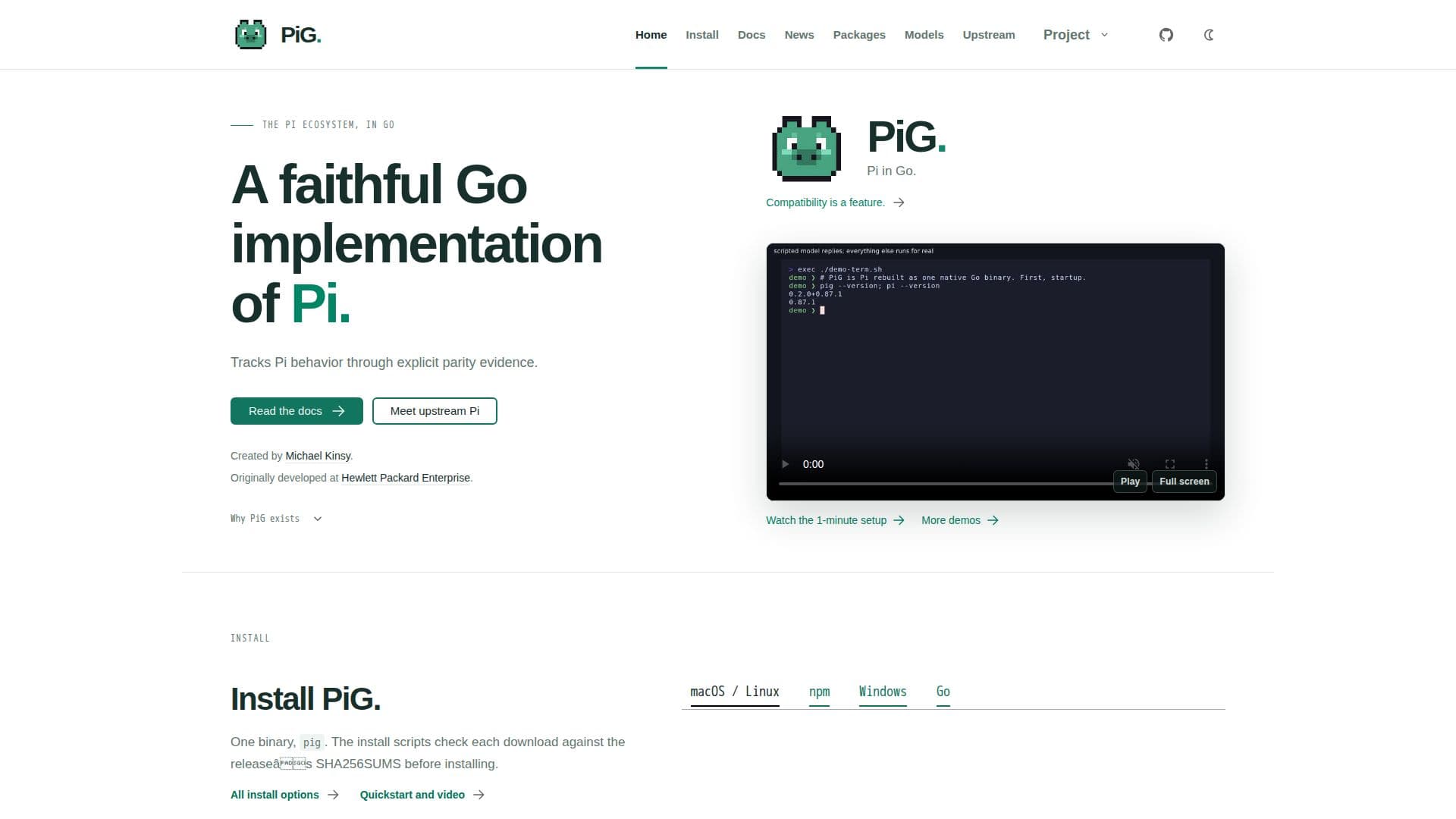
Description
PiG is a faithful Go implementation of the Pi coding agent, created by Michael Kinsy and initially developed at Hewlett Packard Enterprise. It aims to replicate Pi's behavior, architecture, and user experience within the Go ecosystem. PiG is not a standalone product but an extension-friendly platform that allows users to add commands, tools, providers, workflows, or UIs through extensions. It supports over 15 providers and hundreds of models, including Anthropic, OpenAI, Google, and more, with authentication via API keys or OAuth.
Read More
PiG offers a tree-structured, shareable session history, allowing users to navigate and branch from any previous point. Sessions can be exported to HTML or shared via GitHub gists. The platform provides context engineering capabilities, enabling users to control what goes into the context window and how it's managed. PiG supports various modes of operation, including interactive terminal UI, print/JSON for scripts, RPC for integrations, and embedding in Go applications.
Extensions in PiG can be developed using Go, Rust, Python, or Node, and are composed into named agent applications called Piglets. This flexibility allows users to build tools, commands, providers, and custom UIs without altering the core PiG behavior. PiG is maintained independently from the upstream Pi project and follows its architecture while documenting any necessary divergences due to platform requirements or reliability concerns.
PiG is available for installation on macOS, Linux, and Windows, with multiple installation methods, including npm and Go toolchain. The platform encourages community contributions and provides comprehensive documentation for configuring, using, and extending PiG.
- CategoryAI Agent Builders
- Pricing ModelOpen Source
- DeploymentGo, npm
- PlatformsmacOS, Linux, Windows
PiG: A Faithful Go Implementation of Pi's Core Features
Go-based implementation of Pi
Extensible with commands and tools
Supports 15+ providers and hundreds of models
Tree-structured session history
Context engineering capabilities
Multiple operation modes
Develop extensions in Go, Rust, Python, or Node
Independent maintenance from upstream Pi
How to use PiG: A Faithful Go Implementation of Pi?
Install: Use the provided scripts or npm package
Configure: Set up models and extensions
Use: Operate in interactive, print/JSON, or RPC mode
Extend: Develop and integrate custom extensions
PiG: A Faithful Go Implementation of Pi's Use Cases
- Model Integration
- Custom Extensions
- Session Management
- Context Engineering
- Agent Applications