Description
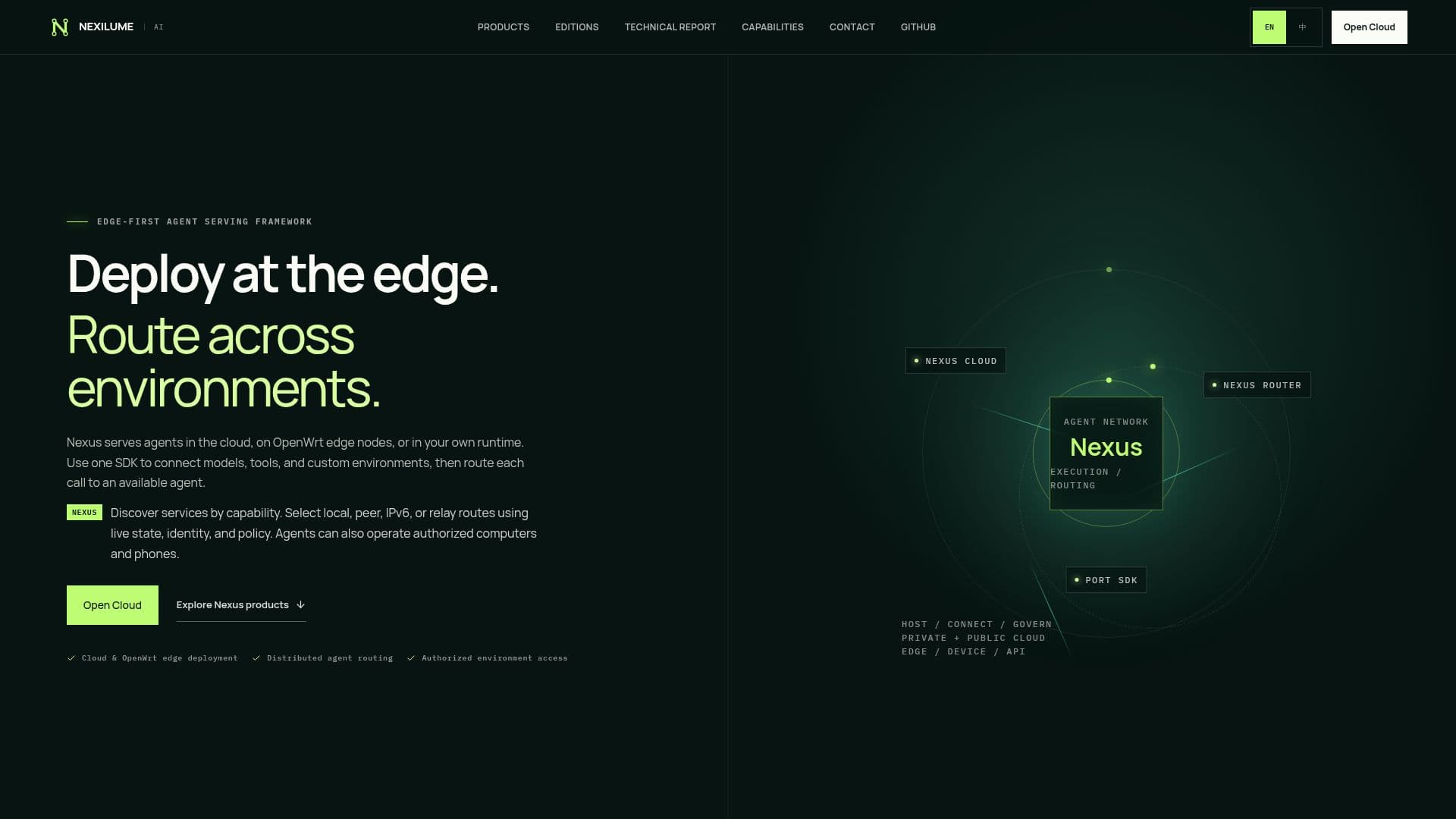
Nexilume AI presents Nexus, an advanced edge-first agent serving framework that facilitates the deployment and management of AI agents across diverse environments. This includes cloud infrastructure, OpenWrt edge nodes, and custom runtime environments. Nexus utilizes a unified SDK, allowing users to seamlessly connect various AI models, tools, and execution environments. The framework intelligently routes agent calls to available agents, leveraging live state, identity, and policy for optimal performance.
Read More
Nexus is built on an edge-first agent infrastructure, creating a single agent service network that spans cloud, edge nodes, and execution environments. Key components include Nexus Cloud for managing services and run lifecycles, OpenWrt Router for discovering and forwarding capabilities within private networks, and the Port SDK for connecting agents and environments. This architecture ensures agents can operate authorized computers and phones securely.
Nexilume AI offers two main editions: Community and Enterprise. The Community edition is self-hosted, designed for single-owner workspaces. Users can download the Cloud Server, Web Console, and Relay source to deploy on their own infrastructure, managing their providers, model pools, routers, and agent runs. The Enterprise edition caters to teams, providing organization access and hosted services through Open Cloud, with advanced features for team membership, roles, and policies, as well as shared execution and enterprise access policies.
The platform addresses critical daily challenges in agent management, focusing on governing credentials, enabling agents to securely operate devices, and maintaining dependable API capacity. Nexus Console provides remote workspace capabilities, including team token management for project-scoped access and attributable usage. Agents can operate phones and computers through controlled cloud interfaces, performing tasks like reading screens, typing, opening apps, and running desktop tools, all with an audit trail. An adaptive API pool connects multiple providers behind a single endpoint, selecting capacity based on health, quota, cost, latency, and enterprise policy.
Nexilume AI encourages users to integrate their existing agent services with Nexus. The company offers assessments for integration, access control, and API capacity, providing direct support for product inquiries, use-case assessments, commercial discussions, technical support, and strategic partnerships.
- CategoryAI Agent Builders
- Pricing ModelCommunity (Self-Host), Enterprise (Hosted)
- DeploymentCloud, OpenWrt, Custom Runtimes
- PlatformsWeb, Android
Nexilume AI's Core Features
Edge-First Agent Serving Framework
Deploy Agents Across Cloud and OpenWrt Nodes
Connect Authorized Environments
Route Agent Calls Across Networks
Unified SDK for Models, Tools, and Custom Environments
Service Discovery by Capability (Local, Peer, IPv6, Relay)
Agents Operate Authorized Computers and Phones
Nexus Cloud for Service and Run Lifecycle Management
OpenWrt Router for Private Network Capability Forwarding
Port SDK for Agent and Environment Connection
Self-Host Community Edition Available
Enterprise Edition for Teams with Hosted Services
Team Token Management for Project-Scoped Access
Agents Operate Devices with Audit Trails
Adaptive API Pool for Capacity Management
How to use Nexilume AI?
Bring Your Agent: Integrate your existing agent service with the Nexus framework.
Deploy Agents: Deploy agents across cloud, OpenWrt edge nodes, or your custom runtime environments.
Connect Environments: Use the unified SDK to connect models, tools, and custom execution environments.
Route Calls: Configure Nexus to route agent calls based on live state, identity, and policy.
Manage Access: Utilize the Nexus Console for team token management, assigning credentials and permissions.
Operate Devices: Authorize agents to securely operate computers and phones through controlled cloud interfaces.
Nexilume AI's Use Cases
- Distributed Agent Deployment
- Cross-Network Agent Routing
- Automated Device Operation
- Team Access Management
- API Capacity Optimization
- Private Network Agent Discovery
- Custom Environment Integration
- Auditable Agent Actions