Description
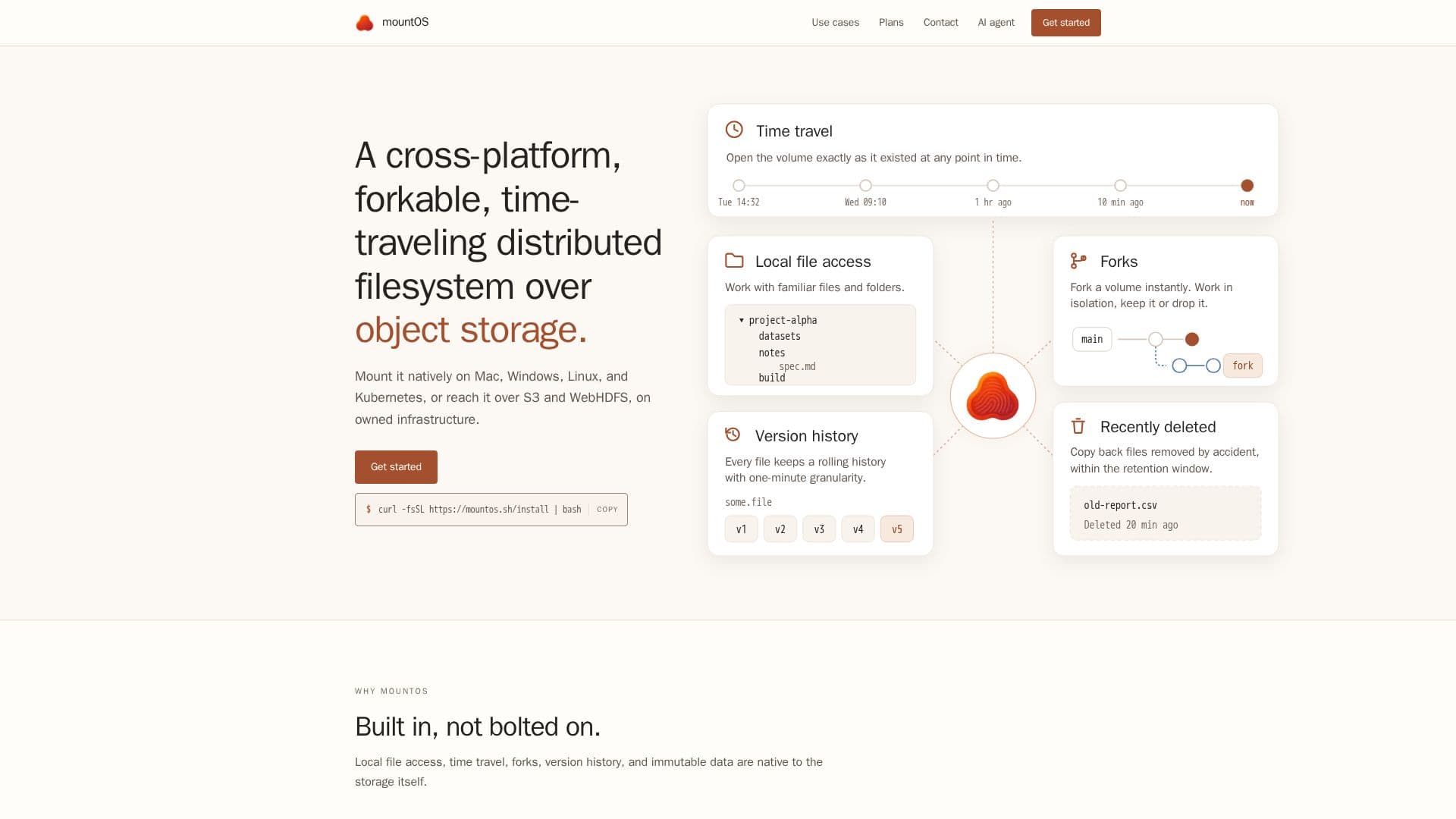
mountOS is a versatile, self-hosted POSIX-compliant filesystem that allows users to mount S3 and object storage on various platforms including Mac, Windows, Linux, and Kubernetes. It provides native file access through FUSE, NFS, SMB, and FSKit, and supports S3 and WebHDFS APIs. This makes it an ideal solution for infrastructure providers looking to deliver production-ready native file access.
Read More
One of the standout features of mountOS is its ability to create forks with copy-on-write, enabling users to work in isolation and experiment without affecting the original data. The time travel and version history capabilities allow users to access previous versions of files and recover recently deleted items, providing a robust data management solution.
mountOS also supports analytical workloads through its Apache Iceberg catalog volumes, allowing analytical engines to query data directly. Additionally, it offers a read-only MCP connector for AI agents, making it suitable for AI-driven applications.
The licensing model is straightforward, with a free self-hosted license available for deployments up to 10 TiB. For larger deployments or additional support, a Business License can be arranged directly with the mountOS team.
Overall, mountOS is designed for teams and businesses that require a scalable, flexible, and secure filesystem solution that integrates seamlessly with existing infrastructure. Its comprehensive feature set and support for multiple platforms make it a valuable tool for managing large volumes of data efficiently.
- CategoryOther AI Tools
- Pricing ModelFreemium
- DeploymentSelf-hosted
- PlatformsMac, Windows, Linux, Kubernetes
mountOS's Core Features
POSIX-compliant filesystem
Native mounts via FUSE, NFS, SMB, FSKit
S3 and WebHDFS API support
Kubernetes CSI driver
Forks with copy-on-write
Time travel and version history
Recently-deleted recovery
Apache Iceberg catalog volumes
How to use mountOS?
Configure: Set up native mounts on your platform
Use: Access files through POSIX-compliant interfaces
Optimize: Utilize forks and time travel for data management
Integrate: Connect with AI agents using the MCP connector
mountOS's Use Cases
- Elastic Volume
- Low-Latency Access
- Cross-Platform Access
- Event-Driven Processing
- CI Workspaces