Description
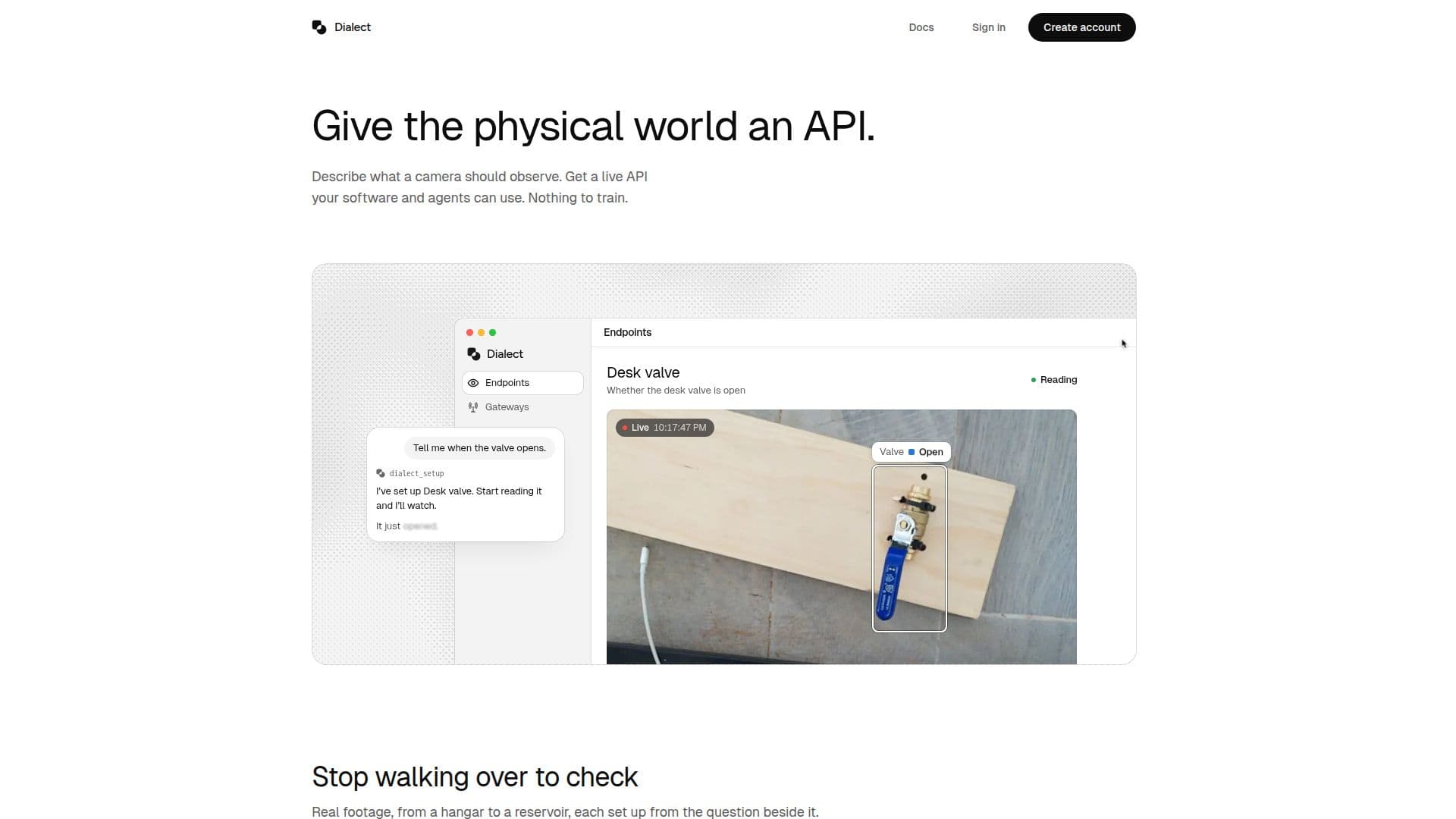
Dialect provides a unique solution for integrating the physical world with software and AI agents by turning standard cameras into live APIs. It eliminates the need for complex model training; instead, users simply describe what a camera should observe using natural language sentences. Dialect then processes this input, proposes an observation, and once confirmed, delivers real-time, typed values to connected systems.
Read More
This platform is compatible with any camera supporting RTSP or ONVIF protocols and operates locally within a Docker container on a computer adjacent to the camera. This architecture ensures low latency and robust performance, even if network connectivity fluctuates or the camera moves. Dialect continuously monitors the scene, providing not only current values but also a history of changes throughout the day, enabling agents to answer complex queries about past events.
Software and agents can access the camera's observations in three primary ways: via an MCP tool compatible with clients like Claude or Codex, through a standard REST API call (GET /v1/endpoints/{name}), or by receiving signed webhooks every time a value changes. This flexibility allows for seamless integration into various applications, from automating tasks based on physical conditions to providing real-time data for analytical systems.
A key feature of Dialect is its transparency: when it cannot confidently determine a value, it explicitly states so rather than guessing. Each value also includes a certainty score and a timestamp indicating when it was first observed, providing reliable data for critical applications. The system supports multiple "questions" or endpoints from a single camera, each configured independently from a sentence, without requiring additional training.
Pricing for Dialect is structured monthly, with a base fee for the first question and an additional charge for each subsequent question on the same camera. A free first answer and a 30-day full refund policy are offered. Custom plans are available for extensive needs or specific security and contract requirements, making Dialect a scalable solution for diverse industrial and operational environments.
- CategoryComputer Vision Tools
- Pricing ModelSubscription
- DeploymentDocker
- PlatformsWeb
Dialect's Core Features
Turns any RTSP or ONVIF camera into a live API
Describe observations in natural language sentences
No model training required for any endpoint
Provides typed values with certainty and timestamp
Runs locally in Docker for real-time processing
Integrates with MCP tools (Claude, Codex)
Offers REST API for data access
Sends signed webhooks on value changes
Explicitly states when it cannot determine a value
Maintains a history of observed values throughout the day
Supports multiple independent questions/endpoints per camera
Handles camera movement and network drops
Offers a free first answer and 30-day full refund
Scalable pricing based on number of questions
Custom plans for large-scale deployments
How to use Dialect?
Connect Camera: Ensure your camera supports RTSP or ONVIF and run Dialect in Docker on a nearby computer.
Describe Observation: In a sentence, tell Dialect what the camera should observe and confirm its proposal.
Access Data: Read typed values via an MCP tool, a REST API call, or receive webhooks when values change.
Monitor & Act: Use the live API to automate software actions, trigger alerts, or analyze historical data.
Dialect's Use Cases
- Automated Facility Monitoring
- Industrial Process Control
- Logistics and Inventory Tracking
- Security and Access Control
- Environmental Sensing
- Agent-Based Automation
- Remote Operations Verification