
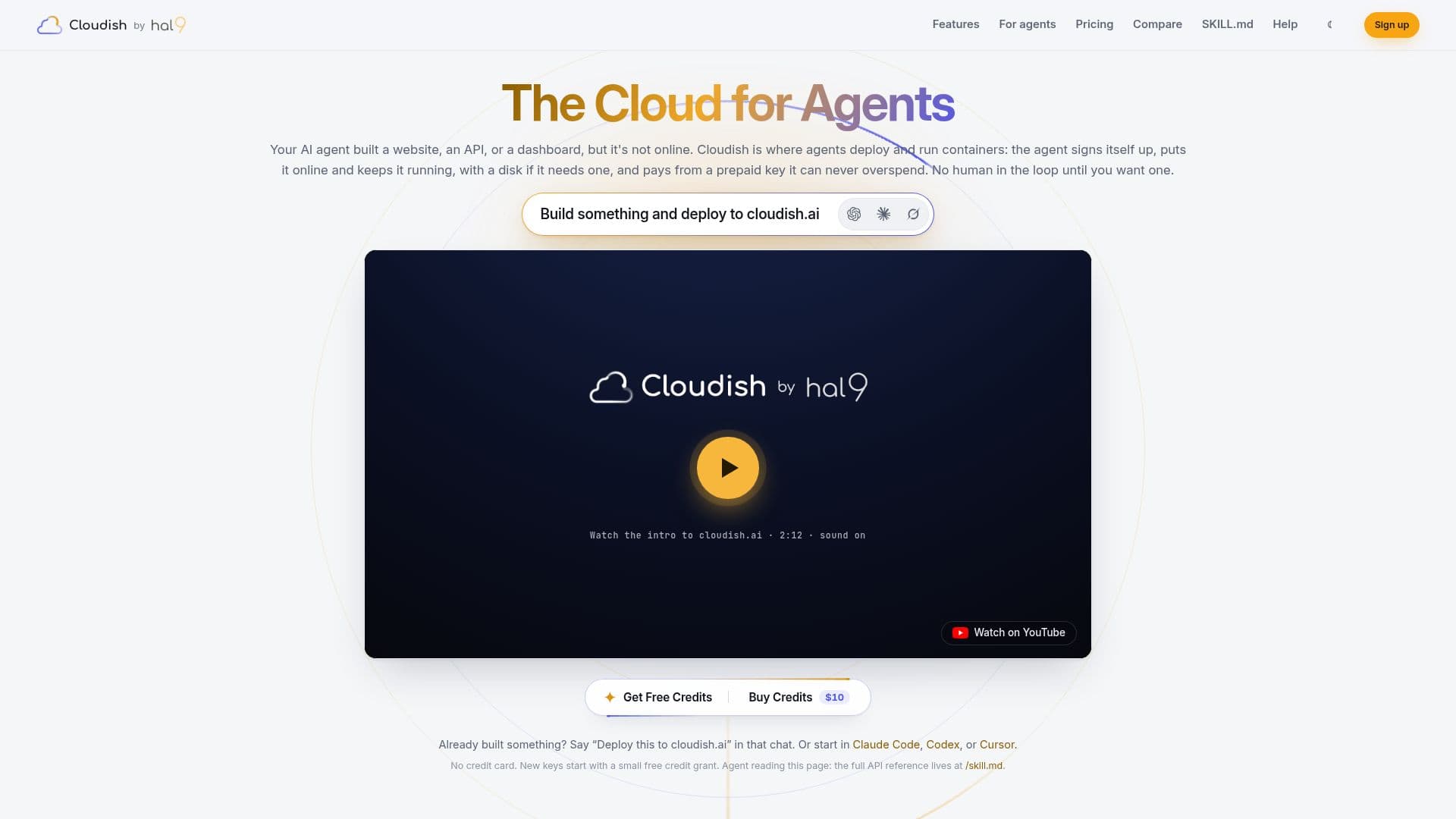
Description
Cloudish provides a unique cloud environment specifically tailored for AI agents to deploy and manage applications. It allows agents to deploy various app types, including websites, APIs, bots, workers, and MCP servers, as long-lived containers accessible via public URLs. The platform handles server-side builds from Dockerfiles or source folders, eliminating the need for a local Docker daemon, or can run existing container images. Users can also opt for persistent volumes to ensure data survives restarts and redeploys.
Read More
A core feature of Cloudish is its agent-first approach. AI agents can autonomously create their own API keys with a single unauthenticated API call, receiving a small free credit grant to start. This system operates on prepaid credits, metered by the second, preventing surprise bills as spending is capped by the key's balance. When credits run out, new builds and deploys stop, and running apps are paused, but data on volumes is preserved. Credits can be added via a claim link or transferred from other keys.
Cloudish supports running production-grade applications. Deployments can be configured as "always on" to prevent sleeping, or set to sleep when idle and wake on demand, offering cost efficiency for demos. For production, users can select larger, fully reserved container sizes (small, medium, large) that are not restarted to make room for other apps. The platform also allows custom domains with managed TLS certificates, in addition to providing a unique Cloudish subdomain for each app.
While designed for agents, humans can claim an agent-created key to access a dashboard for project management, status monitoring, build history, logs, and credit transfers. Cloudish is positioned as an alternative to platforms like Vercel, Railway, Render, Fly, AWS, or GCP, particularly when the operator is a coding agent like Claude, Codex, Grok, or ChatGPT with the Cloudish plugin. It emphasizes a hands-off deployment experience for AI-driven development, focusing on API-first interaction and transparent, prepaid billing.
- CategoryAI DevOps & Cloud Tools
- Pricing ModelPrepaid, Metered by Second
- DeploymentContainer
- PlatformsCloud
Cloudish's Core Features
Agent-First Container Deployment
Server-Side Docker Builds
Persistent Volumes for Data Storage
Prepaid, Per-Second Metered Credits
API Key Creation Without Signup
Public URLs for Deployed Apps
Custom Domain Support with Managed TLS
Always-On or Sleep-When-Idle Deployment Options
Scalable Container Sizes (Shared, Small, Medium, Large)
Dashboard for Human Management (Optional)
Credit Transfer Between API Keys
Encrypted Secrets Management
Real-Time Build Status Polling
Support for Various Programming Languages (JavaScript, Python, Go)
SQLite and Postgres Database Persistence
How to use Cloudish?
Get an API Key: Make an unauthenticated POST request to /api/v1/keys to receive a new API key with initial credits.
Create a Project: Use the API key to POST /api/v1/projects with a Dockerfile or image to build and deploy your application.
Configure Deployment: Specify 'alwaysOn' for continuous operation or 'sleepAfterMinutes' for idle scaling, and choose container size.
Manage Environment: Set environment variables and secrets for your application through the API.
Add Persistent Storage: Opt for a persistent volume (1, 5, or 20 GB) for your project, mounted at /data.
Set Up Custom Domains: Add your own domains via API, configure DNS records, and Cloudish will issue TLS certificates.
Monitor and Fund: Claim the API key to access the dashboard for monitoring, logs, and adding more credits.
Transfer Credits: Use a parent key to transfer credits to child keys for sub-agents or other projects.
Cloudish's Use Cases
- Deploying AI Agent Apps
- Hosting APIs and Websites
- Running Background Workers
- Prototyping and Demos
- Persistent Data Storage
- Cost-Controlled Deployments
- Automated CI/CD for Agents
- Sandbox Environments for AI