
Description
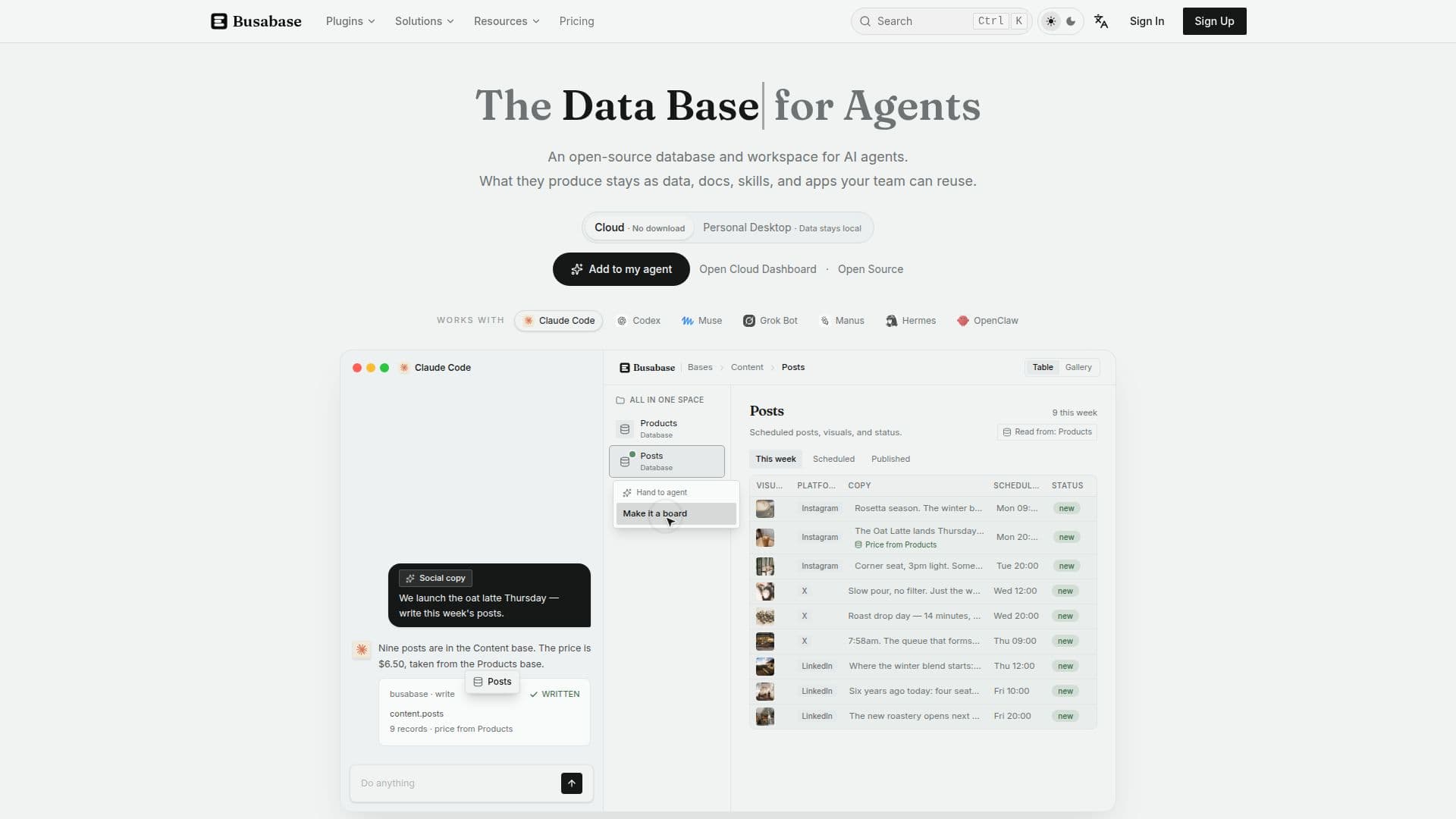
Busabase serves as a system of record for AI agents, providing an open-source (MIT) database and workspace where both AI agents and human teams can collaborate effectively. It centralizes data, documents, skills, and applications, ensuring that all work is stored in a structured, reusable format, unlike ephemeral chat histories.
Read More
The platform offers flexible deployment options: users can run the local engine on their own machine, self-host it within their network using a Docker image, or opt for Busabase Cloud. This flexibility ensures data privacy and control, as sensitive information can remain within the user's network if desired. Every change made within Busabase is meticulously recorded, maintaining a full history and provenance, which is crucial for explainability and auditing.
Busabase integrates with any AI agent capable of calling a REST API, including popular tools like Claude Code, Codex, Gemini CLI, n8n, Zapier, and LangChain. Agents can read and write data, docs, files, and skills through a consistent structure, facilitating seamless collaboration. A key feature is the review and approval workflow, where certain agent writes can be configured to wait for human review before being applied to canonical data. This ensures that rejected work never contaminates the main dataset, and all decisions are attached to the record for future reference.
The platform supports various operational records, including data, knowledge, apps, and skills bases, along with playbooks and external agent integrations. It addresses common challenges of AI work, such as preventing work from being lost in chat logs, ensuring continuity between agent sessions, and retaining work within the company even if an individual leaves. Busabase is committed to data privacy, stating that data never leaves the user's machine with the local engine, and remains in the user's own space on Cloud.
Busabase is not an AI product itself; rather, it is designed to be the "seat" or infrastructure for AI agents, providing a reliable and auditable environment for their operations. The company explicitly states it will never embed AI models, chat, or agents within the product, focusing solely on providing the underlying data and workspace infrastructure. This commitment extends to data ownership and avoiding vendor lock-in, with its open-source nature and self-hosting capabilities.
- CategoryAI SQL & Database Tools
- Pricing ModelFreemium
- DeploymentLocal, Self-Hosted, Cloud
- PlatformsWeb
Busabase's Core Features
Open-source (MIT) database and workspace
Shared data, docs, skills, and apps for agents and people
Local, self-hosted, or cloud deployment options
Full history and provenance for every change
Human review and approval workflow for agent writes
Integration with any REST API-compatible AI agent
Structured storage for agent work (data, docs, skills, apps)
Data privacy and control (local data stays on machine)
Configurable access levels for agents and teammates
Restorable deleted or archived records, fields, and views
Support for various agent types: terminal, IDE plugins, AI editors, web chat, desktop, mobile, agent platforms
No AI models, chat, or agents embedded in the product itself
OpenAPI (REST) and outgoing webhooks for integrations
MCP server support for agent connections
How to use Busabase?
Choose Deployment: Decide whether to run Busabase locally, self-host with Docker, or use Busabase Cloud.
Connect Agents: Integrate your existing AI agents by configuring them to call the Busabase REST API, MCP, or CLI.
Define Workspaces: Set up data, knowledge, apps, and skills bases to organize agent and human work.
Configure Permissions: Assign specific access levels (Read, Propose Changes, Write, Manage) to agents and teammates.
Implement Review Workflows: Designate which agent writes require human review and approval before becoming canonical data.
Monitor Changes: Track every change, its source agent, channel, and approval status for full auditability.
Reuse Agent Output: Turn agent-generated content into structured data, documents, and applications for team reuse.
Busabase's Use Cases
- AI Agent Data Platform
- Sales & Customer Follow-up
- Content & Marketing Operations
- Engineering & Project Management
- Knowledge Base & Internal Q&A
- Management Dashboard
- FDE & AI Implementation
- Agent Delivery & Handoff