
Description
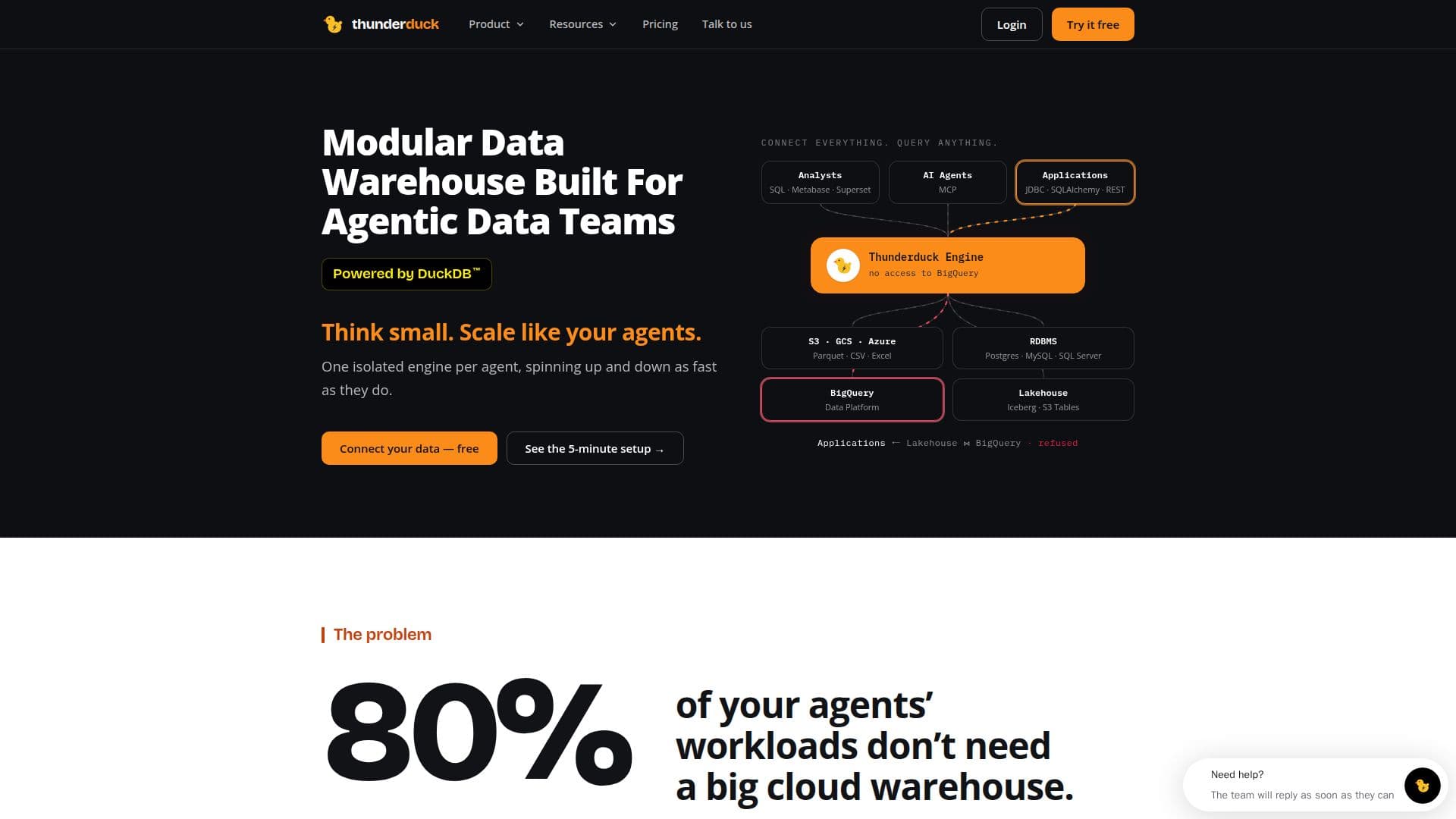
Thunderduck offers a modular data warehouse solution specifically designed for agentic data teams, leveraging the power of DuckDB. It addresses the common issue where 80% of agents' workloads don't require a large cloud warehouse, yet teams incur significant distributed-systems costs and managed-service premiums. By providing one isolated engine per agent, Thunderduck allows engines to spin up and down rapidly, matching the dynamic nature of agentic workloads.
Read More
The platform is engineered to deliver sub-second queries on terabytes of data, regardless of the number of agents running. It simplifies data pipeline construction and automates DevOps tasks, all while maintaining enterprise-grade governance. Users have the flexibility to deploy Thunderduck anywhere, whether on-premise with cloud-like flexibility or within their existing cloud infrastructure.
At its core, Thunderduck utilizes DuckDB, an open-source, in-process analytical database with a vectorized engine. This architecture means it runs where your code runs, eliminating the need for server management. It supports multi-tenancy and offers enterprise-grade security, ensuring data sovereignty by keeping data within the user's cloud or data center under their access rules.
Thunderduck facilitates seamless integration with AI agents like Claude, ChatGPT, or Cursor via MCP. Agents can interpret table and column meanings, not just names, to find the right tables, read partitions and indexes, and write efficient queries. These queries run under predefined roles and cost limits. The platform can also automate dbt model building, following medallion layers, testing on branches, and opening pull requests to maintain clean and manageable data marts.
It supports query federation with zero ETL, allowing users to join data from various sources like Postgres, BigQuery, Iceberg tables, and files in a single query, with filters pushed down to each source. This eliminates the need for data copies, load jobs, or sync babysitting for small and ad-hoc data. When datasets grow or require modeling, users can build dbt pipelines into Iceberg and continue querying them consistently. Thunderduck also provides cost estimation for every query before it runs, enabling budget control and preventing unexpected expenses.
- CategoryAI SQL & Database Tools
- Pricing ModelFreemium
- DeploymentCloud, On-Premise
- PlatformsWeb
Thunderduck's Core Features
Modular data warehouse architecture
One isolated DuckDB engine per agent
Sub-second queries on terabytes of data
On-premise or in-cloud deployment options
Automated DevOps chores
Enterprise-grade governance
Multi-tenant support
Lower latency with no distributed overhead
Data sovereignty and access rules
Integration with AI agents (Claude, ChatGPT, Cursor) via MCP
AI-assisted query generation and dbt model building
Query federation across diverse sources (PostgreSQL, BigQuery, Iceberg, S3)
Automatic schema, table, column, and type discovery
Cost and runtime estimation for every query before execution
AI-powered failed query diagnosis and suggested fixes
Role-based access control for catalogs
Query caching for instant, free repeat queries
How to use Thunderduck?
Connect a Catalog: Provide credentials for your data sources like databases, warehouses, lakehouses, or object storage.
Discover Data: Thunderduck automatically reads schemas, tables, columns, and infers column meanings, keeping them fresh.
Query and Join: Address any table as catalog.schema.table and join across multiple sources in a single SQL statement.
Integrate AI Agents: Connect Claude, ChatGPT, or other MCP clients to enable AI agents to browse catalogs and run SQL.
Automate Workflows: Schedule SQL statements on a cron schedule or connect dbt repositories to run builds, tests, and snapshots.
Monitor and Govern: Utilize pre-query cost estimates, audit logs, and role-based access control to manage usage and security.
Thunderduck's Use Cases
- Agentic Data Workloads
- Cost Optimization for Data Teams
- Real-time Data Analytics
- Data Pipeline Automation
- Data Sovereignty and Security
- AI-Assisted Querying
- Cross-Source Data Joining
- Proactive Cost Management
- Data Governance and Auditing
- Lakehouse Building