
Description
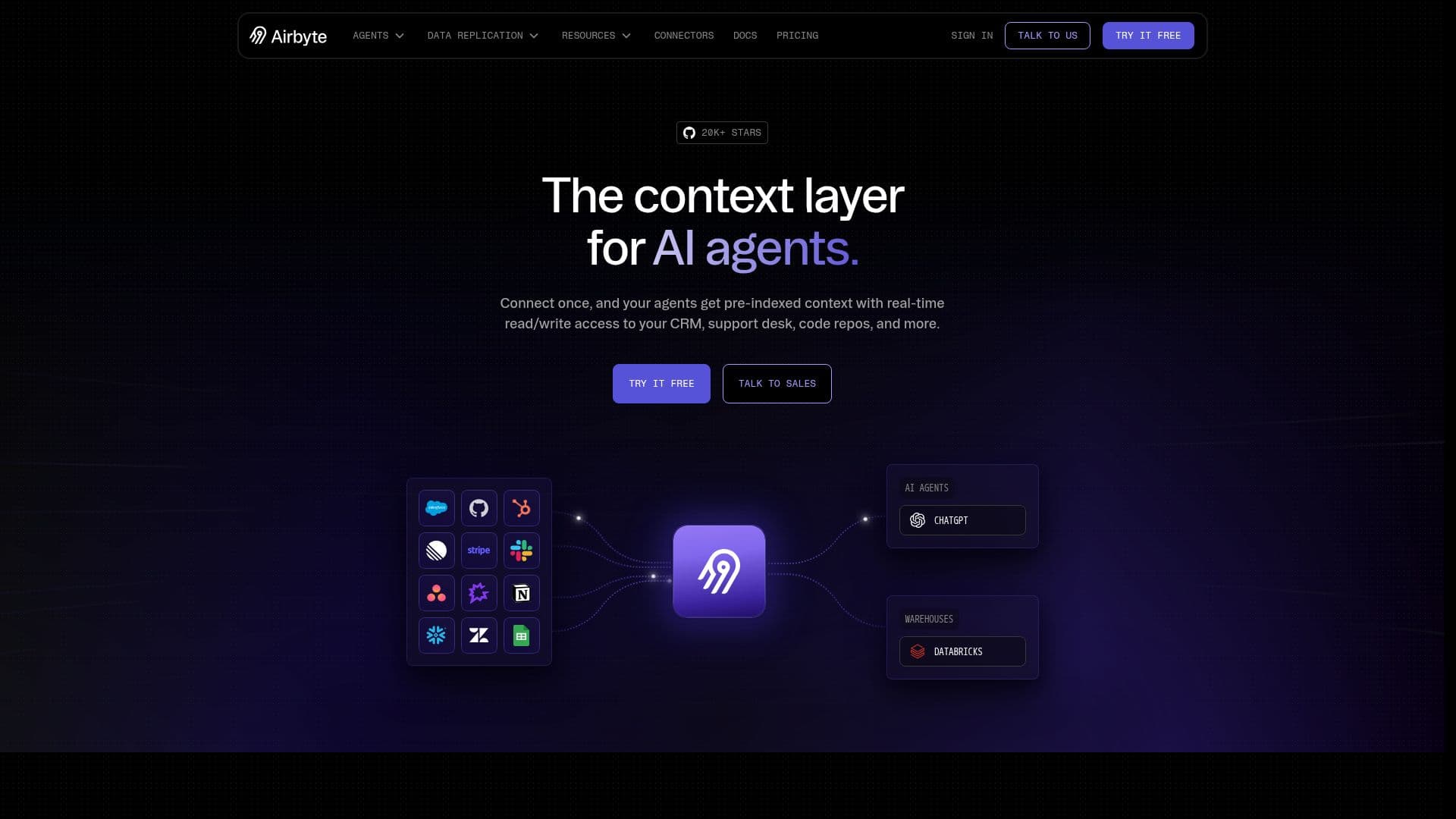
Airbyte is an open-source data integration platform that moves data through ELT pipelines into any warehouse and provides a governed context layer for AI agents, backed by more than 600 connectors. It addresses a common problem with AI agents in production: rather than crawling live APIs across systems like Salesforce, Zendesk, and Stripe on every query, Airbyte replicates, unifies, and indexes data ahead of time so agents query one layer instead of many.
Read More
The architecture sits between your systems and your agents: Airbyte connects to sources through managed connectors with built-in OAuth, builds a governed context layer that is replicated and always fresh, and serves that context to any agent you run. This reduces token waste, latency, and rate-limit issues while giving agents a map of what data exists and how it connects. Teams keep their data portable and choose where it lives.
For developers, Airbyte offers a CLI, SDK, API, and MCP that work with any agent framework, managing connectors, OAuth, tool schemas, and action execution underneath the stack. Plans range from a free tier and self-managed open-source Core to managed data replication and agent-focused tiers with defined operation allowances.
- CategoryData & Analytics
- Pricing ModelFreemium
- DeploymentCloud, Self-hosted
- PlatformsWeb
Airbyte's Core Features
Open-source data integration with 600+ connectors
ELT pipelines into any data warehouse
Governed context layer for AI agents
Managed connectors with built-in OAuth
Replicated, unified, and always-fresh context
CLI, SDK, API, and MCP for any agent framework
Portable data with control over where it lives
Free tier plus self-managed open-source Core
How to use Airbyte?
Connect sources: Add sources from the library of managed connectors with built-in OAuth.
Build context: Let Airbyte replicate, unify, and index your data before any agent runs.
Choose storage: Decide where your data lives to keep it portable and unlocked.
Serve agents: Point your agents at the single context layer instead of live APIs.
Develop: Use the CLI, SDK, API, or MCP with your agent framework.
Airbyte's Use Cases
- Data replication
- AI agent context
- Reducing token waste
- Developer data infrastructure