
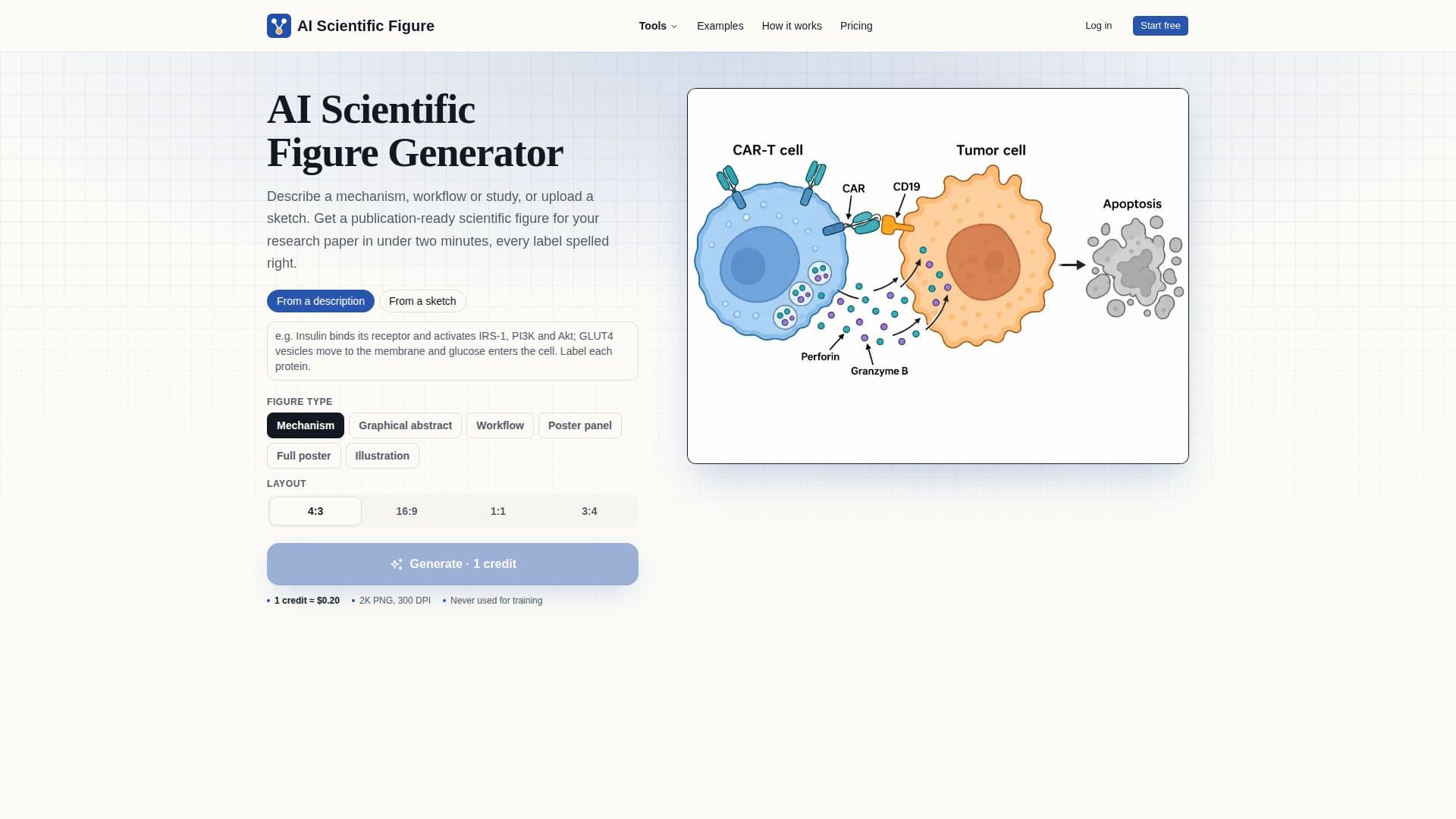
Description
The AI Scientific Figure Generator is a free tool designed to transform textual descriptions, hand-drawn sketches, or paper abstracts into high-quality, publication-ready scientific figures. It supports various figure types, including mechanism diagrams, graphical abstracts, workflows, and poster panels, delivering them as 2K PNG images.
Read More
This generator utilizes advanced AI models, specifically GPT Image 2.5 and Nano Banana 2.1, which are optimized for generating labeled scientific diagrams. It incorporates instructions for journal-appropriate layouts, colorblind-safe palettes, and print-size text, ensuring the figures meet professional standards. Users can describe their desired figure, upload a sketch, or paste a paper abstract, and the AI will interpret the input to create a clear and accurate visual representation.
The platform offers free figures for new accounts at full 2K quality without watermarks, allowing users to evaluate the results on their own research topics. After the initial free credits, users can purchase credit packs that never expire or subscribe to plans like the Researcher, Pro, or Lab tiers for ongoing access. These plans offer varying numbers of credits per month, with unused credits rolling over for subscribers.
Figures generated are owned by the user and can be used in papers, posters, slides, teaching materials, and commercial work without any rights claimed by the generator. The platform ensures the privacy of user data, stating that descriptions, uploads, and figures are private to the account and never used for model training. Reference uploads are deleted after 3 days, and figures after 30 days unless a subscription is maintained.
While the AI Scientific Figure Generator excels at creating schematic diagrams, it does not plot experimental data. Users are advised to plot real data using dedicated statistics software and then use this tool for the conceptual and illustrative parts of their research. The output figures are provided as 2K PNGs (e.g., 2352 × 1760 pixels for 4:3 aspect ratio), printing at 300 DPI at double-column width, making them suitable for direct inclusion in manuscripts, posters, or slides without further resizing. Journal policies on AI-generated images vary, so users are encouraged to check their target journal's author guidelines.
- CategoryAI Graphic Design Tools
- Pricing ModelFreemium
- DeploymentCloud
- PlatformsWeb
AI Scientific Figure Generator's Core Features
Generates publication-ready scientific figures
Transforms descriptions, hand sketches, or paper abstracts into figures
Supports mechanism diagrams, graphical abstracts, workflows, and poster panels
Produces 2K PNG images with clean labels and no watermark
Utilizes GPT Image 2.5 and Nano Banana 2.1 models for accuracy
Includes journal layout, colorblind-safe colors, and print-size text
Offers free figures for new accounts
Credit packs available with no expiration
Subscription plans with rolling unused credits
Users retain full ownership of generated figures
Ensures privacy of user data; never used for model training
Figures are high-resolution (300 DPI at double-column width)
Supports various aspect ratios (4:3, 16:9, 1:1, 3:4)
Allows editing by changing description and regenerating
Compares favorably to manual drawing for speed and ease
How to use AI Scientific Figure Generator?
Describe the Figure: Write what the figure should show, including cells, molecules, actions, and labels, or paste a paper abstract.
Pick Type and Layout: Select the figure type (mechanism, graphical abstract, workflow, poster panel, illustration) and aspect ratio (4:3, 16:9, 1:1, 3:4).
Add a Sketch (Optional): Upload a photo of a notebook sketch, whiteboard drawing, or an older figure to guide the layout.
Download 2K PNG: Receive the publication-ready figure in under two minutes. Modify the description to generate new versions.
AI Scientific Figure Generator's Use Cases
- Mechanism Diagrams
- Graphical Abstracts
- Scientific Workflows
- Poster Panels
- Thesis Illustrations
- Grant Proposal Graphics
- Lecture Slides
- Preprint Figures
- Cell Biology Visuals
- Neuroscience Diagrams