


Description
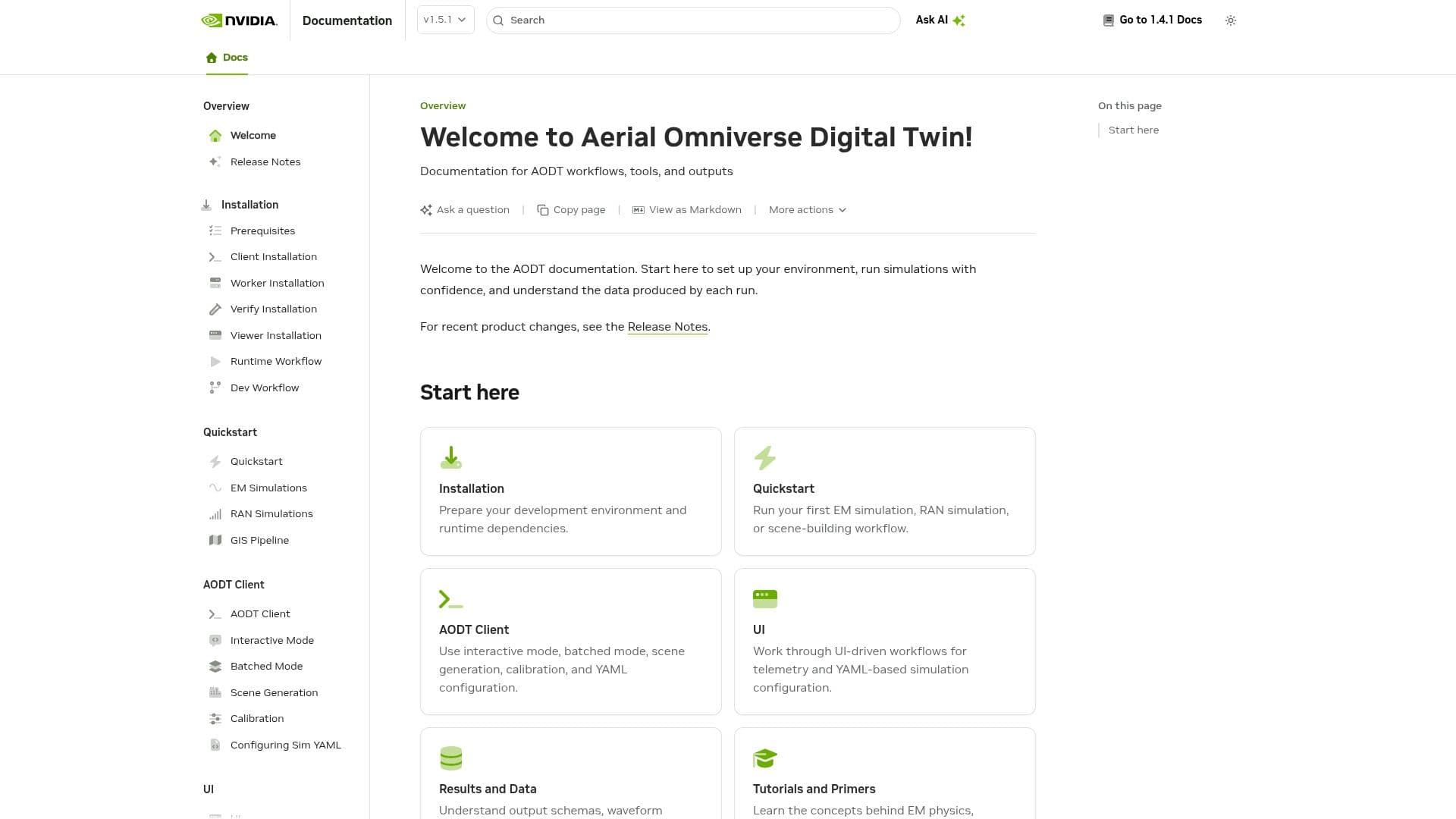
Aerial Omniverse Digital Twin (AODT) is a sophisticated platform designed to simulate and visualize complex environments. It provides users with the ability to run electromagnetic (EM) and radio access network (RAN) simulations, enabling detailed analysis and understanding of various scenarios. The platform supports both interactive and batched modes, allowing users to choose the best approach for their specific needs.
AODT consists of three main components: the Client, Worker, and Viewer. The Client is responsible for configuring simulations and controlling execution, while the Worker runs the simulations on GPU-enabled Linux systems. The Viewer visualizes scenarios and results, requiring only a modern web browser. AODT supports both colocated and non-colocated deployment models, providing flexibility in how the components are distributed across systems.
Installation of AODT involves setting up prerequisites such as GPU drivers and the NVIDIA Container Toolkit. Users can choose between runtime and development modes, with the former using prebuilt Docker images and binaries, and the latter allowing for source code modifications and custom Docker image creation. The platform supports various operational modes, including runtime and development workflows, catering to different user requirements.
AODT is compatible with several qualified systems, including AWS VMs and Dell R750 servers, ensuring robust performance across different hardware configurations. The platform also provides comprehensive documentation, guiding users through setup, simulation execution, and result interpretation. With its advanced capabilities, AODT is ideal for professionals in fields such as telecommunications, engineering, and data science, who require detailed simulations and visualizations for their projects.
Aerial Omniverse Digital Twin's Core Features
Supports EM and RAN simulations
Interactive and batched modes
Client configures simulations
Worker runs simulations on GPU-enabled systems
Viewer visualizes scenarios and results
Colocated and non-colocated deployment models
Runtime and development modes
Comprehensive documentation and support
How to use Aerial Omniverse Digital Twin?
Prepare: Set up development environment and dependencies
Simulate: Run EM or RAN simulations
Visualize: Use the Viewer to see results
Interpret: Analyze output schemas and waveform dumps
Aerial Omniverse Digital Twin's Use Cases
- Telecommunications
- Engineering
- Data Science
- Research
- Education